
Pulp Fiction, 1911 · page 138 of 196
Adventure, June 1911 — page 138: what you’re looking at
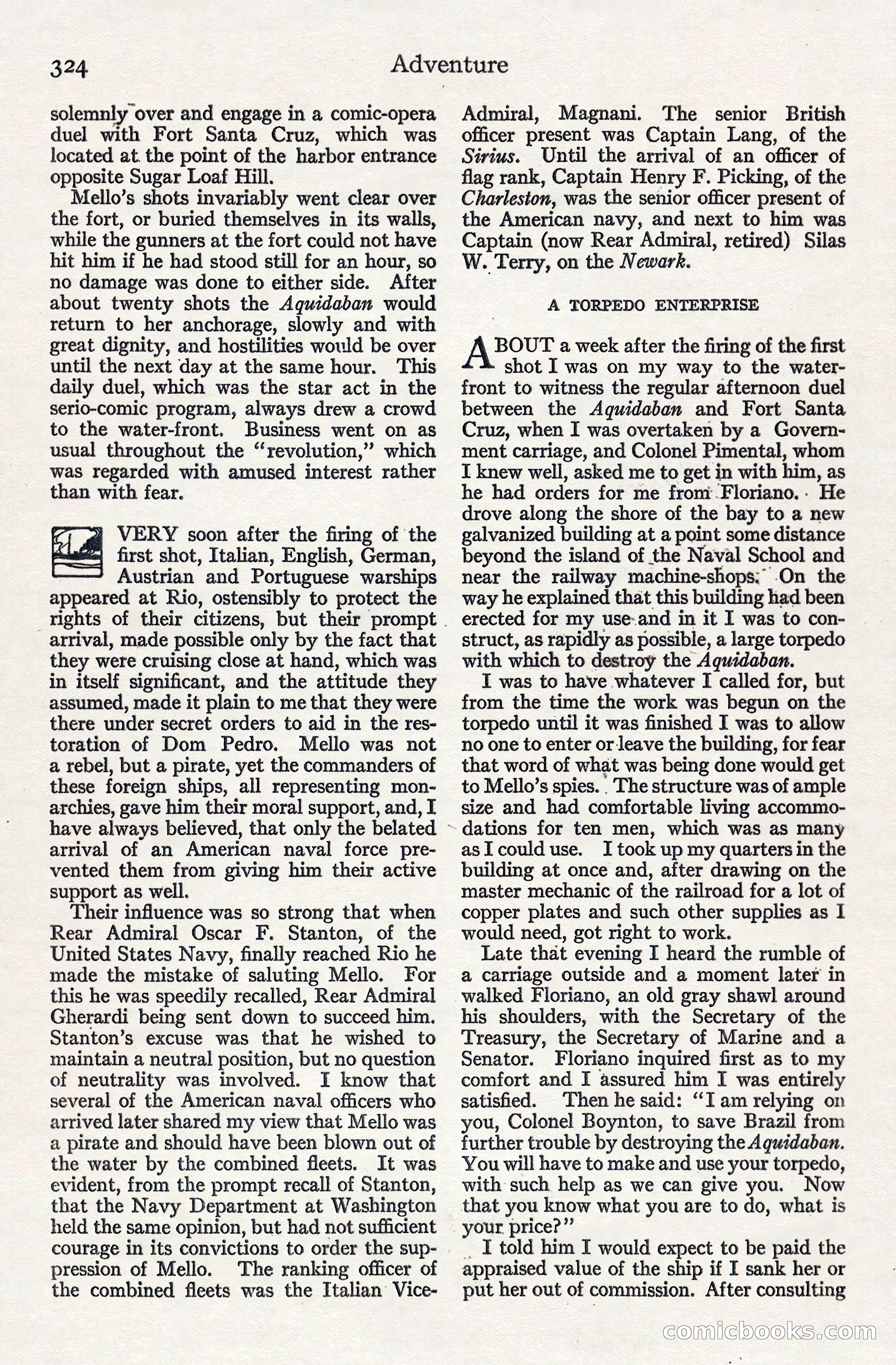
A restored page from Pulp Fiction, 1911. Page through the whole issue in the reader above.
📄 Transcribed text from this page (OCR, searchable)
Machine-transcribed from the original scan — historical spelling and the odd misread are preserved.
324 solemnly over and engage in a comic-opera duel with Fort Santa Cruz, which was located at. the point of the harbor entrance opposite Sugar Loaf Hill. Mello’s shots invariably went clear over the fort, or buried themselves in its walls, while the gunners at the fort could not have hit him if he had stood still for an hour, so no damage was done to either side. After about twenty shots the Aguidaban would return to her anchorage, slowly and with great dignity, and hostilities would be over until the next day at the same hour. This daily duel, which was the star act in the serio-comic program, always drew a crowd to the water-front. Business went on as usual throughout the ‘‘revolution,’’ which was regarded with amused interest rather than with fear. } VERY soon after the firing of the first shot, Italian, English, German, Austrian and Portuguese warships appeared at Rio, ostensibly to protect the rights of their citizens, but their prompt . arrival, made possible only by the fact that they were cruising close at hand, which was in itself significant, and the attitude they assumed, made it plain to me that they were there under secret orders to aid in the res- toration of Dom Pedro. Mello was not a rebel, but a pirate, yet the commanders of these foreign ships, all representing mon- archies, gave him their moral support, and, I have always believed, that only the belated ~ arrival of an American naval force pre- vented them from giving him their active support as well. Their influence was so strong that when Rear Admiral Oscar F. Stanton, of the United States Navy, finally reached Rio he made the mistake of saluting Mello. For this he was speedily recalled, Rear Admiral Gherardi being sent down to succeed him. Stanton’s excuse was that he wished to maintain a neutral position, but no question of neutrality was involved. I know that several of the American naval officers who arrived later shared my view that Mello was a pirate and should have been blown out of the water by the combined fleets. It was evident, from the prompt recall of Stanton, that the Navy Department at Washington held the same opinion, but had not sufficient courage in its convictions to order the sup- pression of Mello. The ranking officer of the combined fleets was the Italian Vice- Adventure Admiral, Magnani. The senior British officer present was Captain Lang, of the Sirius. Until the arrival of an officer of flag rank, Captain Henry F. Picking, of the Charleston, was the senior officer present of the American navy, and next to him was Captain (now Rear Admiral, retired) Silas W. Terry, on the Newark. A TORPEDO ENTERPRISE ABOUT a week after the firing of the first shot I was on my way to the water- front to witness the regular afternoon duel between the Aquidaban and Fort Santa Cruz, when I was overtaken by a Govern- ment carriage, and Colonel Pimental, whom I knew well, asked me to get in with him, as he had orders for me from .Floriano.- He drove along the shore of the bay to a new galvanized building at a point some distance beyond the island “of the Naval School and near the railway machine-shops: .On the way he explained that this building had been erected for my use-and in it I was to con- struct, as rapidly as possible, a large torpedo with which to destroy the Aguidaban. I was to have whatever I called for, but from the time the work was begun on the torpedo until it was finished I was to allow no one to enter or leave the building, for fear that word of what was being done would get to Mello’s spies. The structure was of ample size and had comfortable living accommo- dations for ten men, which was as many asI could use. I took up my quarters in the building at once and, after drawing on the master mechanic of the railroad for a lot of copper plates and such other supplies as I would need, got right to work. Late that evening I heard the rumble of a carriage outside and a moment later in walked Floriano, an old gray shawl around his shoulders, with the Secretary of the Treasury, the Secretary of Marine and a Senator. Floriano inquired first as to my comfort and I assured him I was entirely satisfied. Then he said: “Iam relying on you, Colonel Boynton, to save Brazil from further trouble by destroying the Aguidaban. You will have to make and use your torpedo, with such help as we can give you. Now that you know what you are to do, what is your price?”’ I told him I would expect to be paid the appraised value of the ship if I sank her or put her out of commission. After consulting COMNMIG S (C@ JOO