
Pulp Fiction, 1911 · page 14 of 196
Adventure, June 1911 — page 14: what you’re looking at
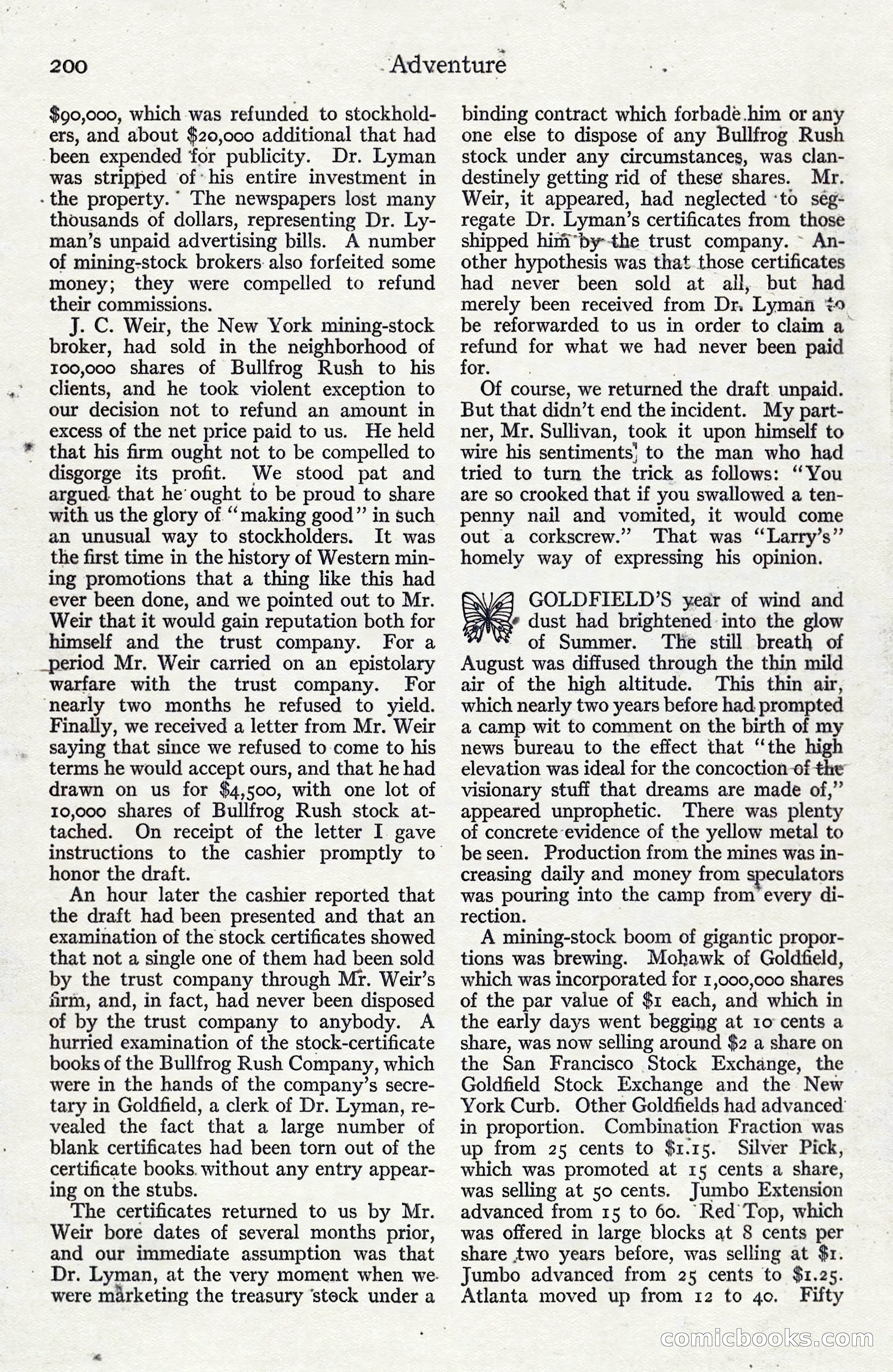
A restored page from Pulp Fiction, 1911. Page through the whole issue in the reader above.
📄 Transcribed text from this page (OCR, searchable)
Machine-transcribed from the original scan — historical spelling and the odd misread are preserved.
200 $90,000, which was refunded to stockhold- ers, and about $20,000 additional that had been expended ‘for publicity. Dr. Lyman was stripped of*his entire investment in - the property. ° The newspapers lost many thousands of dollars, representing Dr. Ly- man’s unpaid advertising bills. A number of mining-stock brokers: also forfeited some money; they were compelled to refund their commissions. J. C. Weir, the New York mining-stock broker, had sold in the neighborhood of 100,000 shares of Bullfrog Rush to his clients, and he took violent exception to our decision not to refund an amount in excess of the net price paid to us. He held ' that his firm ought not to be compelled to disgorge its profit. We stood pat and argued. that he ought to be proud to share with us the glory of “‘making good”’ in such an unusual way to stockholders. It was the first time in the history of Western min- ing promotions that a thing like this had ever been done, and we pointed out to Mr. Weir that it would gain reputation both for himself and the trust company. For a _period Mr. Weir carried on an epistolary warfare with the trust company. For nearly two months he refused to yield. Finally, we received a letter from Mr. Weir saying that since we refused to come to his terms he would accept ours, and that he had drawn on us for $4,500, with one lot of 10,000 shares of Bullfrog Rush stock at- tached. On receipt of the letter I gave instructions to the cashier promptly to honor the draft. An hour later the cashier reported that the draft had been presented and that an examination of the stock certificates showed that not a single one of them had been sold by the trust company through Mr. Weir’s firm, and, in fact, had never been disposed of by the trust company to anybody. A hurried examination of the stock-certificate books of the Bullfrog Rush Company, which were in the hands of the company’s secre- tary in Goldfield, a clerk of Dr. Lyman, re- vealed the fact that a large number of blank certificates had been torn out of the certificate books. without any entry appear- ing on the stubs. The certificates returned to us by Mr. Weir bore dates of several months prior, and our immediate assumption was that ' Dr. Lyman, at the very moment when we. were marketing the treasury ‘steck under a Adventure binding contract which forbade.him or any one else to dispose of any Bullfrog Rush stock under any circumstances, was clan- destinely getting rid of these shares. Mr. Weir, it appeared, had neglected ‘to seg- regate Dr. Lyman’s certificates from those shipped him*by-the trust company. ~ An- other hypothesis was that those certificates had never been sold at all, but had merely been received from Dr. Lyman % be reforwarded to us in order to claim a refund for what we had never been paid for: ~ = | Of course, we returned the draft unpaid. But that didn’t end the incident. My part- ner, Mr. Sullivan, took it upon himself to wire his sentiments, to the man who had tried to turn the trick as follows: ‘You are so crooked that if you swallowed a ten- penny nail and vomited, it would come out a corkscrew.” That was “Larry’s” homely way of expressing his opinion. ae dust had brightened into the glow of Summer. The still breath of August was diffused through the thin mild air of the high altitude. This thin air, which nearly two years before had prompted a camp wit to comment on the birth of my news bureau to the effect that “‘the high elevation was ideal for the concoction-of the visionary stuff that dreams are made of,” appeared unprophetic. There was plenty of concrete evidence of the yellow metal to be seen. Production from the mines was in- creasing daily and money from speculators was pouring into the camp from’every di- rection. A mining-stock boom of gigantic propor- tions was brewing. Mohawk of Goldfield, which was incorporated for 1,000,000 shares of the par value of $x each, and which in the early days went begging at 10 cents a share, was now selling around $2 a share on the San Francisco Stock Exchange, the Goldfield Stock Exchange and the New York Curb. Other Goldfields had advanced’ in proportion. Combination Fraction was up from 25 cents to $1.15. Silver Pick, which was promoted at 15 cents a share, was selling at 50 cents. Jumbo Extension advanced from 15 to 60. Red Top, which was offered in large blocks at 8 cents per share two years before, was selling at $1. Jumbo advanced from 25 cents to $1.25. Atlanta moved up from 12 to go. Fifty GOLDFIELD’S year of wind and E@ JOO ANG SnCO)