
Pulp Fiction, 1911 · page 145 of 196
Adventure, June 1911 — page 145: what you’re looking at
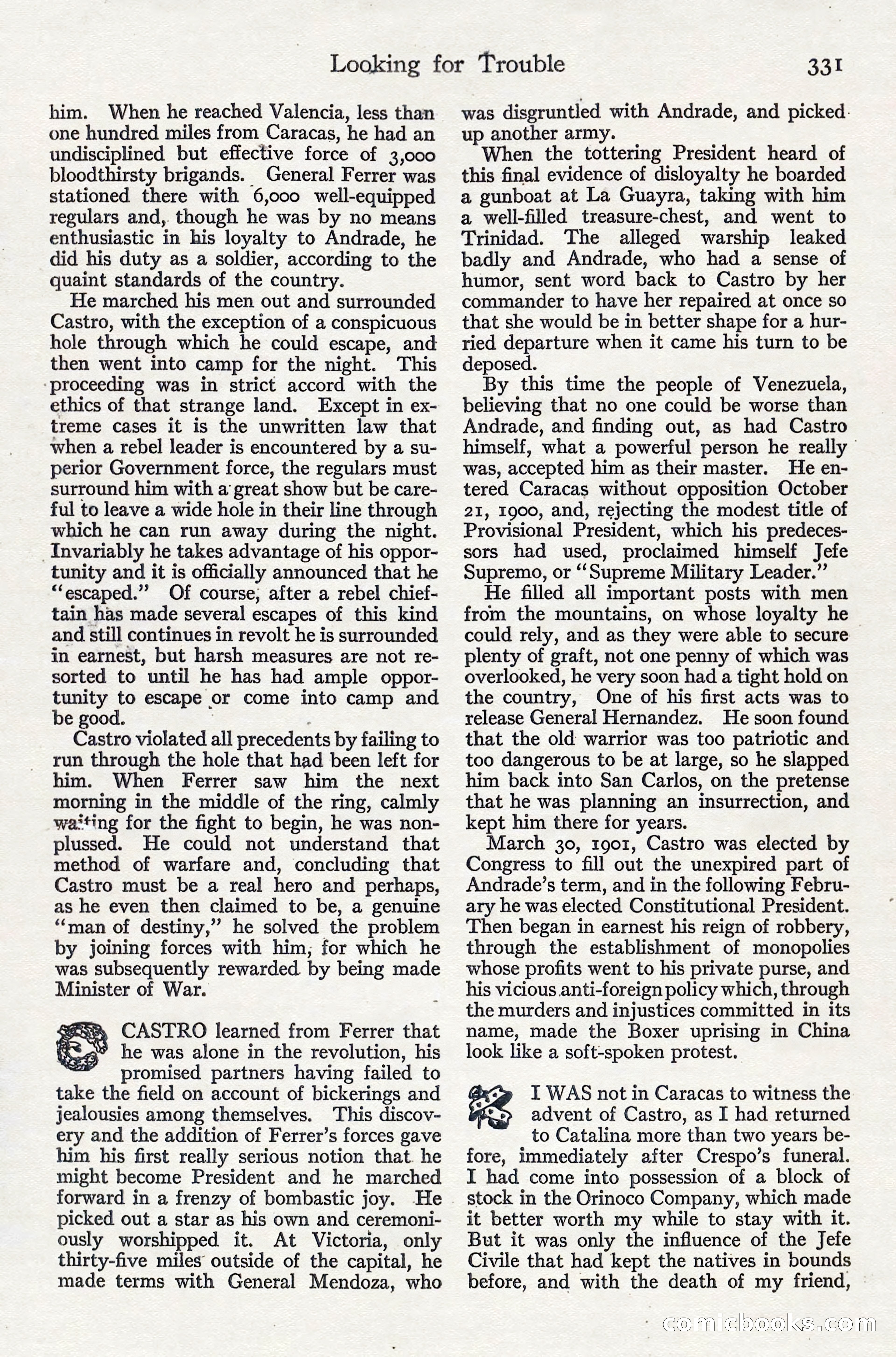
A restored page from Pulp Fiction, 1911. Page through the whole issue in the reader above.
📄 Transcribed text from this page (OCR, searchable)
Machine-transcribed from the original scan — historical spelling and the odd misread are preserved.
Looking for Trouble him. When he reached Valencia, less than one hundred miles from Caracas, he had an undisciplined but effective force of 3,000 bloodthirsty brigands. General Ferrer was stationed there with 6,000 well-equipped regulars and, though he was by no means enthusiastic in his loyalty to Andrade, he did his duty as a soldier, according to the quaint standards of the country. He marched his men out and surrounded Castro, with the exception of a conspicuous hole through which he could escape, and then went into camp for the night. This ‘proceeding was in strict accord with the ethics of that strange land. Except in ex- treme cases it is the unwritten law that when a rebel leader is encountered by a su- perior Government force, the regulars must surround him with a great show but be care- ful to leave a wide hole in their line through which he can run away during the night. Invariably he takes advantage of his oppor- tunity and it is officially announced that he “‘escaped.”’ Of course; after a rebel chief- tain has made several escapes of this kind and still continues in revolt he is surrounded in earnest, but harsh measures are not re- sorted to until he has had ample oppor- tunity to escape or come into camp and be good. : Castro violated all precedents by failing to run through the hole that had been left for him. When Ferrer saw him the next morning in the middle of the ring, calmly wating for the fight to begin, he was non- plussed. He could not understand that method of warfare and, concluding that Castro must be a real hero and perhaps, as he even then claimed to be, a genuine “‘man of destiny,’”’ he solved the problem by joining forces with him; for which he was subsequently rewarded. by being made Minister of War. wee, CASTRO learned from Ferrer that i.” he was alone in the revolution, his promised partners having failed to take the field on account of bickerings and jealousies among themselves. This discov- ery and the addition of Ferrer’s forces gave him his first really serious notion that. he might become President and he marched forward in a frenzy of bombastic joy. He | picked out a star as his own and ceremoni- ously worshipped it. At Victoria, only thirty-five miles outside of the capital, he made terms with General Mendoza, who 331 was disgruntled with Andrade, and picked. up another army. When the tottering President heard of this final evidence of disloyalty he boarded a gunboat at La Guayra, taking with him a well-filled treasure-chest, and went to Trinidad. The alleged warship leaked badly and Andrade, who had a sense of humor, sent word back to Castro by her commander to have her repaired at once so that she would be in better shape for a hur- ried departure when it came his turn to be deposed. By this time the people of Venezuela, believing that no one could be worse than Andrade, and finding out, as had Castro himself, what a powerful person he really was, accepted him as their master. He en- tered Caracas without opposition October 21, 1900, and, rejecting the modest title of Provisional President, which his predeces- sors had used, proclaimed himself Jefe Supremo, or “‘Supreme Military Leader.” He filled all important posts with men from the mountains, on whose loyalty he could rely, and as they were able to secure plenty of graft, not one penny of which was overlooked, he very soon had a tight hold on the country, One of his first acts was to release General Hernandez. He soon found that the old warrior was too patriotic and too dangerous to be at large, so he slapped him back into San Carlos, on the pretense that he was planning an insurrection, and kept him there for years. March 30, 1901, Castro was elected by Congress to fill out the unexpired part of Andrade’s term, and in the following Febru- ary he was elected Constitutional President. Then began in earnest his reign of robbery, through the establishment of monopolies whose profits went to his private purse, and his vicious anti-foreign policy which, through the murders and injustices committed in its name, made the Boxer uprising in China look like a soft-spoken protest. fe) I WAS not in Caracas to witness the es advent of Castro, as I had returned to Catalina more than two years be- fore, immediately after Crespo’s funeral. I had come into possession of a block of stock in the Orinoco Company, which made it better worth my while to stay with it. But it was only the influence of the Jefe Civile that had kept the natives in bounds before, and with the death of my friend, GO 9)(0)(6) ANG SoG