
Pulp Fiction, 1911 · page 147 of 196
Adventure, June 1911 — page 147: what you’re looking at
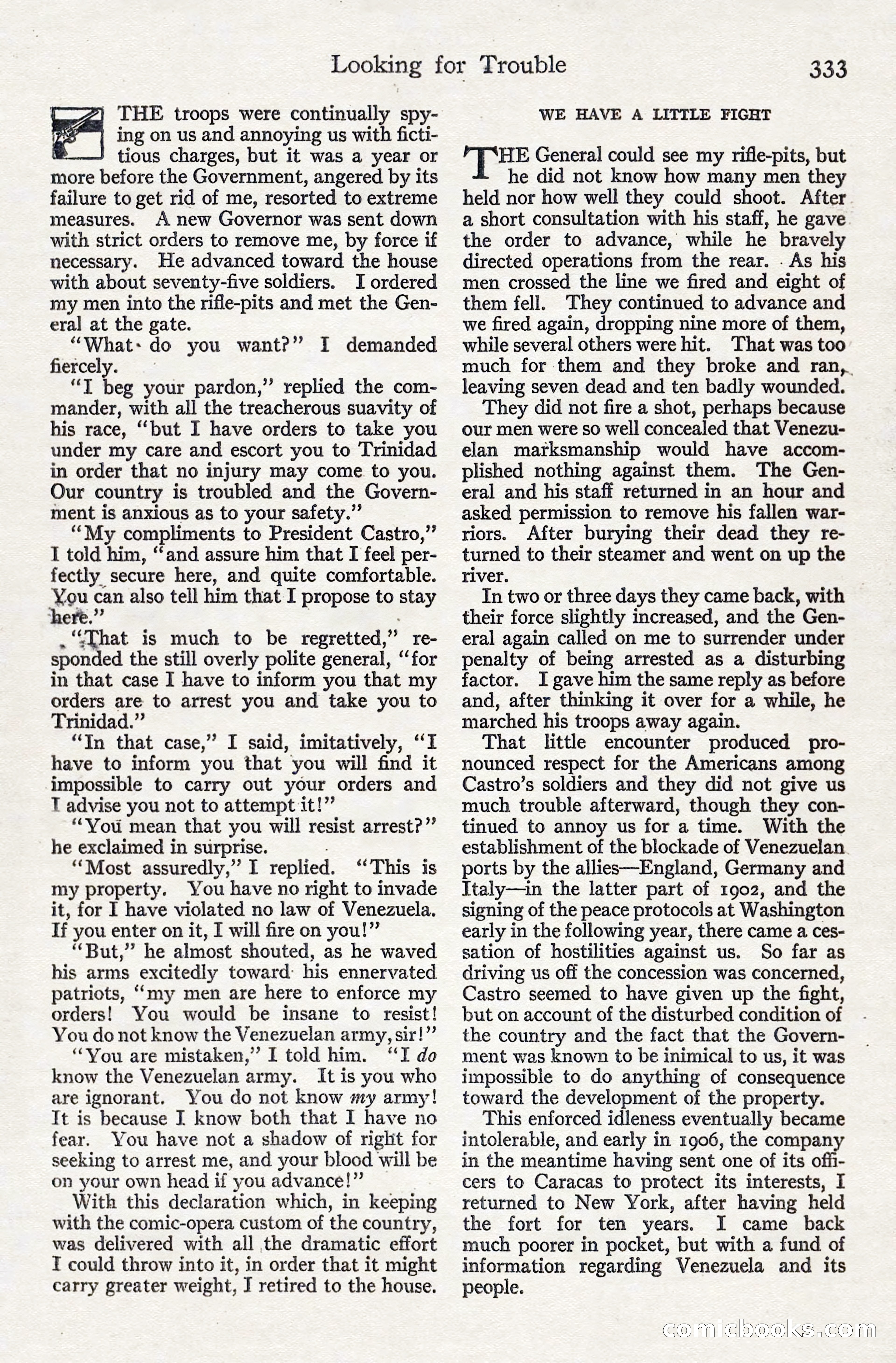
A restored page from Pulp Fiction, 1911. Page through the whole issue in the reader above.
📄 Transcribed text from this page (OCR, searchable)
Machine-transcribed from the original scan — historical spelling and the odd misread are preserved.
Looking for Trouble Cay THE troops were continually spy- a ing on us and annoying us with ficti- tious charges, but it was a year or more before the Government, angered by its failure to get rid of me, resorted to extreme measures. A new Governor was sent down with strict orders to remove me, by force if necessary. He advanced toward the house with about seventy-five soldiers. I ordered my men into the rifle-pits and met the Gen- eral at the gate. “What: do you want?” I demanded fiercely. “T beg your pardon,” replied the com- mander, with all the treacherous suavity of his race, “‘but I have orders to take you under my care and escort you to Trinidad in order that no injury may come to you. Our country is troubled and the Govern- ment is anxious as to your safety.” ‘“My compliments to President Castro,” I told him, ‘‘and assure him that I feel per- fectly secure here, and quite comfortable. You can also tell him that I propose to aby That is much to be regretted,” re- sponded the still overly polite general, “for in that case I have to inform you that my orders are to arrest you and take you to Trinidad.” “In that case,” I said, imitatively, ‘I have to inform you that you will find it impossible to carry out your orders and T advise you not to attempt it!” “You mean that you will resist arrest?’’ he exclaimed in surprise. “Most assuredly,” I replied. “This is my property. You have no right to invade it, for I have violated no law of Venezuela. If you enter on it, I will fire on you!” “But,” he almost shouted, as he waved his arms excitedly toward: his ennervated patriots, ‘my men are here to enforce my orders! You would be insane to resist! You do not know the Venezuelan army, sir!”’ “Vou are mistaken,’ I told him. “I do know the Venezuelan army. It is you who are ignorant. You do not know my army! It is because I know both that I have no fear. You have not a shadow of right for seeking to arrest me, and your blood will be on your own head if you advance!” With this declaration which, in keeping with the comic-opera custom of the country, was delivered with all the dramatic effort I could throw into it, in order that it might carry greater weight, J retired to the house. 333 WE HAVE A LITTLE FIGHT "THE General could see my rifle-pits, but he did not know how many men they held nor how well they could shoot. After a short consultation with his staff, he gave the order to advance, while he bravely directed operations from the rear. - As his men crossed the line we fired and eight of them fell. They continued to advance and we fired again, dropping nine more of them, while several others were hit. That was too much for them and they broke and ran, leaving seven dead and ten badly wounded. They did not fire a shot, perhaps because our men were so well concealed that Venezu- elan marksmanship would have accom- plished nothing against them. The Gen- eral and his staff returned in an hour and asked permission to remove his fallen war- riors. After burying their dead they re- turned to their steamer and went on up the river. In two or three days they came back, with their force slightly increased, and the Gen- eral again called on me to surrender under penalty of being arrested as a disturbing factor. I gave him the same reply as before and, after thinking it over for a while, he marched his troops away again. That little encounter produced pro- nounced respect for the Americans among Castro’s soldiers and they did not give us much trouble afterward, though they con- tinued to annoy us for a time. With the establishment of the blockade of Venezuelan ports by the allies—England, Germany and Italy—in the latter part of 1902, and the signing of the peace protocols at Washington early in the following year, there came a ces- sation of hostilities against us. So far as driving us off the concession was concerned, Castro seemed to have given up the fight, but on account of the disturbed condition of the country and the fact that the Govern- ment was known to be inimical to us, it was impossible to do anything of consequence toward the development of the property. This enforced idleness eventually became intolerable, and early in 1906, the company in the meantime having sent one of its offi- cers to Caracas to protect its interests, I returned to New York, after having held the fort for ten years. I came back much poorer in pocket, but with a fund of information regarding Venezuela and its people. Comicdoo SoCO) S|