
Pulp Fiction, 1911 · page 161 of 196
Adventure, June 1911 — page 161: what you’re looking at
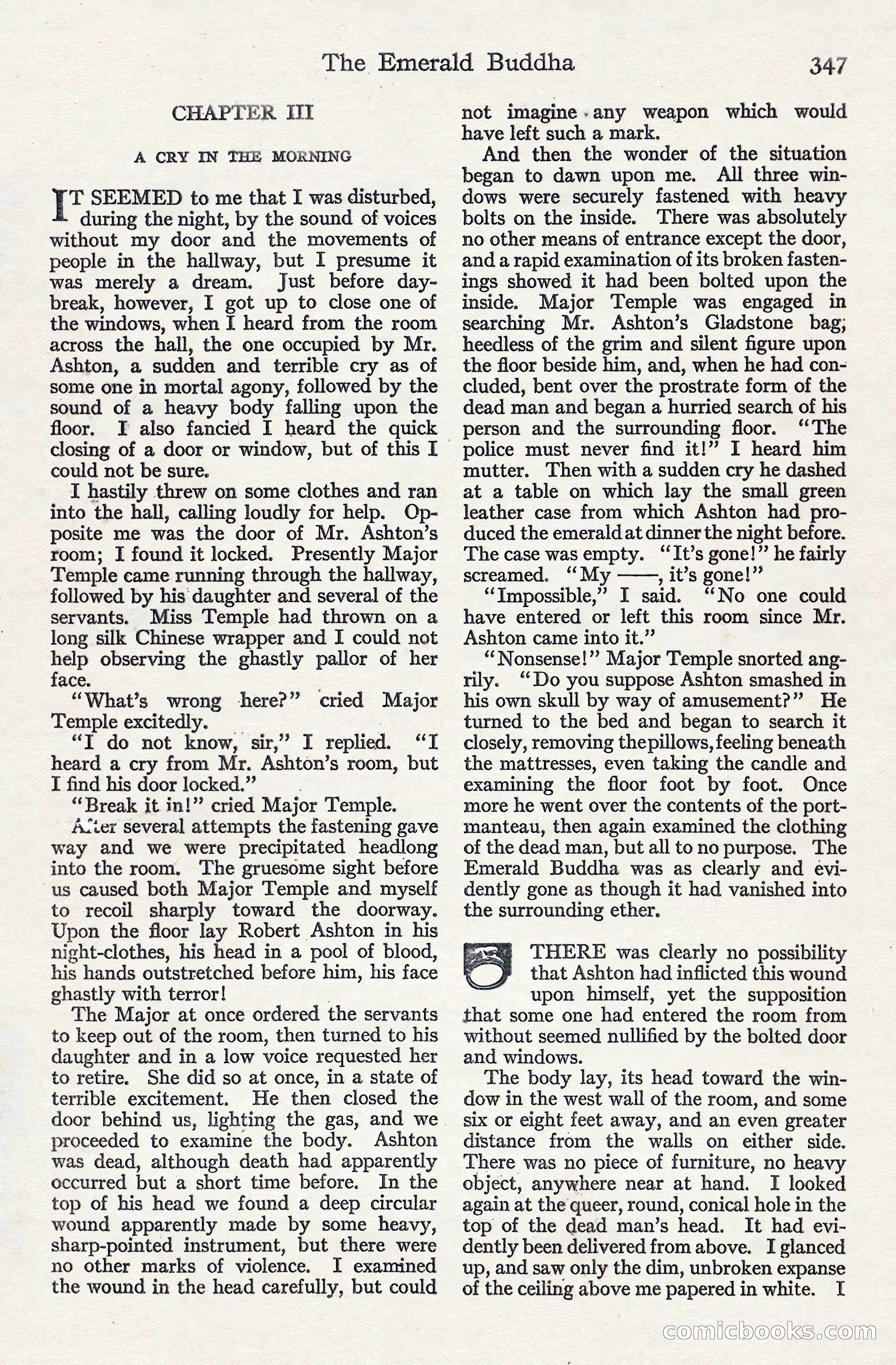
A restored page from Pulp Fiction, 1911. Page through the whole issue in the reader above.
📄 Transcribed text from this page (OCR, searchable)
Machine-transcribed from the original scan — historical spelling and the odd misread are preserved.
The Emerald Buddha CHAPTER III A CRY IN THE MORNING T SEEMED to me that I was disturbed, during the night, by the sound of voices without my door and the movements of people in the hallway, but I presume it was merely a dream. Just before day- break, however, I got up to close one of the windows, when I heard from the room across the hall, the one occupied by Mr. Ashton, a sudden and terrible cry as of some one in mortal agony, followed by the sound of a heavy body falling upon the floor. I also fancied I heard the quick closing of a door or window, but of this I could not be sure. I hastily threw on some clothes and ran into the hall, calling loudly for help. QOp- posite me was the door of Mr. Ashton’s room; I found it locked. Presently Major Temple came running through the hallway, followed by his daughter and several of the servants. Miss Temple had thrown on a long silk Chinese wrapper and I could not help observing the ghastly pallor of her face. “What’s wrong here?” cried Major Temple excitedly. “T do not know, sir,” I replied. od 3 heard a cry from Mr. Ashton’s room, but I find his door locked.” “Break it in!” cried Major Temple. Ac‘ver several attempts the fastening gave way and we were precipitated headlong into the room. The gruesome sight before us caused both Major Temple and myself to recoil sharply toward the doorway. Upon the floor lay Robert Ashton in his night-clothes, his head in a pool of blood, his hands outstretched before him, his face ghastly with terror! The Major at once ordered the servants to keep out of the room, then turned to his daughter and in a low voice requested her to retire. She did so at once, in a state of terrible excitement. He then closed the door behind us, lighting the gas, and we proceeded to examine the body. Ashton was dead, although death had apparently occurred but a short time before. In the top of his head we found a deep circular wound apparently made by some heavy, sharp-pointed instrument, but there were no other marks of violence. I examined the wound in the head carefully, but could 347 not imagine .any weapon which would have left such a mark. And then the wonder of the situation began to dawn upon me. All three win- dows were securely fastened with heavy bolts on the inside. There was absolutely no other means of entrance except the door, and a rapid examination of its broken fasten- ings showed it had been bolted upon the inside. Major Temple was engaged in searching Mr. Ashton’s Gladstone bag; heedless of the grim and silent figure upon the floor beside him, and, when he had con- cluded, bent over the prostrate form of the dead man and began a hurried search of his person and the surrounding floor. ‘“‘The police must never find it!” I heard him mutter. Then with a sudden cry he dashed at a table on which lay the small green leather case from which Ashton had pro- duced the emerald at dinner the night before. The case was empty. “It’s gone!” he fairly screamed. ‘“‘ My ——, it’s gone!” “Impossible,” I said. “No one could have entered or left this room since Mr. Ashton came into it.” ““Nonsense!”” Major Temple snorted ang- rily. ‘‘Do you suppose Ashton smashed in his own skull by way of amusement?” He turned to the bed and began to search it closely, removing thepillows, feeling beneath the mattresses, even taking the candle and examining the floor foot by foot. Once more he went over the contents of the port- manteau, then again examined the clothing of the dead man, but all tono purpose. The Emerald Buddha was as clearly and evi- dently gone as though it had vanished into the surrounding ether. THERE was clearly no possibility that Ashton had inflicted this wound upon himself, yet the supposition that some one had entered the room from without seemed nullified by the bolted door and windows. The body lay, its head toward the win- dow in the west wall of the room, and some six or eight feet away, and an even greater distance from the walls on either side. There was no piece of furniture, no heavy object, anywhere near at hand. I looked again at the queer, round, conical hole in the top of the dead man’s head. It had evi- dently been delivered from above. I glanced up, and saw only the dim, unbroken expanse of the ceiling above me papered in white. I Go NOOKS ANUC (C©