
Pulp Fiction, 1911 · page 167 of 196
Adventure, June 1911 — page 167: what you’re looking at
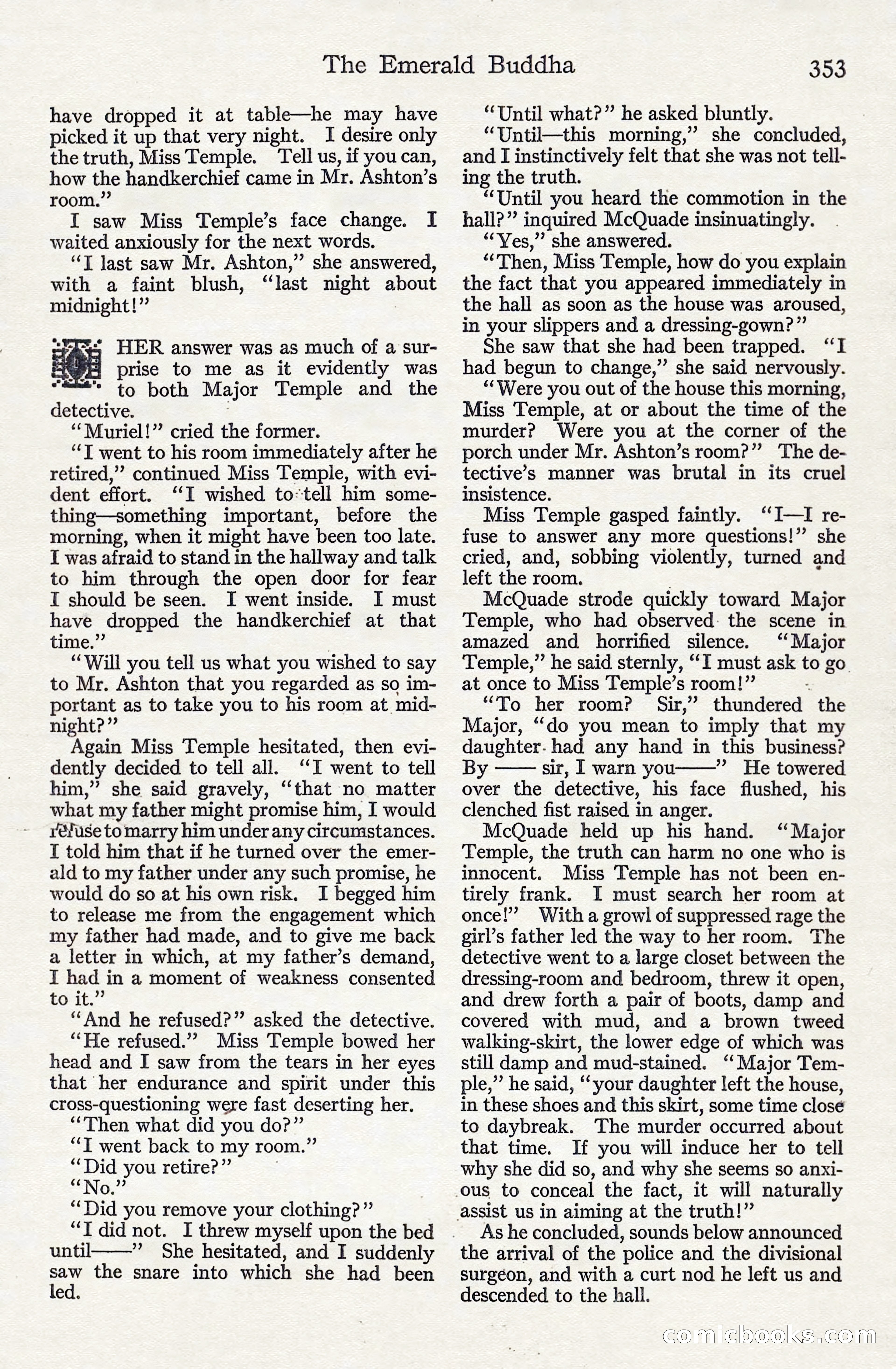
A restored page from Pulp Fiction, 1911. Page through the whole issue in the reader above.
📄 Transcribed text from this page (OCR, searchable)
Machine-transcribed from the original scan — historical spelling and the odd misread are preserved.
The Emerald Buddha have dropped it at table—he may have picked it up that very night. I desire only the truth, Miss Temple. Tell us, if you can, how the handkerchief came in Mr. Ashton’s room.” I saw Miss Temple’s face change. I waited anxiously for the next words. “T last saw Mr. Ashton,” she answered, with a faint blush, “last night about midnight!” *%> HER answer was as much of a sur- prise to me as it evidently was * to both Major Temple and the detective. “Muriel!” cried the former. “T went to his room immediately after he retired,” continued Miss Temple, with evi- dent effort. ‘I wished to-tell him some- thing—something important, before the morning, when it might have been too late. I was afraid to stand in the hallway and talk to him through the open door for fear I should be seen. I went inside. I must have dropped the handkerchief at that time.” “Will you tell us what you wished to say to Mr. Ashton that you regarded as so im- portant as to take you to his room at mid- night?” Again Miss Temple hesitated, then evi- dently decided to tell all. “I went to tell him,” she said gravely, “that no matter what my father might promise him, I would refuse to marry him under any circumstances. T told him that if he turned over the emer- ald to my father under any such promise, he would do so at his own risk. I begged him to release me from the engagement which my father had made, and to give me back a letter in which, at my father’s demand, I had in a moment of weakness consented to'1f,”" ‘“‘And he refused?” asked the detective. “He refused.”’ Miss Temple bowed her head and I saw from the tears in her eyes that her endurance and spirit under this cross-questioning were fast deserting her. “Then what did you do?” “T went back to my room.” “Did you retire?” : €¢ No.”’ “Did you remove your clothing?” “I did not. I threw myself upon the bed until ”” She hesitated, and I suddenly i the snare into which she had been ed. 353 “Until what?” he asked bluntly. “Until—this morning,” she concluded, and I instinctively felt that she was not tell- ing the truth. “Until you heard the commotion in the hall?” inquired McQuade insinuatingly. “Yes,” she answered. “Then, Miss Temple, how do you explain the fact that you appeared immediately in the hall as soon as the house was aroused, in your slippers and a dressing-gown?”’ She saw that she had been trapped. ‘‘I had begun to change,” she said nervously. ““Were you out of the house this morning, Miss Temple, at or about the time of the murder? Were you at the corner of the porch under Mr. Ashton’s room?” The de- tective’s manner was brutal in its cruel insistence. Miss Temple gasped faintly. “‘I—TI re- fuse to answer any more questions!” she cried, and, sobbing violently, turned and left the room. : McQuade strode quickly toward Major Temple, who had observed: the scene in amazed and horrified silence. ‘“ Major Temple,” he said sternly, “I must ask to go at once to Miss Temple’s room!” | “To her room? Sir,’ thundered the Major, “do you mean to imply that my daughter. had any hand in this business? By sir, I warn you———”’ He towered over the detective, his face flushed, his clenched fist raised in anger. McQuade held up his hand. “Major Temple, the truth can harm no one who is innocent. Miss Temple has not been en- tirely frank. I must search her room at once!’ With a growl of suppressed rage the girl’s father led the way to her room. The detective went to a large closet between the dressing-room and bedroom, threw it open, and drew forth a pair of boots, damp and covered with mud, and a brown tweed walking-skirt, the lower edge of which was still damp and mud-stained. ‘Major Tem- ple,” he said, ‘‘ your daughter left the house, in these shoes and this skirt, some time closé to daybreak. The murder occurred about that time. If you will induce her to tell why she did so, and why she seems so anxi- ous to conceal the fact, it will naturally assist us in aiming at the truth!” As he concluded, sounds below announced the arrival of the police and the divisional surgeon, and with a curt nod he left us and descended to the hall. COnmmiclbooks (C@