
Pulp Fiction, 1911 · page 178 of 196
Adventure, June 1911 — page 178: what you’re looking at
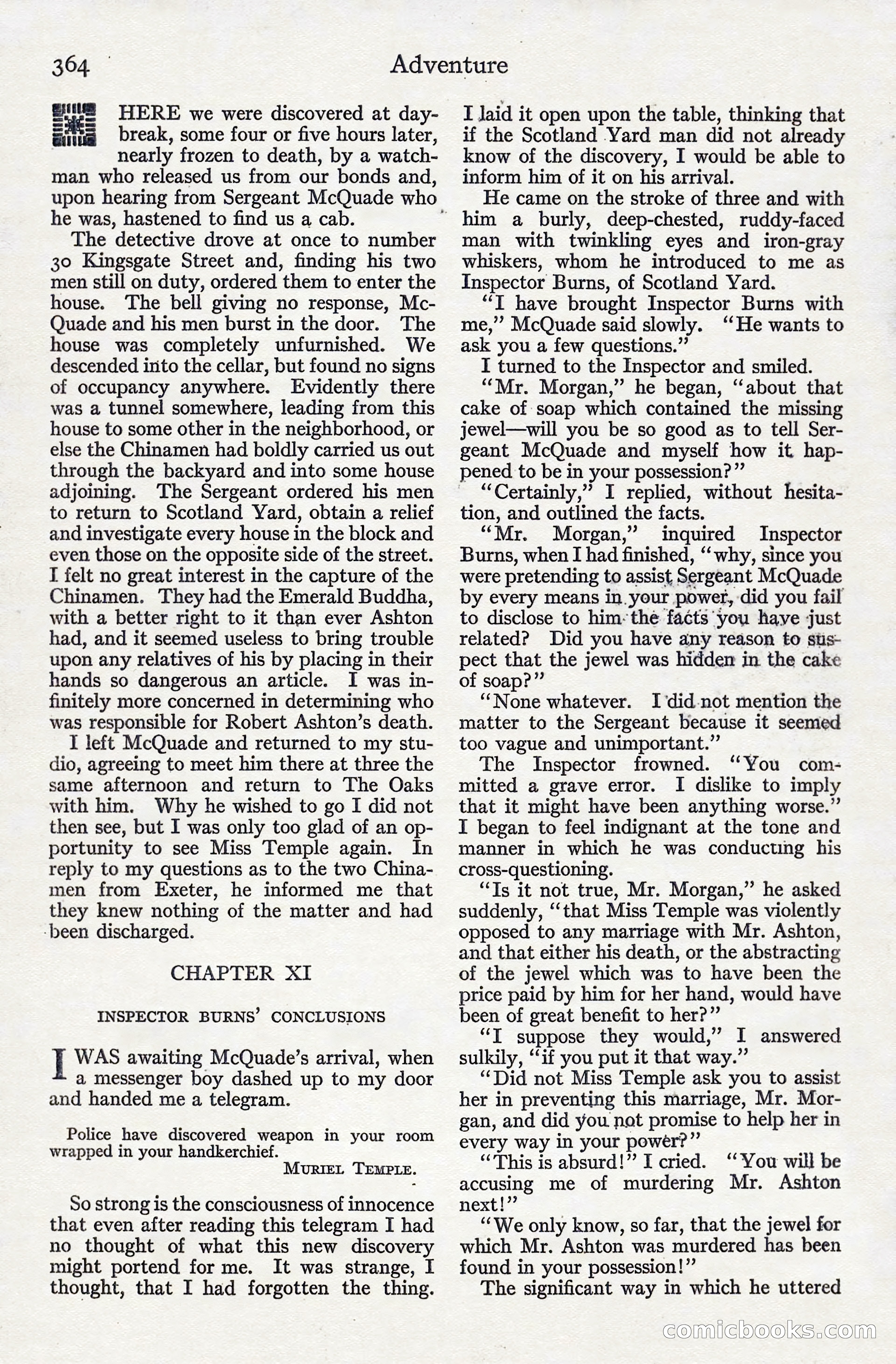
A restored page from Pulp Fiction, 1911. Page through the whole issue in the reader above.
📄 Transcribed text from this page (OCR, searchable)
Machine-transcribed from the original scan — historical spelling and the odd misread are preserved.
364 Secs HERE we were discovered at day- sium break, some four or five hours later, nearly frozen to death, by a watch- man who released us from our bonds and, upon hearing from Sergeant McQuade who he was, hastened to find us a cab. The detective drove at once to number 30 Kingsgate Street and, finding his two men still on duty, ordered them to enter the house. The bell giving no response, Mc- Quade and his men burst in the door. The house was completely unfurnished. We descended isito the cellar, but found no signs of occupancy anywhere. Evidently there was a tunnel somewhere, leading from this house to some other in the neighborhood, or else the Chinamen had boldly carried us out through the backyard and into some house adjoining. ‘The Sergeant ordered his men to return to Scotland Yard, obtain a relief and investigate every house in the block and even those on the opposite side of the street. [ felt no great interest in the capture of the Chinamen. They had the Emerald Buddha, with a better right to it than ever Ashton had, and it seemed useless to bring trouble upon any relatives of his by placing in their hands so dangerous an article. I was in- finitely more concerned in determining who was responsible for Robert Ashton’s death. I left McQuade and returned to my stu- dio, agreeing to meet him there at three the same afternoon and return to The Oaks with him. Why he wished to go I did not then see, but I was only too glad of an op- portunity to see Miss Temple again. In reply to my questions as to the two China- men from Exeter, he informed me that they knew nothing of the matter and had ‘been discharged. CHAPTER XI INSPECTOR BURNS’ CONCLUSIONS I WAS awaiting McQuade’s arrival, when a messenger boy dashed up to my door and handed me a telegram. Police have discovered weapon in your room wrapped in your handkerchief. MURIEL TEMPLE. So strong is the consciousness of innocence that even after reading this telegram I had no thought of what this new discovery might portend for me. It was strange, I thought, that I had forgotten the thing. Adventure I laid it open upon the table, thinking that if the Scotland Yard man did not already know of the discovery, I would be able to inform him of it on his arrival. He came on the stroke of three and with ' him a burly, deep-chested, ruddy-faced man with twinkling eyes and iron-gray whiskers, whom he introduced to me as Inspector Burns, of Scotland Yard. “TI have brought Inspector Burns with me,” McQuade said slowly. ‘‘He wants to ask you a few questions.” I turned to the Inspector and smiled. ““Mr. Morgan,” he began, “about that cake of soap which contained the missing jewel—will you be so good as to tell Ser- geant McQuade and myself how it hap- pened to be in your possession?”’ “‘Certainly,” I replied, without hesita- tion, and outlined the facts. “Mr. Morgan,” inquired Inspector Burns, when I had finished, ‘‘ why, since you were pretending to assist Sergeant McQuade by every means in your power, did you fail to disclose to him- the facts you have just related? Did you have any reason to stis- pect that the jewel was hidden in the cake of soap?” ‘““None whatever. I did-not mention the matter to the Sergeant because it seemed too vague and unimportant.” _ The Inspector frowned. ‘You com- mitted a grave error. I dislike to imply that it might have been anything worse.” I began to feel indignant at the tone and manner in which he was conducting his cross-questioning. “Ts it not true, Mr. Morgan,” he asked suddenly, “‘that Miss Temple was violently opposed to any marriage with Mr. Ashton, and that either his death, or the abstracting of the jewel which was to have been the price paid by him for her hand, would have been of great benefit to her?” “T suppose they would,” I answered sulkily, “if you put it that way.” “Did not Miss Temple ask you to assist her in preventing this marriage, Mr. Mor- gan, and did you not promise to help her in every way in your power?” “This is absurd!” I cried. ‘‘ You will be accusing me of murdering Mr. Ashton next!” ‘We only know, so far, that the jewel for which Mr. Ashton was murdered has been found in your possession!”’ The significant way in which he uttered COnmmiclbooks (C@