
Pulp Fiction, 1911 · page 183 of 196
Adventure, June 1911 — page 183: what you’re looking at
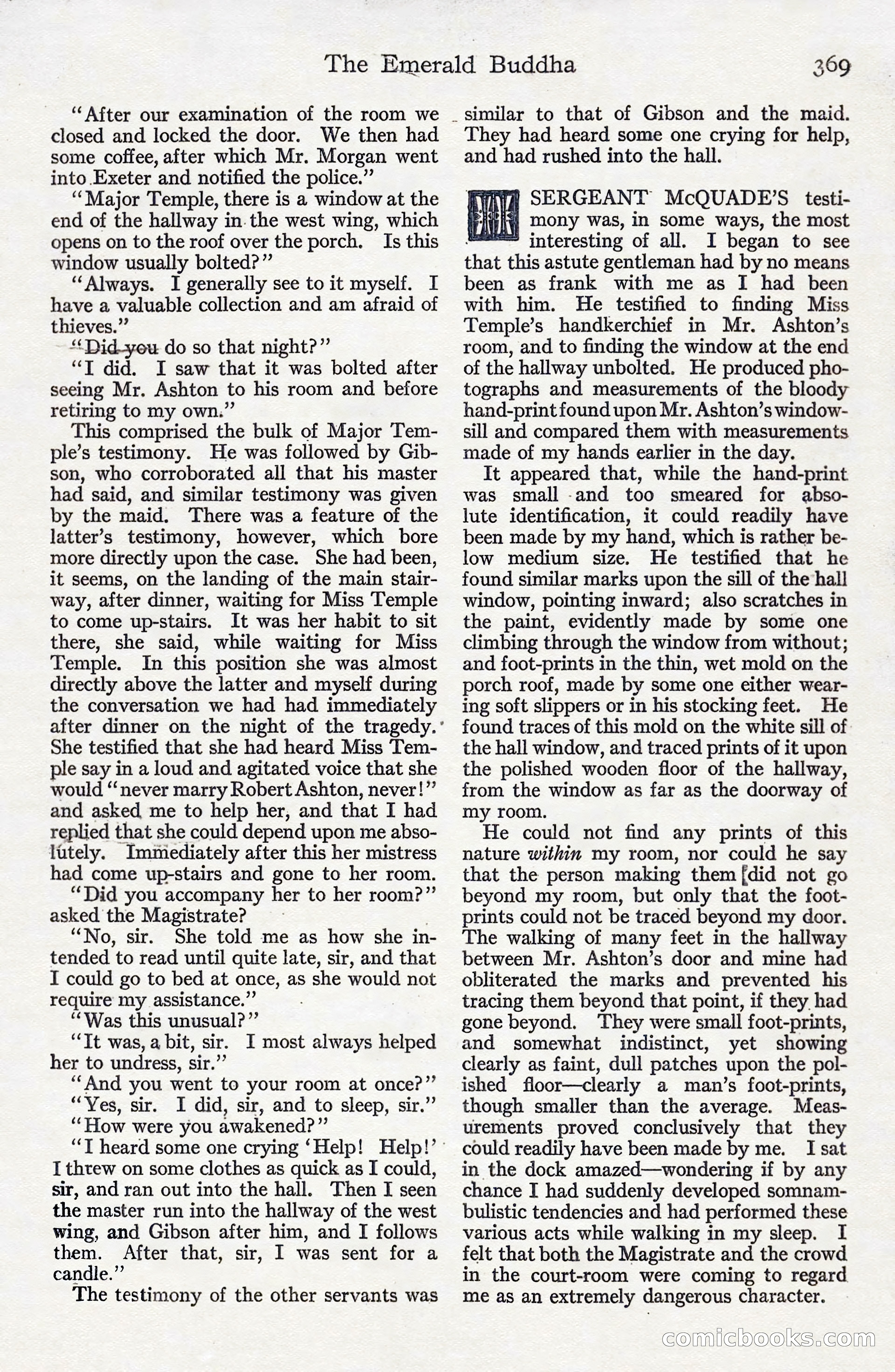
A restored page from Pulp Fiction, 1911. Page through the whole issue in the reader above.
📄 Transcribed text from this page (OCR, searchable)
Machine-transcribed from the original scan — historical spelling and the odd misread are preserved.
The Emerald Buddha 369 ‘After our examination of the room we closed and locked the door. We then had some coffee, after which Mr. Morgan went into Exeter and notified the police.” ‘Major Temple, there is a window at the end of the hallway in. the west wing, which opens on to the roof over the porch, Is this window usually bolted?’”’ ‘Always. I generally see to it myself. I have a valuable collection and am afraid of thieves.” “Did-you do so that night?” “T did. I saw that it was bolted after seeing Mr. Ashton to his room and before retiring to my own.”’ This comprised the bulk of Major Tem- ple’s testimony. He was followed by Gib- son, who corroborated all that his master had said, and similar testimony was given by the maid. There was a feature of the latter’s testimony, however, which bore more directly upon the case. She had been, it seems, on the landing of the main stair- way, after dinner, waiting for Miss Temple to come up-stairs. It was her habit to sit there, she said, while waiting for Miss Temple. In this position she was almost directly above the latter and myself during the conversation we had had immediately after dinner on the night of the tragedy.’ She testified that she had heard Miss Tem- ple say in a loud and agitated voice that she would ‘‘never marry Robert Ashton, never!’ and asked me to help her, and that I had replied that she could depend upon me abso- lutely. Immediately after this her mistress had come up-stairs and gone to her room. “Did you accompany her to her room?” asked the Magistrate? “No, sir. She told me as how she in- tended to read until quite late, sir, and that I could go to bed at once, as she would not require my assistance.”’ ‘Was this unusual?” ‘It was, a bit, sir. I most always helped her to undress, sir.’ “And you went to your room at once?” “Ves, sir. I did, sir, and to sleep, sir.’ “How were you awakened?” “T heard some one crying ‘Help! Help!’ - I threw on some clothes as quick as I could, sir, and ran out into the hall. Then I seen the master run into the hallway of the west wing, and Gibson after him, and I follows them. After that, sir, I was sent for a candle.” The testimony of the other servants was _similar to that of Gibson and the maid. They had heard some one crying for help, and had rushed into the hall. | SERGEANT McQUADE’S testi- a mony was, in some ways, the most interesting of all. I began to see that this astute gentleman had by no means been as frank with me as I had been with him. He testified to finding Miss Temple’s handkerchief in Mr. Ashton’s room, and to finding the window at the end of the hallway unbolted. He produced pho- tographs and measurements of the bloody hand-print found upon Mr. Ashton’s window- sill and compared them with measurements made of my hands earlier in the day. It appeared that, while the hand-print was small -and too smeared for abso- lute identification, it could readily have been made by my hand, which is rather be- low medium size. He testified that he found similar marks upon the sill of the hall window, pointing inward; also scratches in the paint, evidently made by some one climbing through the window from without; and foot-prints in the thin, wet mold on the porch roof, made by some one either wear- ing soft slippers or in his stocking feet. He found traces of this mold on the white sill of the hall window, and traced prints of it upon the polished wooden floor of the hallway, from the window as far as the doorway of my room. He could not find any prints of this nature within my room, nor could he say that the person making them fdid not go beyond my room, but only that the foot- prints could not be traced beyond my door. The walking of many feet in the hallway between Mr. Ashton’s door and mine had obliterated the marks and prevented his tracing them beyond that point, if they had gone beyond. ‘They were small foot-prints, and somewhat indistinct, yet showing clearly as faint, dull patches upon the pol- ished floor—clearly a man’s foot-prints, though smaller than the average. Meas- urements proved conclusively that they could readily have been made by me. Isat in the dock amazed—wondering if by any chance I had suddenly developed somnam- bulistic tendencies and had performed these various acts while walking in my sleep. I felt that both the Magistrate and the crowd in the court-room were coming to regard me as an extremely dangerous character. Ni { IY Go VnOOKS CO ANUC