
Pulp Fiction, 1911 · page 193 of 196
Adventure, June 1911 — page 193: what you’re looking at
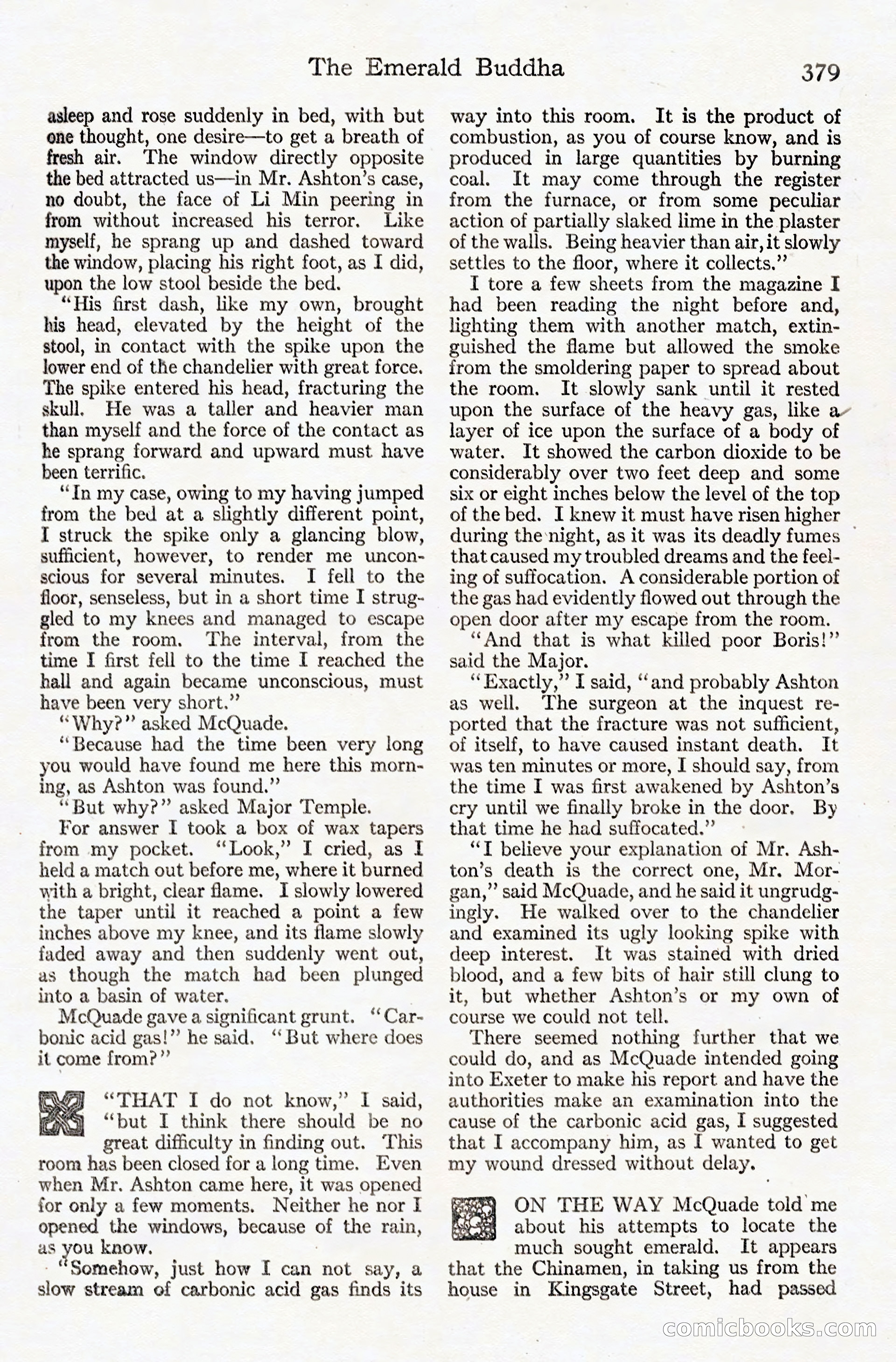
A restored page from Pulp Fiction, 1911. Page through the whole issue in the reader above.
📄 Transcribed text from this page (OCR, searchable)
Machine-transcribed from the original scan — historical spelling and the odd misread are preserved.
The Emerald Buddha asleep and rose suddenly in bed, with but one thought, one desire—to get a breath of fresh air. The window directly opposite the bed attracted us—in Mr. Ashton’s case, no doubt, the face of Li Min peering in from without increased his terror, Like myself, he sprang up and dashed toward the window, placing his right foot, as I did, upon the low stool beside the bed. “His first dash, ike my own, brought his head, elevated by the height of the stool, in contact with the spike upon the lower end of the chandelier with great force. The spike entered his head, fracturing the skull. He was a taller and heavier man than myself and the force of the contact as he sprang forward and upward must have been terrific. “In my case, owing to my having jumped from the bed at a slightly different point, I struck the spike only a glancing blow, sufficient, however, to render me uncon- scious for several minutes. I fell to the floor, senseless, but in a short time I strug- gled to my knees and managed to escape from the room. The interval, from the time I first fell to the time I reached the hall and again became unconscious, must have been very short.” “Why?” asked McQuade. ‘Because had the time been very long you would have found me here this morn- ing, as Ashton was found.” “But why?” asked Major Temple. For answer I took a box of wax tapers from my pocket. “Look,” I cried, as I held a match out before me, where it burned with a bright, clear flame. I slowly lowered the taper until it reached a point a few inches above my knee, and its flame slowly faded away and then suddenly went out, as though the match had been plunged into a basin of water. McQuade gave a significant grunt. ‘‘ Car- bonic acid gas!” he said. ‘But where does it come from?”’ “THAT I do not know,” I said, “but I think there should be no great difficulty in finding out. This room has been closed for a long time. Even when Mr. Ashton came here, it was opened for only a few moments. Neither he nor I opened the windows, because of the rain, as you know. ) - “Somehow, just how I can not say, a slow stream of carbonic acid gas finds its 379 way into this room. It is the product of combustion, as you of course know, and is produced in large quantities by burning coal. It may come through the register from the furnace, or from some peculiar action of partially slaked lime in the plaster of the walls. Being heavier than air, it slowly settles to the floor, where it collects.” I tore a few sheets from the magazine I had been reading the night before and, lighting them with another match, extin- guished the flame but allowed the smoke from the smoldering paper to spread about the room. It slowly sank until it rested upon the surface of the heavy gas, like a- layer of ice upon the surface of a body of water. It showed the carbon dioxide to be considerably over two feet deep and some six or eight inches below the level of the top of the bed. I knew it must have risen higher during thenight, as it was its deadly fumes | that caused my troubled dreams and the feel- ing of suffocation. A considerable portion of the gas had evidently flowed out through the open door after my escape from the room. “And that is what killed poor Boris!” said the Major. “Exactly,” I said, ‘‘and probably Ashton as well. The surgeon at the inquest re- ported that the fracture was not sufficient, of itself, to have caused instant death. It was ten minutes or more, I should say, from the time I was first awakened by Ashton’s cry until we finally broke in the door. By that time he had suffocated.” “T believe your explanation of Mr. Ash- ton’s death is the correct one, Mr. Mor- gan,” said McQuade, and he said it ungrudg- ingly. He walked over to the chandelier and examined its ugly looking spike with deep interest. It was stained with dried blood, and a few bits of hair still clung to it, but whether Ashton’s or my own of course we could not tell. There seemed nothing further that we could do, and as McQuade intended going into Exeter to make his report and have the authorities make an examination into the cause of the carbonic acid gas, I suggested that I accompany him, as [ wanted to get my wound dressed without delay. ON THE WAY McQuade told’ me about his attempts to locate the much sought emerald. It appears that the Chinamen, in taking us from the house in Kingsgate Street, had passed GCOMmIGDOOKSEEO