
Pulp Fiction, 1911 · page 20 of 196
Adventure, June 1911 — page 20: what you’re looking at
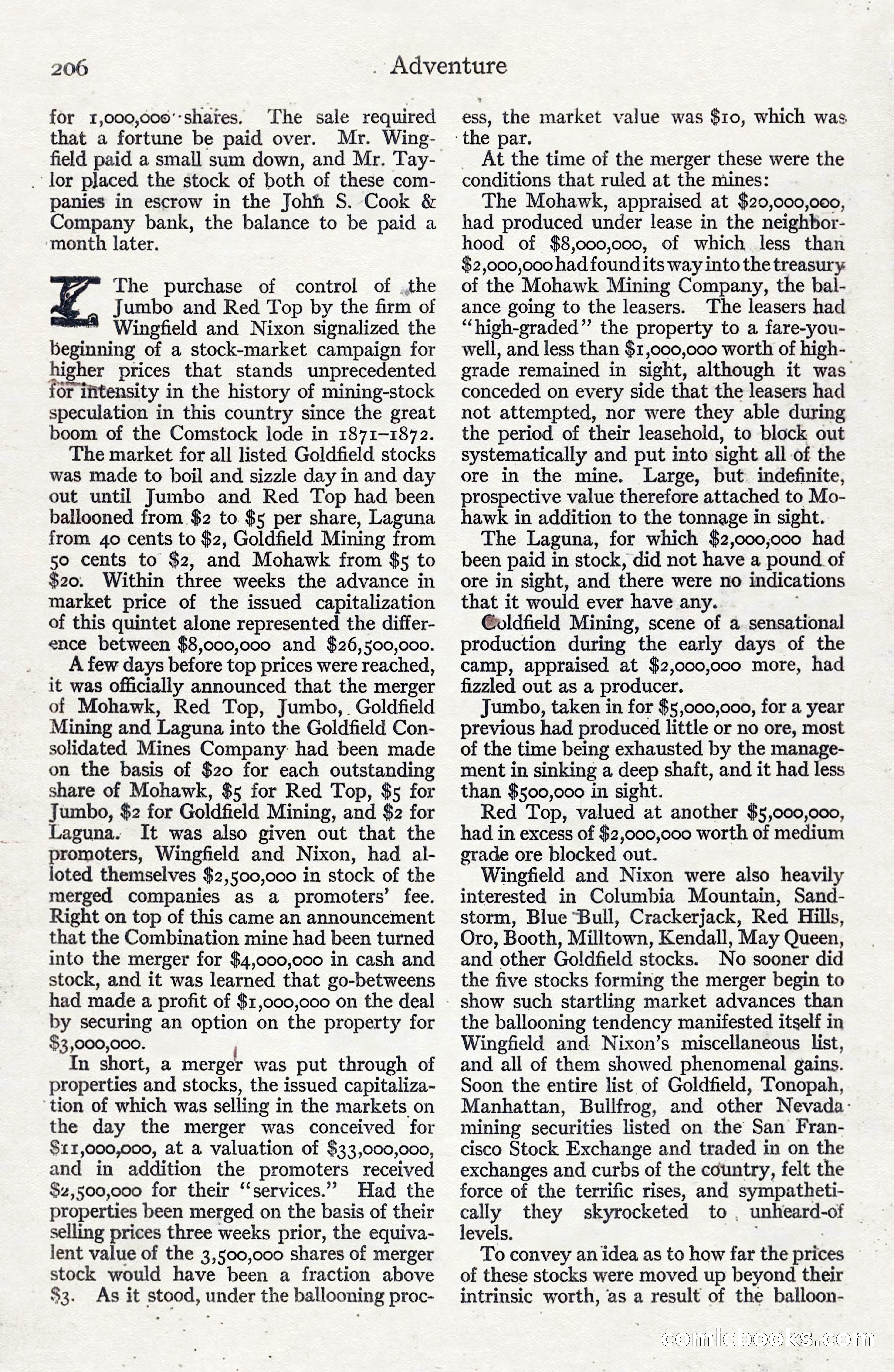
A restored page from Pulp Fiction, 1911. Page through the whole issue in the reader above.
📄 Transcribed text from this page (OCR, searchable)
Machine-transcribed from the original scan — historical spelling and the odd misread are preserved.
206 for 1,000,000’‘shares. The sale required that a fortune be paid over. Mr. Wing- field paid a small sum down, and Mr. Tay- . lor placed the stock of both of these com- panies in escrow in the Johh S. Cook & Company bank, the balance to be paid a ‘month later. The purchase of control of .the Jumbo and Red Top by the firm of " Wingfield and Nixon signalized the beginning of a stock-market campaign for higher prices that stands unprecedented for r intensity in the history of mining-stock speculation in this country since the great boom of the Comstock lode in 1871-1872. The market for all listed Goldfield stocks was made to boil and sizzle day in and day out until Jumbo and Red Top had been ballooned from $2 to $5 per share, Laguna from 40 cents to $2, Goldfield Mining from so cents to $2, and Mohawk from $5 to $20. Within three weeks the advance in market price of the issued capitalization of this quintet alone represented the differ- ence between $8,000,000 and $26,500,000. A few days before top prices were ‘reached, it was officially announced that the merger of Mohawk, Red Top, Jumbo, Goldfield Mining and Laguna into the Goldfield Con- solidated Mines Company: had been made on the basis of $20 for each outstanding share of Mohawk, $5 for Red Top, $5 for Jumbo, $2 for Goldfield Mining, and $2 for Laguna. It was also given out that the promoters, Wingfield and N ixon, had al- loted themselves ‘$2, 500,000 in stock of the merged companies as a promoters’ fee. Right on top of this came an announcement that the Combination mine had been turned into the merger for $4,000,000 in cash and stock, and it was learned that go-betweens had made a profit of $1,000,000 on the deal by securing an option on the property for $3,000,000. In short, a merger was put through of properties and stocks, the issued capitaliza- ‘tion of which was selling in the markets on the day the merger was conceived for $11,000,000, at a valuation of $33,000,000, and in addition the promoters received $2,500,000 for their ‘‘services.”” Had the properties been merged on the basis of their selling prices three weeks prior, the equiva- lent value of the 3,500,000 shares of merger stock would have been a fraction above $3. As it stood, under the ballooning proc- . Adventure ess, the market value was $10, which was ‘the par. _ At the time of the merger these were the conditions that ruled at the mines: The Mohawk, appraised at $20,000,000, had produced under lease in the neighbor- hood of $8,000,000, of which less than $2,000,000 had found its way into the treasury of the Mohawk Mining Company, the bal- ance going to the leasers. The leasers had “high-graded”’ the property to a fare-you- well, and less than $1,000,000 worth of high- grade remained in sight, although it was conceded on every side that the leasers had not attempted, nor were they able during the period of their leasehold, to block out systematically and put into sight all of the ore in the mine. Large, but indefinite, prospective value therefore attached to Mo- hawk in addition to the tonnage in sight. The Laguna, for which $2,000,000 had been paid in stock, did not have a pound of ore in sight, and there were no indications that it would ever have any. @oldfield Mining, scene of a sensational production during the early days of the camp, appraised at $2,000,000 more, had fizzled out as a producer. Jumbo, taken in for $5,000,000, for a year previous had produced little or no ore, most of the time being exhausted by the manage- ment in sinking a deep shaft, and it had less than $500,000 in sight. Red Top, valued at another $5,000,000, had in excess of $2,000,000 worth of medium grade ore blocked out. Wingfield and Nixon were also heavily interested in Columbia Mountain, Sand- storm, Blue “Bull, Crackerjack, Red Hills, Oro, Booth, Milltown, Kendall, May Queen, and other Goldfield stocks. No sooner did the five stocks forming the merger begin to - show such startling market advances than the ballooning tendency manifested itself in Wingfield and Nixon’s miscellaneous list, and all of them showed phenomenal gains. Soon the entire list of Goldfield, Tonopah, Manhattan, Bullfrog, and other Nevada: mining securities listed on the San Fran- cisco Stock Exchange and traded in on the exchanges and curbs of the country, felt the force of the terrific rises, and sympatheti- cally they skyrocketed to. unheard-of 3 levels. To convey an idea as to how far the prices of these stocks were moved up beyond their intrinsic worth, as a result of the balloon- (© AMG S DOO|KS CO