
Pulp Fiction, 1911 · page 8 of 196
Adventure, June 1911 — page 8: what you’re looking at
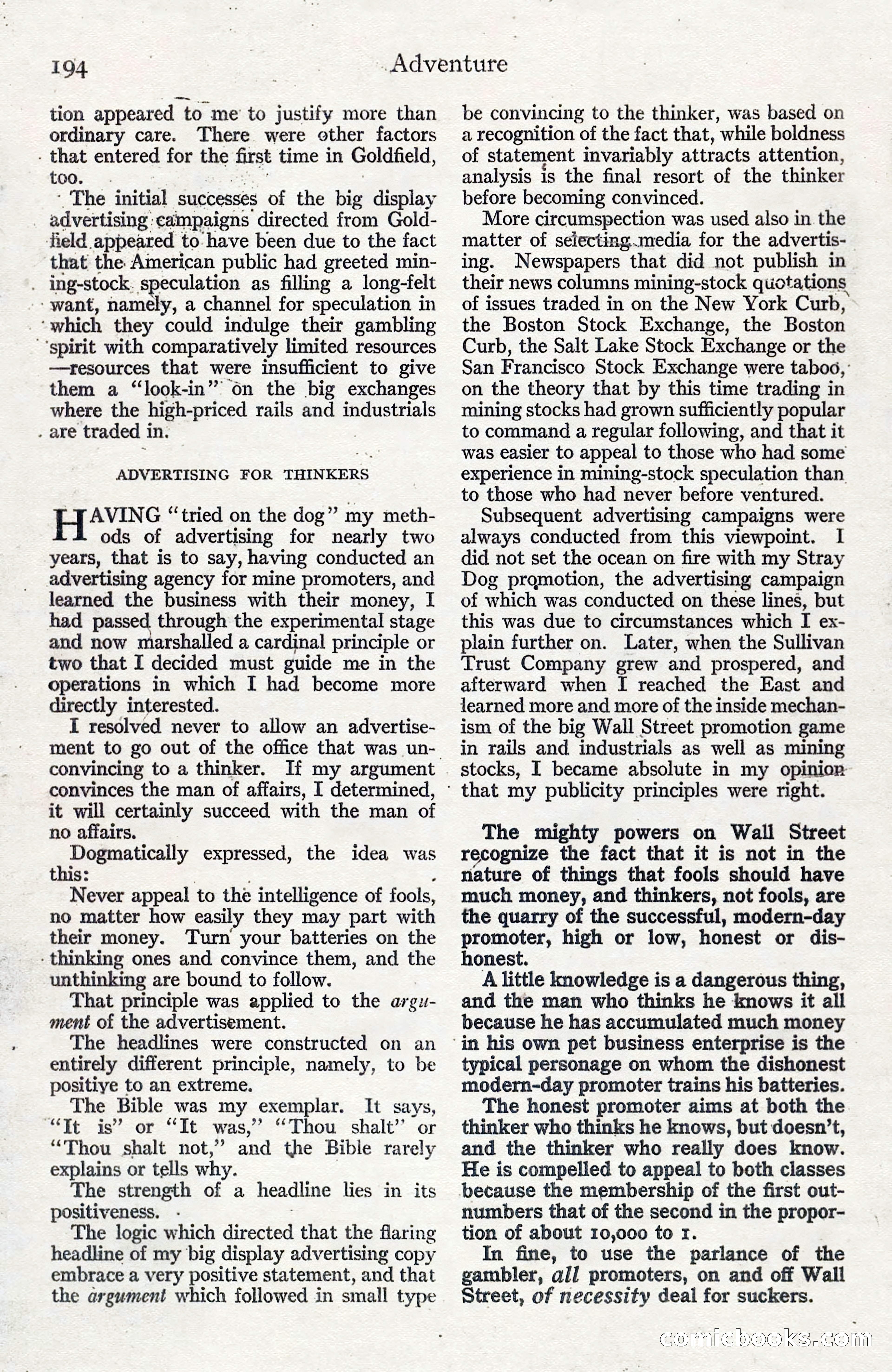
A restored page from Pulp Fiction, 1911. Page through the whole issue in the reader above.
📄 Transcribed text from this page (OCR, searchable)
Machine-transcribed from the original scan — historical spelling and the odd misread are preserved.
194 tion appeared to me to justify more than ordinary care. There were other factors - that entered for the first time in Goldfield, too. . ‘ The initial successes of the bie display advertising’ campaigns ‘directed from Gold- jield appeared to-have been due to the fact that the American public had greeted min- . ing-stock. speculation as filling a long-felt ‘want, namely, a channel for speculation in - which they could indulge their gambling ‘spirit with comparatively limited resources —resources that were insufficient to give them a “look-in” on the big exchanges where the high-priced rails and industrials . are traded in. : ADVERTISING FOR THINKERS AVING “tried on the dog” my meth- ods of advertising for nearly two years, that is to say, having conducted an advertising agency for mine promoters, and learned the business with their money, I had passed. through the experimental stage and now marshalled a cardinal principle or two that I decided must guide me in the operations in which I had become more directly interested. I resolved never to allow an advertise- ment to go out of the office that was un- convincing to a thinker. If my argument convinces the man of affairs, I determined, it will certainly succeed with the man of no affairs. Dogmatically expressed, the idea was this: Never appeal to the intelligence of fools, no matter how easily they may part with their money. Turn your batteries on the - thinking ones and convince them, and the unthinking are bound to follow. That principle was applied to the argu- ment of the advertisement. The headlines were constructed on an entirely different principle, namely, to be positiye to an extreme. The Bible was my exemplar. It says, “Tt is’ or “It was,’ “Thou shalt’’ or “Thou shalt not,” and the Bible rarely explains or tells why. The strength of a headline lies in its positiveness. - The logic which ered that the flaring headline of my big display advertising copy embrace a very positive statement, and that the argument which followed in small type _Adventure be convincing to the thinker, was based on a recognition of the fact that, while boldness of statement invariably attracts attention, analysis is the final resort of the thinker before becoming convinced. More circumspection was used also in the matter of selecting.media for the advertis- ing. Newspapers that did not publish in their news columns mining-stock quotations of issues traded in on the New York Curb, the Boston Stock Exchange, the Boston Curb, the Salt Lake Stock Exchange or the San Francisco Stock Exchange were tabod,: on the theory that by this time trading in mining stocks had grown sufficiently popular to command a regular following, and that it was easier to appeal to those who had some experience in mining-stock speculation than to those who had never before ventured. Subsequent advertising campaigns were always conducted from this viewpoint. I did not set the ocean on fire with my Stray Dog prqmotion, the advertising campaign of which was conducted on these lines, but this was due to circumstances which I ex- plain further on. Later, when the Sullivan Trust Company grew and prospered, and afterward when I reached the East and learned more and more of the inside mechan- ism of the big Wall Street promotion game in rails and industrials as well as mining stocks, I became absolute in my opinion ‘ that my publicity principles were right. The mighty powers on Wali Street recognize the fact that it is not in the nature of things that fools should have much money, and thinkers, not fools, are the quarry of the successful, modern-day promoter, high or low, honest or dis- honest. A little knowledge is a dangerous thing, and the man who thinks he knows it all because he has accumulated much money ‘in his own pet business enterprise is the typical personage on whom the dishonest modern-day promoter trains his batteries. The honest promoter aims at both the thinker who thinks he knows, but doesn’t, and the thinker who really does know. He is compelled to appeal to both classes because the membership of the first out- numbers that of the second in the propor- tion of about 10,000 to I. In fine, to use the parlance of the gambler, all promoters, on and off Wall Street, of necessity deal for suckers. COnIICLOO SoC