
Pulp Fiction, 1911 · page 100 of 196
Adventure Magazine Cover — page 100: what you’re looking at
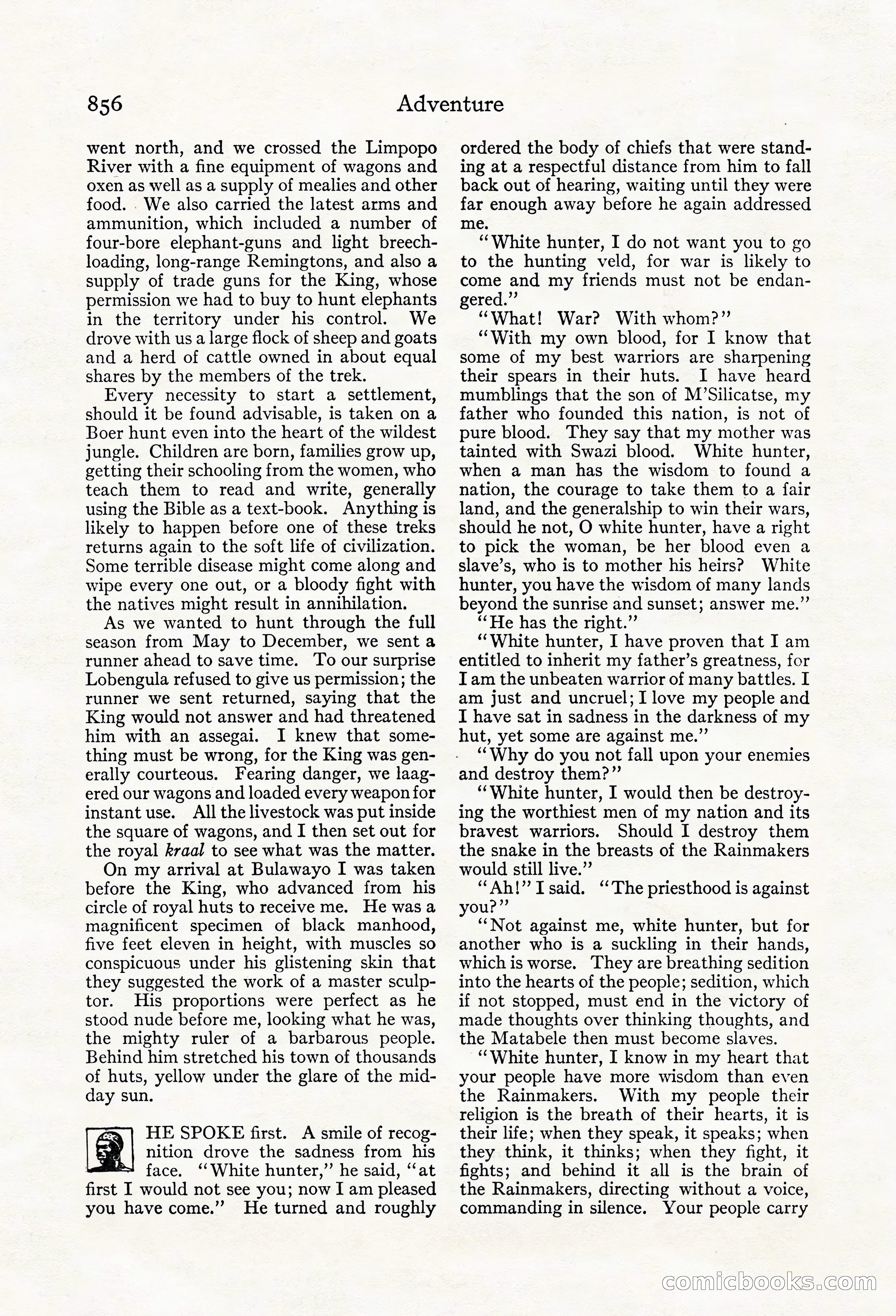
A restored page from Pulp Fiction, 1911. Page through the whole issue in the reader above.
📄 Transcribed text from this page (OCR, searchable)
Machine-transcribed from the original scan — historical spelling and the odd misread are preserved.
856 went north, and we crossed the Limpopo River with a fine equipment of wagons and oxen as well as a supply of mealies and other food. . We also carried the latest arms and ammunition, which included a number of four-bore elephant-guns and light breech- loading, long-range Remingtons, and also a supply of trade guns for the King, whose permission we had to buy to hunt elephants in the territory under his control. We drove with us a large flock of sheep and goats and a herd of cattle owned in about equal shares by the members of the trek. Every necessity to start a settlement, should it be found advisable, is taken on a Boer hunt even into the heart of the wildest jungle. Children are born, families grow up, getting their schooling from the women, who teach them to read and write, generally using the Bible as a text-book. Anything is likely to happen before one of these treks returns again to the soft life of civilization. Some terrible disease might come along and wipe every one out, or a bloody fight with the natives might result in annihilation. As we wanted to hunt through the full season from May to December, we sent a runner ahead to save time. To our surprise Lobengula refused to give us permission; the runner we sent returned, saying that the King would not answer and had threatened him with an assegai. I knew that some- thing must be wrong, for the King was gen- erally courteous. Fearing danger, we laag- ered our wagons and loaded every weapon for instant use. All the livestock was put inside the square of wagons, and I then set out for the royal kraal to see what was the matter. On my arrival at Bulawayo I was taken before the King, who advanced from his circle of royal huts to receive me. He wasa magnificent specimen of black manhood, five feet eleven in height, with muscles so conspicuous under his glistening skin that they suggested the work of a master sculp- tor. His proportions were perfect as he stood nude before me, looking what he was, the mighty ruler of a barbarous people. Behind him stretched his town of thousands of huts, yellow under the glare of the mid- day sun. HE SPOKE first. A smile of recog- wy | nition drove the sadness from his wil face. ‘‘ White hunter,” he said, “‘at first I would not see you; now I am pleased you have come.” He turned and roughly Adventure ordered the body of chiefs that were stand- ing at a respectful distance from him to fall back out of hearing, waiting until they were far enough away before he again addressed me. ‘White hunter, I do not want you to go to the hunting veld, for war is likely to come and my friends must not be endan- gered.” “What! War? With whom?” “With my own blood, for I know that some of my best warriors are sharpening their spears in their huts. I have heard mumblings that the son of M’Silicatse, my father who founded this nation, is not of pure blood. They say that my mother was tainted with Swazi blood. White hunter, when a man has the wisdom to found a nation, the courage to take them to a fair land, and the generalship to win their wars, should he not, O white hunter, have a right to pick the woman, be her blood even a slave’s, who is to mother his heirs? White hunter, you have the wisdom of many lands beyond the sunrise and sunset; answer me.”’ ‘‘He has the right.” ‘““White hunter, I have proven that I am entitled to inherit my father’s greatness, for Iam the unbeaten warrior of many battles. I am just and uncruel;I love my people and I have sat in sadness in the darkness of my hut, yet some are against me.” ‘Why do you not fall upon your enemies and destroy them?” ‘White hunter, I would then be destroy- ing the worthiest men of my nation and its bravest warriors. Should I destroy them the snake in the breasts of the Rainmakers would still live.” “Ah!” Isaid. “The priesthood is against youp”’ ‘““Not against me, white hunter, but for another who is a suckling in their hands, which is worse. They are breathing sedition into the hearts of the people; sedition, which if not stopped, must end in the victory of made thoughts over thinking thoughts, and the Matabele then must become slaves. ‘White hunter, I know in my heart that your people have more wisdom than even the Rainmakers. With my people their religion is the breath of their hearts, it is their life; when they speak, it speaks; when they think, it thinks; when they fight, it fights; and behind it all is the brain of the Rainmakers, directing without a voice, commanding in silence. Your people carry C© MICLOOKS (©