
Pulp Fiction, 1911 · page 12 of 196
Adventure Magazine Cover — page 12: what you’re looking at
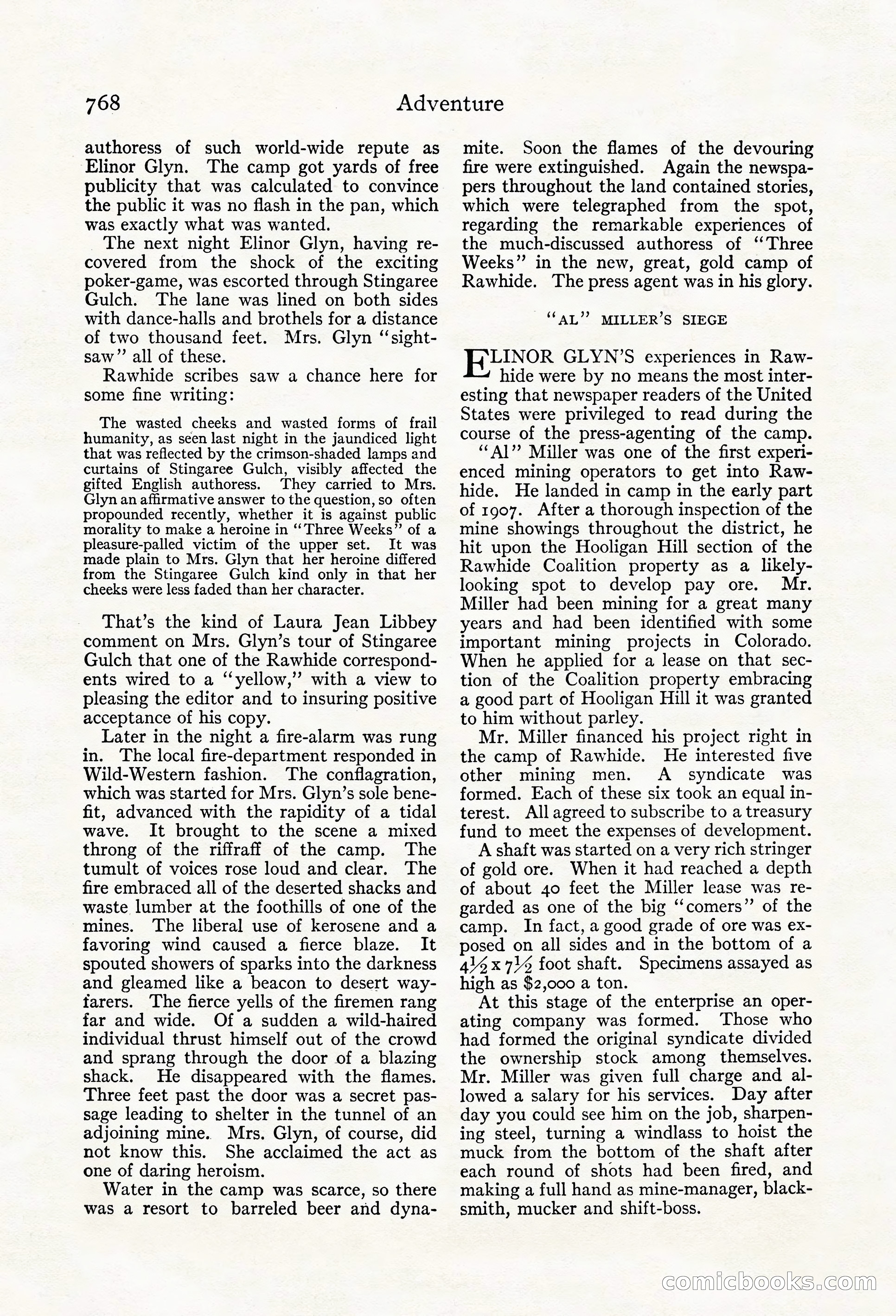
A restored page from Pulp Fiction, 1911. Page through the whole issue in the reader above.
📄 Transcribed text from this page (OCR, searchable)
Machine-transcribed from the original scan — historical spelling and the odd misread are preserved.
768 authoress of such world-wide repute as Elinor Glyn. The camp got yards of free publicity that was calculated to convince the public it was no flash in the pan, which was exactly what was wanted. _ The next night Elinor Glyn, having re- covered from the shock of the exciting poker-game, was escorted through Stingaree Gulch. The lane was lined on both sides with dance-halls and brothels for a distance of two thousand feet. Mrs. Glyn “sight- saw’’ all of these. Rawhide scribes saw a chance here for some fine writing: The wasted cheeks and wasted forms of frail humanity, as seen last night in the jaundiced light that was reflected by the crimson-shaded lamps and curtains of Stingaree Gulch, visibly affected the gifted English authoress. They carried to Mrs. Glyn an affirmative answer to the question, so often propounded recently, whether it is against public morality to make a heroine in ‘‘ Three Weeks” of a pleasure-palled victim of the upper set. It was made plain to Mrs. Glyn that her heroine differed from the Stingaree Gulch kind only in that her cheeks were less faded than her character. That’s the kind of Laura Jean Libbey comment on Mrs. Glyn’s tour of Stingaree Gulch that one of the Rawhide correspond- ents wired to a ‘“‘yellow,” with a view to pleasing the editor and to insuring positive acceptance of his copy. | Later in the night a fire-alarm was rung in. The local fire-department responded in Wild-Western fashion. The conflagration, which was started for Mrs. Glyn’s sole bene- fit, advanced with the rapidity of a tidal wave. It brought to the scene a mixed throng of the riffraff of the camp. The tumult of voices rose loud and clear. The fire embraced all of the deserted shacks and waste lumber at the foothills of one of the mines. The liberal use of kerosene and a favoring wind caused a fierce blaze. It spouted showers of sparks into the darkness and gleamed like a beacon to desert way- tarers. The fierce yells of the firemen rang far and wide. Of a sudden a wild-haired individual thrust himself out of the crowd and sprang through the door of a blazing shack. He disappeared with the flames. Three feet past the door was a secret pas- sage leading to shelter in the tunnel of an adjoining mine. Mrs. Glyn, of course, did not know this. She acclaimed the act as one of daring heroism. Water in the camp was scarce, so there was a resort to barreled beer and dyna- Adventure mite. Soon the flames of the devouring fire were extinguished. Again the newspa- pers throughout the land contained stories, which were telegraphed from the spot, regarding the remarkable experiences of the much-discussed authoress of “Three Weeks”’ in the new, great, gold camp of Rawhide. The press agent was in his glory. ‘f aL”? MILLER’S SIEGE Hoo GLYN’S experiences in Raw- hide were by no means the most inter- esting that newspaper readers of the United States were privileged to read during the course of the press-agenting of the camp. “Al” Miller was one of the first experi- enced mining operators to get into Raw- hide. He landed in camp in the early part of 1907. After a thorough inspection of the mine showings throughout the district, he hit upon the Hooligan Hill section of the Rawhide Coalition property as a likely- looking spot to develop pay ore. Mr. Miller had been mining for a great many years and had been identified with some important mining projects in Colorado. When he applied for a lease on that sec- tion of the Coalition property embracing a good part of Hooligan Hill it was granted to him without parley. Mr. Miller financed his project right in the camp of Rawhide. He interested five other mining men. A _ syndicate was formed. Each of these six took an equal in- terest. All agreed to subscribe to a treasury fund to meet the expenses of development. A shaft was started on a very rich stringer of gold ore. When it had reached a depth of about 40 feet the Miller lease was re- garded as one of the big “‘comers” of the camp. In fact, a good grade of ore was ex- posed on all sides and in the bottom of a 414x714 foot shaft. Specimens assayed as high as $2,000 a ton. At this stage of the enterprise an oper- ating company was formed. ‘Those who had formed the original syndicate divided the ownership stock among themselves. Mr. Miller was given full charge and al- lowed a salary for his services. Day after day you could see him on the job, sharpen- ing steel, turning a windlass to hoist the muck from the bottom of the shaft after each round of shots had been fired, and making a full hand as mine-manager, black- smith, mucker and shift-boss. Conn CloOOLkKS CO