
Pulp Fiction, 1911 · page 124 of 196
Adventure Magazine Cover — page 124: what you’re looking at
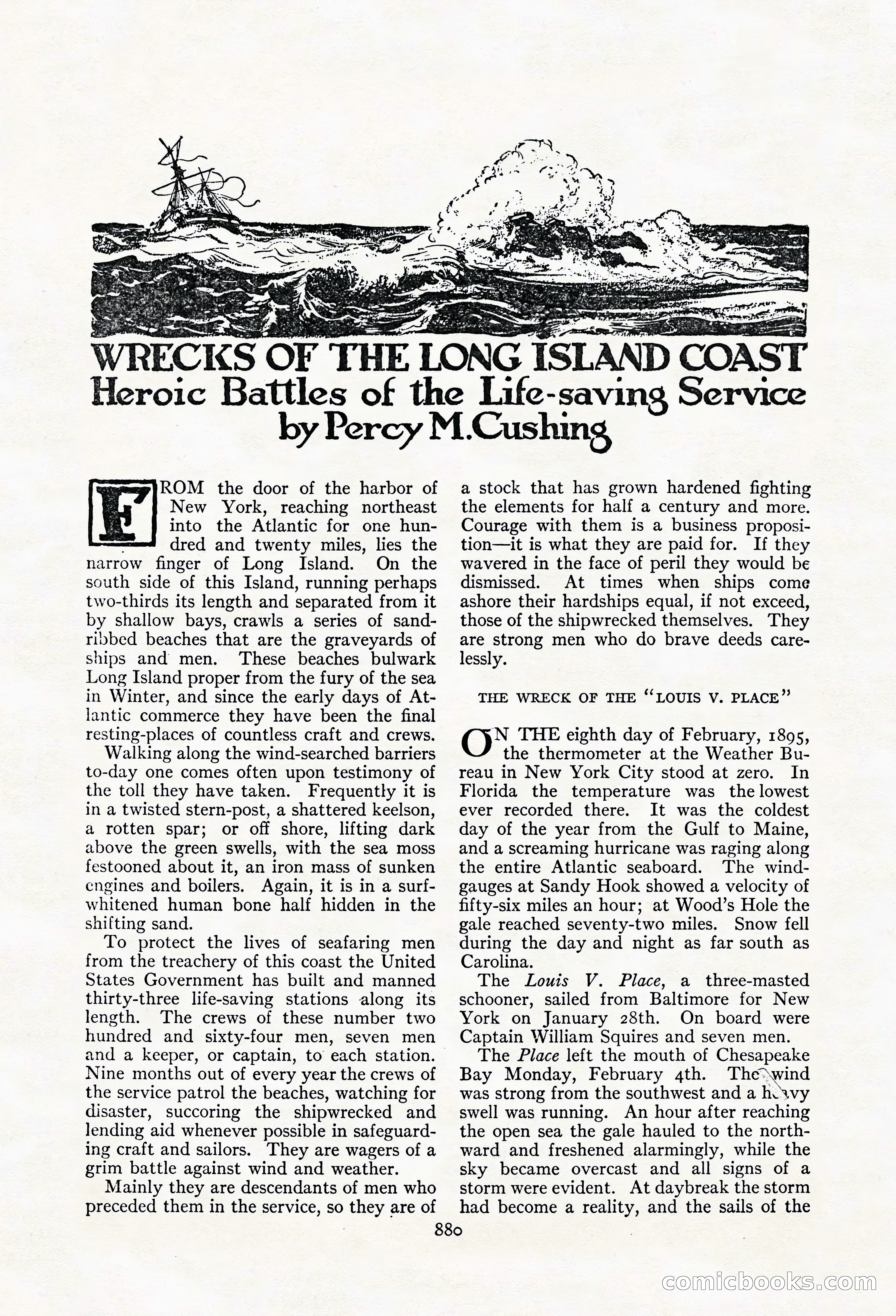
A restored page from Pulp Fiction, 1911. Page through the whole issue in the reader above.
📄 Transcribed text from this page (OCR, searchable)
Machine-transcribed from the original scan — historical spelling and the odd misread are preserved.
to Wye eo * ‘ Ye 3 Lz as: oe - 4. meee ©. a < a = WRECKS AST Heroic Battles of the Life-saving Service by Percy M.Cushing, ROM the door of the harbor of New York, reaching northeast ‘3 into the Atlantic for one hun- = dred and twenty miles, lies the narrow finger of Long Island. On the south side of this Island, running perhaps two-thirds its length and separated from it by shallow bays, crawls a series of sand- ribbed beaches that are the graveyards of ships and men. These beaches bulwark Long Island proper from the fury of the sea in Winter, and since the early days of At- lantic commerce they have been the final resting-places of countless craft and crews. Walking along the wind-searched barriers to-day one comes often upon testimony of the toll they have taken. Frequently it is in a twisted stern-post, a shattered keelson, a rotten spar; or off shore, lifting dark above the green swells, with the sea moss festooned about it, an iron mass of sunken engines and boilers. Again, it is in a surf- whitened human bone half hidden in the shifting sand. To protect the lives of seafaring men from the treachery of this coast the United States Government has built and manned thirty-three life-saving stations along its length. The crews of these number two hundred and sixty-four men, seven men and a keeper, or captain, to each station. Nine months out of every year the crews of the service patrol the beaches, watching for disaster, succoring the shipwrecked and lending aid whenever possible in safeguard- ing craft and sailors. They are wagers of a grim battle against wind and weather. Mainly they are descendants of men who preceded them in the service, so they are of a stock that has grown hardened fighting the elements for half a century and more. Courage with them is a business proposi- tion—it is what they are paid for. If they wavered in the face of peril they would be dismissed. At times when ships come ashore their hardships equal, if not exceed, those of the shipwrecked themselves. They are strong men who do brave deeds care- lessly. THE WRECK OF THE ‘‘LOUIS V. PLACE”’ ON THE eighth day of February, 1895, the thermometer at the Weather Bu- reau in New York City stood at zero. In Florida the temperature was _ the lowest ever recorded there. It was the coldest day of the year from the Gulf to Maine, and a screaming hurricane was raging along the entire Atlantic seaboard. The wind- gauges at Sandy Hook showed a velocity of fifty-six miles an hour; at Wood’s Hole the gale reached seventy-two miles. Snow fell during the day and night as far south as Carolina. The Louis V. Place, a_ three-masted schooner, sailed from Baltimore for New York on January 28th. On board were Captain William Squires and seven men. The Place left the mouth of Chesapeake Bay Monday, February 4th. The wind was strong from the southwest and a h vy swell was running. An hour after reaching the open sea the gale hauled to the north- ward and freshened alarmingly, while the sky became overcast and all signs of a storm were evident. At daybreak the storm had become a reality, and the sails of the 880 C© MICLOOKS 5}