
Pulp Fiction, 1911 · page 183 of 196
Adventure Magazine Cover — page 183: what you’re looking at
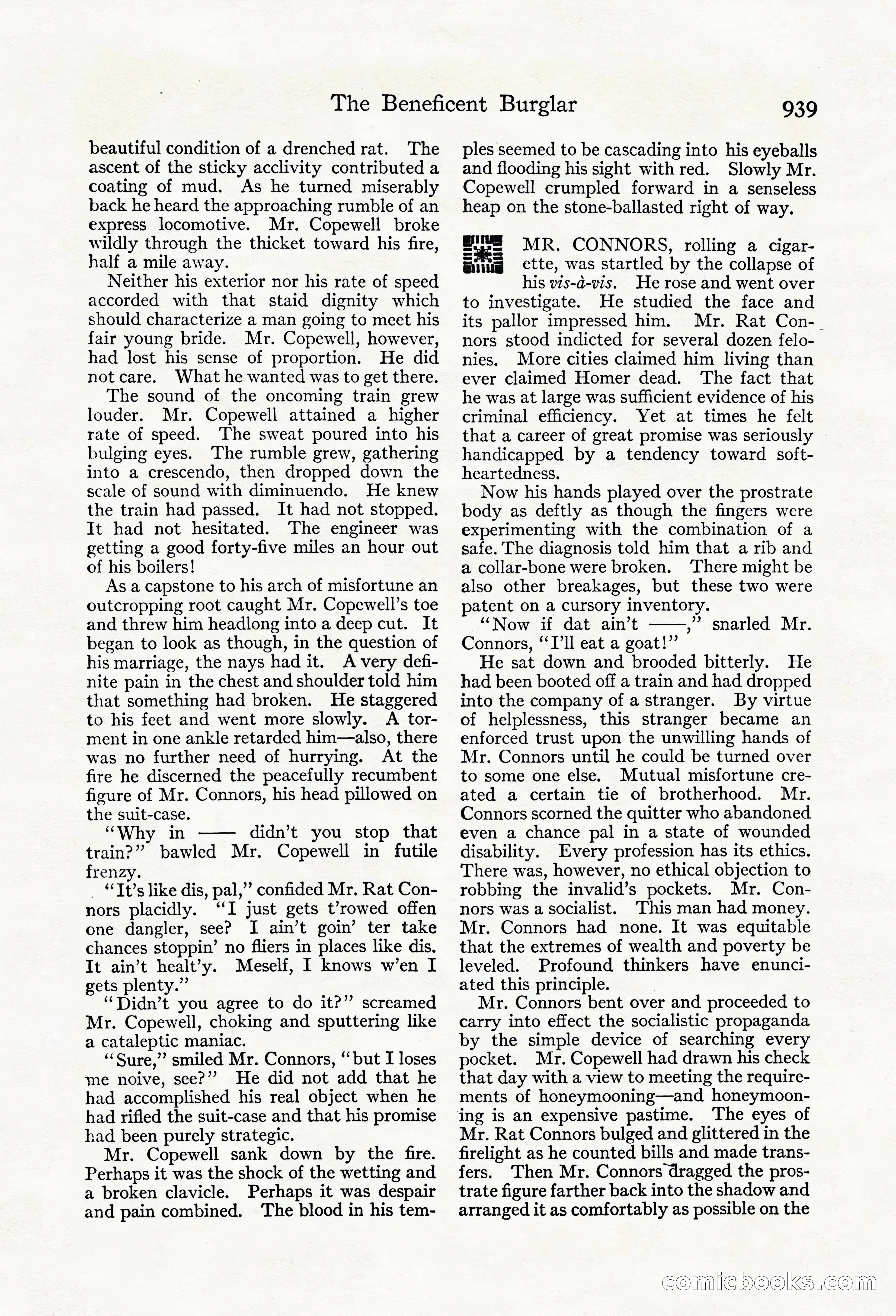
A restored page from Pulp Fiction, 1911. Page through the whole issue in the reader above.
📄 Transcribed text from this page (OCR, searchable)
Machine-transcribed from the original scan — historical spelling and the odd misread are preserved.
The Beneficent Burglar beautiful condition of a drenched rat. The ascent of the sticky acclivity contributed a coating of mud. As he turned miserably back he heard the approaching rumble of an express locomotive. Mr. Copewell broke wildly through the thicket toward his fire, half a mile away. Neither his exterior nor his rate of speed accorded with that staid dignity which should characterize a man going to meet his fair young bride. Mr. Copewell, however, had lost his sense of proportion. He did not care. What he wanted was to get there. The sound of the oncoming train grew louder. Mr. Copewell attained a higher rate of speed. The sweat poured into his bulging eyes. The rumble grew, gathering into a crescendo, then dropped down the scale of sound with diminuendo. He knew the train had passed. It had not stopped. It had not hesitated. The engineer was getting a good forty-five miles an hour out of his boilers! As a capstone to his arch of misfortune an outcropping root caught Mr. Copewell’s toe and threw him headlong into a deep cut. It began to look as though, in the question of his marriage, the nays had it. Avery defi- nite pain in the chest and shoulder told him that something had broken. He staggered to his feet and went more slowly. A tor- ment in one ankle retarded him—also, there was no further need of hurrying. At the fire he discerned the peacefully recumbent figure of Mr. Connors, his head pillowed on the suit-case. “Why in didn’t you stop that train?” bawled Mr. Copewell in futile frenzy. _ “Tt’s like dis, pal,” confided Mr. Rat Con- nors placidly. ‘I just gets t’rowed offen one dangler, see? I ain’t goin’ ter take chances stoppin’ no fliers in places like dis. It ain’t healt’y. Meself, I knows w’en I gets plenty.” “Didn’t you agree to do it?” screamed Mr. Copewell, choking and sputtering like a cataleptic maniac. ‘‘Sure,”’ smiled Mr. Connors, “but I loses ye noive, see?”? He did not add that he had accomplished his real object when he had rifled the suit-case and that his promise had been purely strategic. Mr. Copewell sank down by the fire. Perhaps it was the shock of the wetting and a broken clavicle. Perhaps it was despair and pain combined. ‘The blood in his tem- ing is an expensive pastime. 939 ples seemed to be cascading into his eyeballs and flooding his sight with red. Slowly Mr. Copewell crumpled forward in a senseless heap on the stone-ballasted right of way. wee MR. CONNORS, rolling a cigar- Sid ette, was startled by the collapse of his vis-d-vis. He rose and went over to investigate. He studied the face and its pallor impressed him. nors stood indicted for several dozen felo- nies. More cities claimed him living than ever claimed Homer dead. The fact that he was at large was sufficient evidence of his criminal efficiency. Yet at times he felt that a career of great promise was seriously handicapped by a tendency toward soft- heartedness. Now his hands played over the prostrate body as deftly as though the fingers were experimenting with the combination of a safe. The diagnosis told him that a rib and a collar-bone were broken. There might be also other breakages, but these two were patent on a cursory inventory. “Now if dat ain’t ,’ snarled Mr. Connors, ‘‘I’ll eat a goat!”’ He sat down and brooded bitterly. He had been booted off a train and had dropped into the company of a stranger. By virtue of helplessness, this stranger became an enforced trust upon the unwilling hands of Mr. Connors until he could be turned over to some one else. Mutual misfortune cre- ated a certain tie of brotherhood. Mr. Connors scorned the quitter who abandoned even a chance pal in a state of wounded disability. Every profession has its ethics. There was, however, no ethical objection to robbing the invalid’s pockets. Mr. Con- nors was a socialist. ‘This man had money. Mr. Connors had none. It was equitable that the extremes of wealth and poverty be leveled. Profound thinkers have enunci- ated this principle. | Mr. Connors bent over and proceeded to carry into effect the socialistic propaganda by the simple device of searching every pocket. Mr. Copewell had drawn his check that day with a view to meeting the require- ments of honeymooning—and honeymoon- The eyes of Mr. Rat Connors bulged and glittered in the firelight as he counted bills and made trans- fers. Then Mr. Connors dragged the pros- trate figure farther back into the shadow and arranged it as comfortably as possible on the cComicbook Mr. Rat Con-_ (©