
Pulp Fiction, 1911 · page 185 of 196
Adventure Magazine Cover — page 185: what you’re looking at
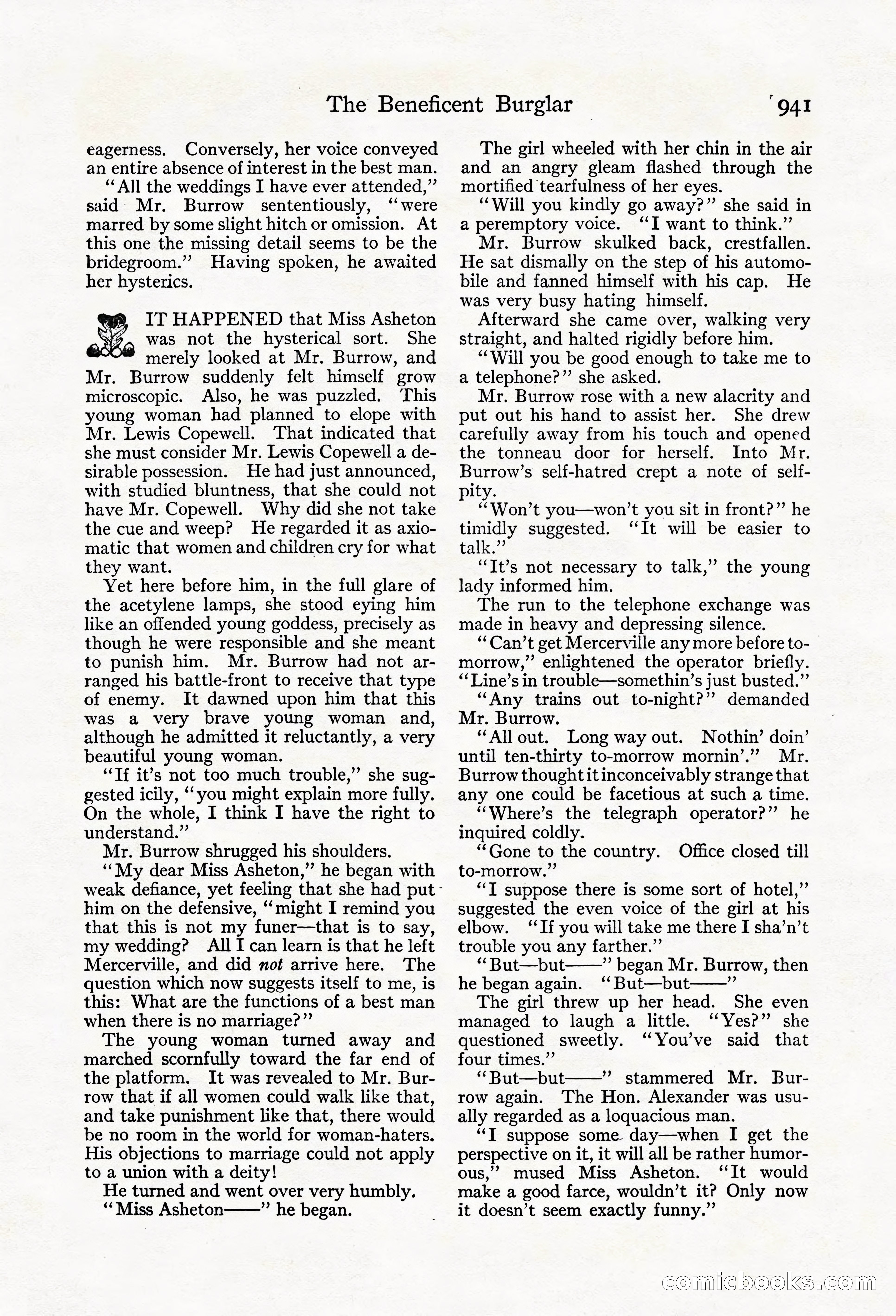
A restored page from Pulp Fiction, 1911. Page through the whole issue in the reader above.
📄 Transcribed text from this page (OCR, searchable)
Machine-transcribed from the original scan — historical spelling and the odd misread are preserved.
The Beneficent Burglar eagerness. Conversely, her voice conveyed an entire absence of interest in the best man. ‘‘ All the weddings I have ever attended,” said: Mr. Burrow sententiously, ‘were marred by some slight hitch or omission. At this one the missing detail seems to be the bridegroom.’”’ Having spoken, he awaited her hysterics. wm, IT HAPPENED that Miss Asheton was not the hysterical sort. She GeO merely looked at Mr. Burrow, and Mr. Burrow suddenly felt himself grow microscopic. Also, he was puzzled. This young woman had planned to elope with Mr. Lewis Copewell. That indicated that she must consider Mr. Lewis Copewell a de- sirable possession. He had just announced, with studied bluntness, that she could not have Mr. Copewell. Why did she not take the cue and weep? He regarded it as axio- matic that women and children cry for what they want. Yet here before him, in the full glare of the acetylene lamps, she stood eying him like an offended young goddess, precisely as though he were responsible and she meant to punish him. Mr. Burrow had not ar- ranged his battle-front to receive that type of enemy. It dawned upon him that this was a very brave young woman and, although he admitted it reluctantly, a very beautiful young woman. “Tf it’s not too much trouble,” she sug- gested icily, ‘‘ you might explain more fully. On the whole, I think I have the right to understand.” Mr. Burrow shrugged his shoulders. ‘““My dear Miss Asheton,” he began with weak defiance, yet feeling that she had put - him on the defensive, “‘might I remind you that this is not my funer—that is to say, my wedding? All I can learn is that he left Mercerville, and did not arrive here. The question which now suggests itself to me, is this: What are the functions of a best man when there is no marriage? ”’ The young woman turned away and marched scornfully toward the far end of the platform. It was revealed to Mr. Bur- row that if all women could walk like that, and take punishment lke that, there would be no room in the world for woman-haters. His objections to marriage could not apply to a union with a deity! He turned and went over very humbly. ‘Miss Asheton——” he began. “941 The girl wheeled with her chin in the air and an angry gleam flashed through the mortified tearfulness of her eyes. ‘Will you kindly go away?” she said in a peremptory voice. “I want to think.” Mr. Burrow skulked back, crestfallen. He sat dismally on the step of his automo- bile and fanned himself with his cap. He was very busy hating himself. Afterward she came over, walking very straight, and halted rigidly before him. “Will you be good enough to take me to a telephone?” she asked. Mr. Burrow rose with a new alacrity and put out his hand to assist her. She drew carefully away from his touch and opened the tonneau door for herself. Into Mr. Burrow’s self-hatred crept a note of self- pity. ‘“Won’t you—won’t you sit in front?” he timidly suggested. “It will be easier to talk.” “It’s not necessary to talk,” the young lady informed him. The run to the telephone exchange was made in heavy and depressing silence. “‘Can’t get Mercerville any more before to- morrow,” enlightened the operator briefly. ‘*Line’s in trouble—somethin’s just busted.”’ ‘““Any trains out to-night?’”’ demanded Mr. Burrow. ‘All out. Long way out. Nothin’ doin’ until ten-thirty to-morrow mornin’.” Mr. Burrow thought it inconceivably strange that any one could be facetious at such a time. ‘““Where’s the telegraph operator?” he inquired coldly. “Gone to the country. to-morrow.” ‘“‘T suppose there is some sort of hotel,” suggested the even voice of the girl at his elbow. ‘“‘If you will take me there I sha’n’t trouble you any farther.”’ ““But—but ” began Mr. Burrow, then he began again. ‘“‘But—but = The girl threw up her head. She even managed to laugh a little. ‘Yes?’ she questioned sweetly. ‘‘You’ve said that four times.” “But—but ”» stammered Mr. Bur- row again. The Hon. Alexander was usu- ally regarded as a loquacious man. “IT suppose some day—when I get the perspective on it, it will all be rather humor- ous,” mused Miss Asheton. “It would make a good farce, wouldn’t it? Only now it doesn’t seem exactly funny.” Office closed till COmiclbook C©