
Pulp Fiction, 1911 · page 20 of 196
Adventure Magazine Cover — page 20: what you’re looking at
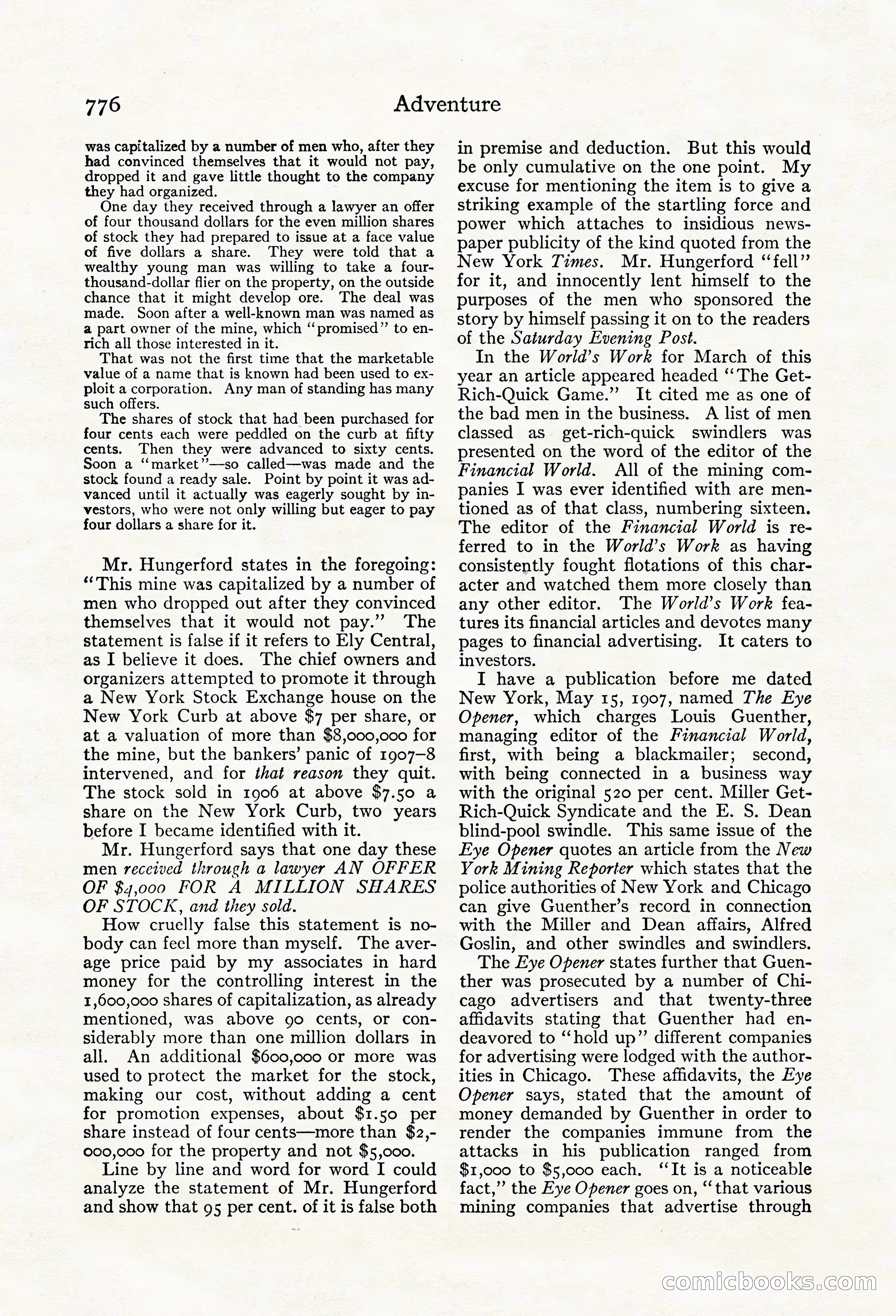
A restored page from Pulp Fiction, 1911. Page through the whole issue in the reader above.
📄 Transcribed text from this page (OCR, searchable)
Machine-transcribed from the original scan — historical spelling and the odd misread are preserved.
776 was capitalized by a number of men who, after they had convinced themselves that it would not pay, dropped it and gave little thought to the company they had organized. One day they received through a lawyer an offer of four thousand dollars for the even million shares of stock they had prepared to issue at a face value of five dollars a share. They were told that a wealthy young man was willing to take a four- thousand-dollar flier on the property, on the outside chance that it might develop ore. The deal was made. Soon after a well-known man was named as a part owner of the mine, which “ promised”’ to en- rich all those interested in it. That was not the first time that the marketable value of a name that is known had been used to ex- ploit a corporation. Any man of standing has many such offers. The shares of stock that had been purchased for four cents each were peddled on the curb at fifty cents. Then they were advanced to sixty cents. Soon a ‘‘market’—so called—was made and the stock found a ready sale. Point by point it was ad- vanced until it actually was eagerly sought by in- vestors, who were not only willing but eager to pay four dollars a share for it. Mr. Hungerford states in the foregoing: “This mine was capitalized by a number of men who dropped out after they convinced themselves that it would not pay.” The statement is false if it refers to Ely Central, as I believe it does. The chief owners and organizers attempted to promote it through a New York Stock Exchange house on the New York Curb at above $7 per share, or at a valuation of more than $8,000,000 for the mine, but the bankers’ panic of 1907-8 intervened, and for that reason they quit. The stock sold in 1906 at above $7.50 a share on the New York Curb, two years before I became identified with it. Mr. Hungerford says that one day these men received through a lawyer AN OFFER OF $4,000 FOR A MILLION SHARES OF STOCK, and they sold. How cruelly false this statement is no- body can feel more than myself. The aver- age price paid by my associates in hard money for the controlling interest in the 1,600,000 shares of capitalization, as already mentioned, was above 90 cents, or con- siderably more than one million dollars in all. An additional $600,000 or more was used to protect the market for the stock, making our cost, without adding a cent for promotion expenses, about $1.50 per share instead of four cents—more than §2,- 000,000 for the property and not $5,000. Line by line and word for word I could analyze the statement of Mr. Hungerford and show that 95 per cent. of it is false both Adventure in premise and deduction. But this would | be only cumulative on the one point. My excuse for mentioning the item is to give a striking example of the startling force and power which attaches to insidious news- paper publicity of the kind quoted from the New York Times. Mr. Hungerford ‘‘fell”’ for it, and innocently lent himself to the purposes of the men who sponsored the story by himself passing it on to the readers of the Saturday Evening Post. In the World’s Work for March of this year an article appeared headed “‘ The Get- Rich-Quick Game.’’ It cited me as one of the bad men in the business. A list of men classed as get-rich-quick swindlers was presented on the word of the editor of the Financial World. All of the mining com- panies I was ever identified with are men- tioned as of that class, numbering sixteen. The editor of the Financial World is re- ferred to in the World’s Work as having consistently fought flotations of this char- acter and watched them more closely than any other editor. The World’s Work fea- tures its financial articles and devotes many pages to financial advertising. It caters to investors. I have a publication before me dated New York, May 15, 1907, named The Eye Opener, which charges Louis Guenther, managing editor of the Financial World, first, with being a blackmailer; second, with being connected in a business way with the original 520 per cent. Miller Get- Rich-Quick Syndicate and the E. S$. Dean blind-pool swindle. This same issue of the Eye Opener quotes an article from the Vew York Mining Reporter which states that the police authorities of New York and Chicago can give Guenther’s record in connection with the Miller and Dean affairs, Alfred Goslin, and other swindles and swindlers. The Eye Opener states further that Guen- ther was prosecuted by a number of Chi- cago advertisers and that twenty-three affidavits stating that Guenther had en- deavored to “hold up” different companies for advertising were lodged with the author- ities in Chicago. These affidavits, the Eye Opener says, stated that the amount of money demanded by Guenther in order to render the companies immune from the attacks in his publication ranged from $1,000 to $5,000 each. “It is a noticeable fact,” the Eye Opener goes on, “that various mining companies that advertise through Gbooks S|