
Pulp Fiction, 1911 · page 23 of 196
Adventure Magazine Cover — page 23: what you’re looking at
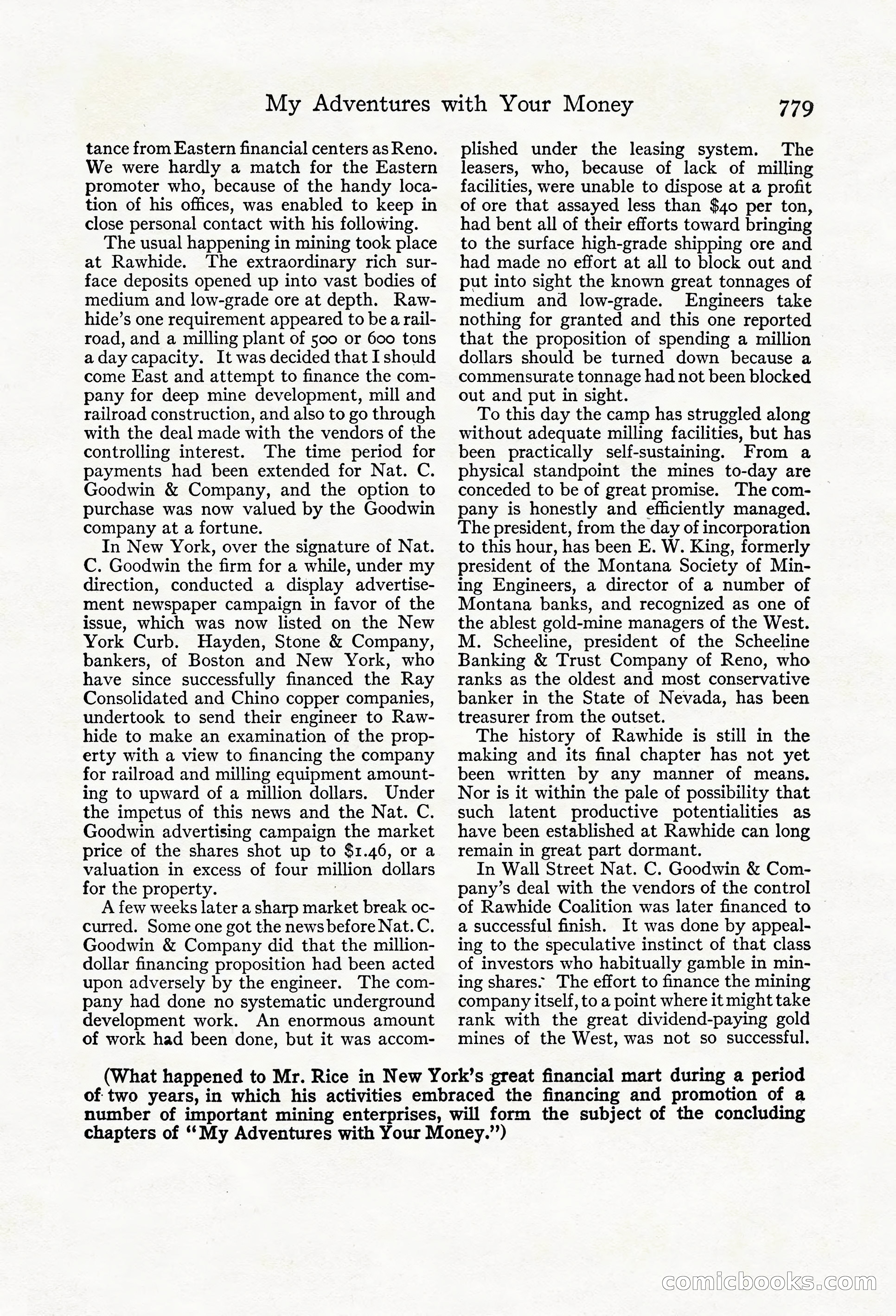
A restored page from Pulp Fiction, 1911. Page through the whole issue in the reader above.
📄 Transcribed text from this page (OCR, searchable)
Machine-transcribed from the original scan — historical spelling and the odd misread are preserved.
My Adventures with Your Money tance from Eastern financial centers as Reno. We were hardly a match for the Eastern promoter who, because of the handy loca- tion of his offices, was enabled to keep in close personal contact with his following. The usual happening in mining took place at Rawhide. ‘The extraordinary rich sur- face deposits opened up into vast bodies of medium and low-grade ore at depth. Raw- hide’s one requirement appeared to be a rail- road, and a milling plant of 500 or 600 tons aday capacity. It was decided that I should come East and attempt to finance the com- pany for deep mine development, mill and railroad construction, and also to go through with the deal made with the vendors of the controlling interest. The time period for payments had been extended for Nat. C. Goodwin & Company, and the option to purchase was now valued by the Goodwin company at a fortune. In New York, over the signature of Nat. C. Goodwin the firm for a while, under my direction, conducted a display advertise- ment newspaper campaign in favor of the issue, which was now listed on the New York Curb. Hayden, Stone & Company, bankers, of Boston and New York, who have since successfully financed the Ray Consolidated and Chino copper companies, undertook to send their engineer to Raw- hide to make an examination of the prop- erty with a view to financing the company for railroad and milling equipment amount- ing to upward of a million dollars. Under the impetus of this news and the Nat. C. Goodwin advertising campaign the market price of the shares shot up to $1.46, or a valuation in excess of four million dollars for the property. | A few weeks later a sharp market break oc- curred. Some one got the news before Nat. C. Goodwin & Company did that the million- dollar financing proposition had been acted upon adversely by the engineer. The com- pany had done no systematic underground development work. An enormous amount of work had been done, but it was accom- 779 plished under the leasing system. The leasers, who, because of lack of milling facilities, were unable to dispose at a profit of ore that assayed less than $40 per ton, had bent all of their efforts toward bringing to the surface high-grade shipping ore and had made no effort at all to block out and put into sight the known great tonnages of medium and low-grade. Engineers take nothing for granted and this one reported that the proposition of spending a million dollars should be turned down because a commensurate tonnage had not been blocked out and put in sight. To this day the camp has struggled along without adequate milling facilities, but has been practically self-sustaining. From a physical standpoint the mines to-day are conceded to be of great promise. The com- pany is honestly and efficiently managed. The president, from the day of incorporation to this hour, has been E. W. King, formerly president of the Montana Society of Min- ing Engineers, a director of a number of Montana banks, and recognized as one of the ablest gold-mine managers of the West. M. Scheeline, president of the Scheeline Banking & Trust Company of Reno, who ranks as the oldest and most conservative banker in the State of Nevada, has been treasurer from the outset. The history of Rawhide is still in the making and its final chapter has not yet been written by any manner of means. Nor is it within the pale of possibility that such latent productive potentialities as have been established at Rawhide can long remain in great part dormant. In Wall Street Nat. C. Goodwin & Com- pany’s deal with the vendors of the control of Rawhide Coalition was later financed to a successful finish. It was done by appeal- ing to the speculative instinct of that class of investors who habitually gamble in min- ing shares. The effort to finance the mining company itself, to a point where it might take rank with the great dividend-paying gold mines of the West, was not so successful. (What happened to Mr. Rice in New York’s great financial mart during a period of: two years, in which his activities embraced the financing and promotion of a number of important mining enterprises, will form the subject of the concluding chapters of ‘‘My Adventures with Your Money.”’) Comiclbook ©