
Pulp Fiction, 1911 · page 25 of 196
Adventure Magazine Cover — page 25: what you’re looking at
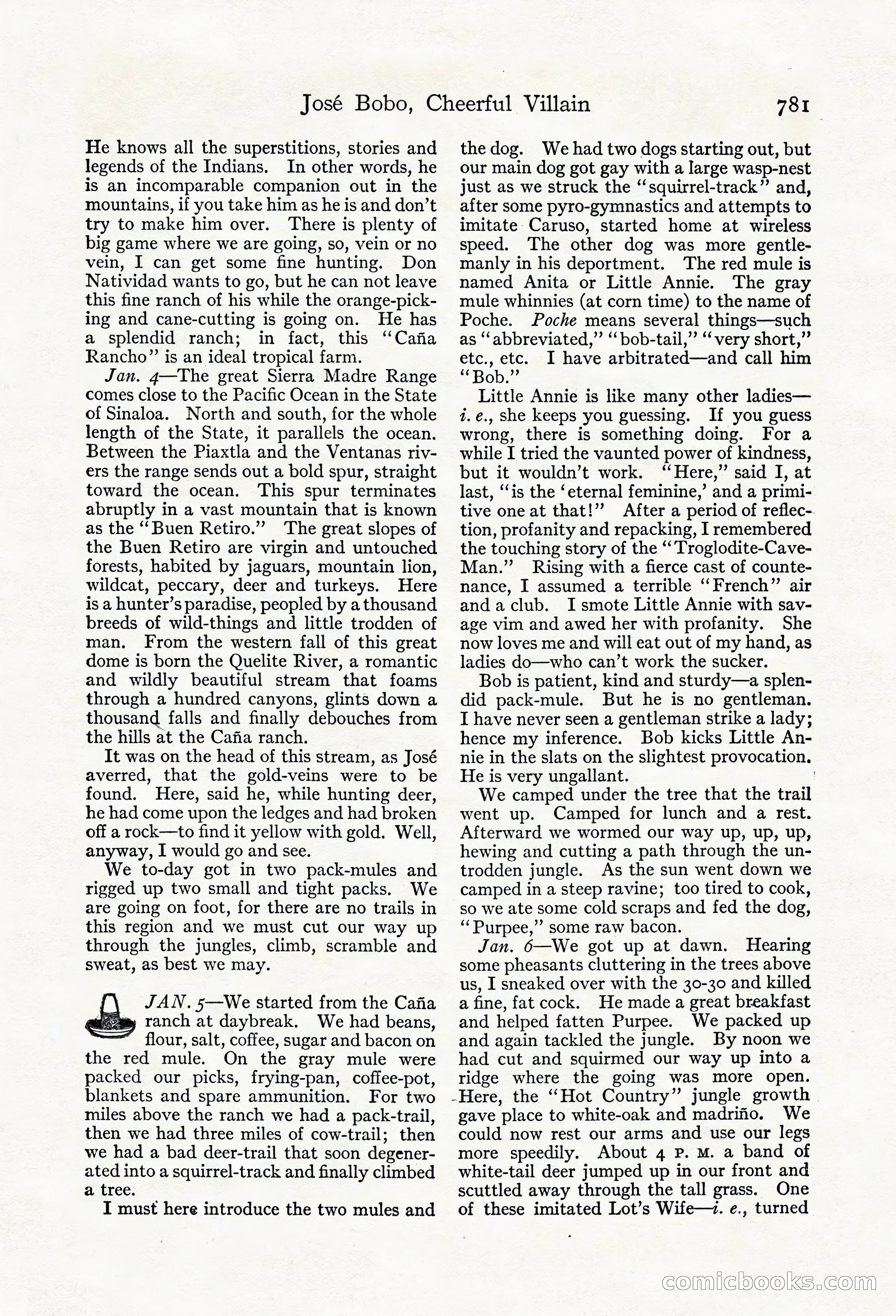
A restored page from Pulp Fiction, 1911. Page through the whole issue in the reader above.
📄 Transcribed text from this page (OCR, searchable)
Machine-transcribed from the original scan — historical spelling and the odd misread are preserved.
José Bobo, Cheerful Villain He knows all the superstitions, stories and legends of the Indians. In other words, he is an incomparable companion out in the mountains, if you take him as he is and don’t try to make him over. There is plenty of big game where we are going, so, vein or no vein, I can get some fine hunting. Don Natividad wants to go, but he can not leave this fine ranch of his while the orange-pick- ing and cane-cutting is going on. He has a splendid ranch; in fact, this ‘“‘Cafia Rancho” is an ideal tropical farm. Jan. 4—The great Sierra Madre Range comes close to the Pacific Ocean in the State of Sinaloa. North and south, for the whole length of the State, it parallels the ocean. Between the Piaxtla and the Ventanas riv- ers the range sends out a bold spur, straight toward the ocean. This spur terminates abruptly in a vast mountain that is known as the “Buen Retiro.” The great slopes of the Buen Retiro are virgin and untouched forests, habited by jaguars, mountain lion, wildcat, peccary, deer and turkeys. Here is a hunter’s paradise, peopled by a thousand breeds of wild-things and little trodden of man. From the western fall of this great dome is born the Quelite River, a romantic and wildly beautiful stream that foams through a hundred canyons, glints down a thousand falls and finally debouches from the hills at the Cafia ranch. It was on the head of this stream, as José averred, that the gold-veins were to be found. Here, said he, while hunting deer, he had come upon the ledges and had broken off a rock—to find it yellow with gold. Well, anyway, I would go and see. We to-day got in two pack-mules and rigged up two small and tight packs. We are going on foot, for there are no trails in this region and we must cut our way up through the jungles, climb, scramble and sweat, as best we may. ete ranch at daybreak. We had beans, flour, salt, coffee, sugar and bacon on the red mule. On the gray mule were packed our picks, frying-pan, coffee-pot, blankets and spare ammunition. For two miles above the ranch we had a pack-trail, then we had three miles of cow-trail; then we had a bad deer-trail that soon degener- ated into a squirrel-track and finally climbed a tree. I must here introduce the two mules and JAN. 5—We started from the Cafia the dog. We had two dogs starting out, but our main dog got gay with a large wasp-nest just as we struck the “squirrel-track” and, after some pyro-gymnastics and attempts to imitate Caruso, started home at wireless speed. The other dog was more gentle- manly in his deportment. The red mule is named Anita or Little Annie. The gray mule whinnies (at corn time) to the name of Poche. Poche means several things—such as ‘abbreviated,’ “‘bob-tail,” ‘‘ very short,” etc., etc. I have arbitrated—and call him é< Bob.’’ Little Annie is like many other ladies— 1.€., She keeps you guessing. If you guess wrong, there is something doing. For a while I tried the vaunted power of kindness, but it wouldn’t work. “Here,” said I, at last, “‘is the ‘eternal feminine,’ and a primi- tive one at that!”’ After a period of reflec- tion, profanity and repacking, I remembered the touching story of the “ Troglodite-Cave- Man.” Rising with a fierce cast of counte- nance, I assumed a terrible “French” air andaclub. I smote Little Annie with sav- age vim and awed her with profanity. She now loves me and will eat out of my hand, as ladies do—who can’t work the sucker. Bob is patient, kind and sturdy—a splen- did pack-mule. But he is no gentleman. I have never seen a gentleman strike a lady; hence my inference. Bob kicks Little An- nie in the slats on the slightest provocation. He is very ungallant. We camped under the tree that the trail went up. Camped for lunch and a rest. Afterward we wormed our way up, up, up, hewing and cutting a path through the un- trodden jungle. As the sun went down we camped in a steep ravine; too tired to cook, so we ate some cold scraps and fed the dog, ‘“‘Purpee,”’ some raw bacon. Jan. 6—We got up at dawn. Hearing some pheasants cluttering in the trees above us, I sneaked over with the 30-30 and killed a fine, fat cock. He made a great breakfast and helped fatten Purpee. We packed up and again tackled the jungle. By noon we had cut and squirmed our way up into a ridge where the going was more open. -Here, the ‘“Hot Country” jungle growth gave place to white-oak and madrifo. We could now rest our arms and use our legs more speedily. About 4 Pp. M. a band of white-tail deer jumped up in our front and scuttled away through the tall grass. One of these imitated Lot’s Wife—. e., turned C© 781 Ghbooks (©