
Pulp Fiction, 1911 · page 36 of 196
Adventure Magazine Cover — page 36: what you’re looking at
A restored page from Pulp Fiction, 1911. Page through the whole issue in the reader above.
📄 Transcribed text from this page (OCR, searchable)
Machine-transcribed from the original scan — historical spelling and the odd misread are preserved.
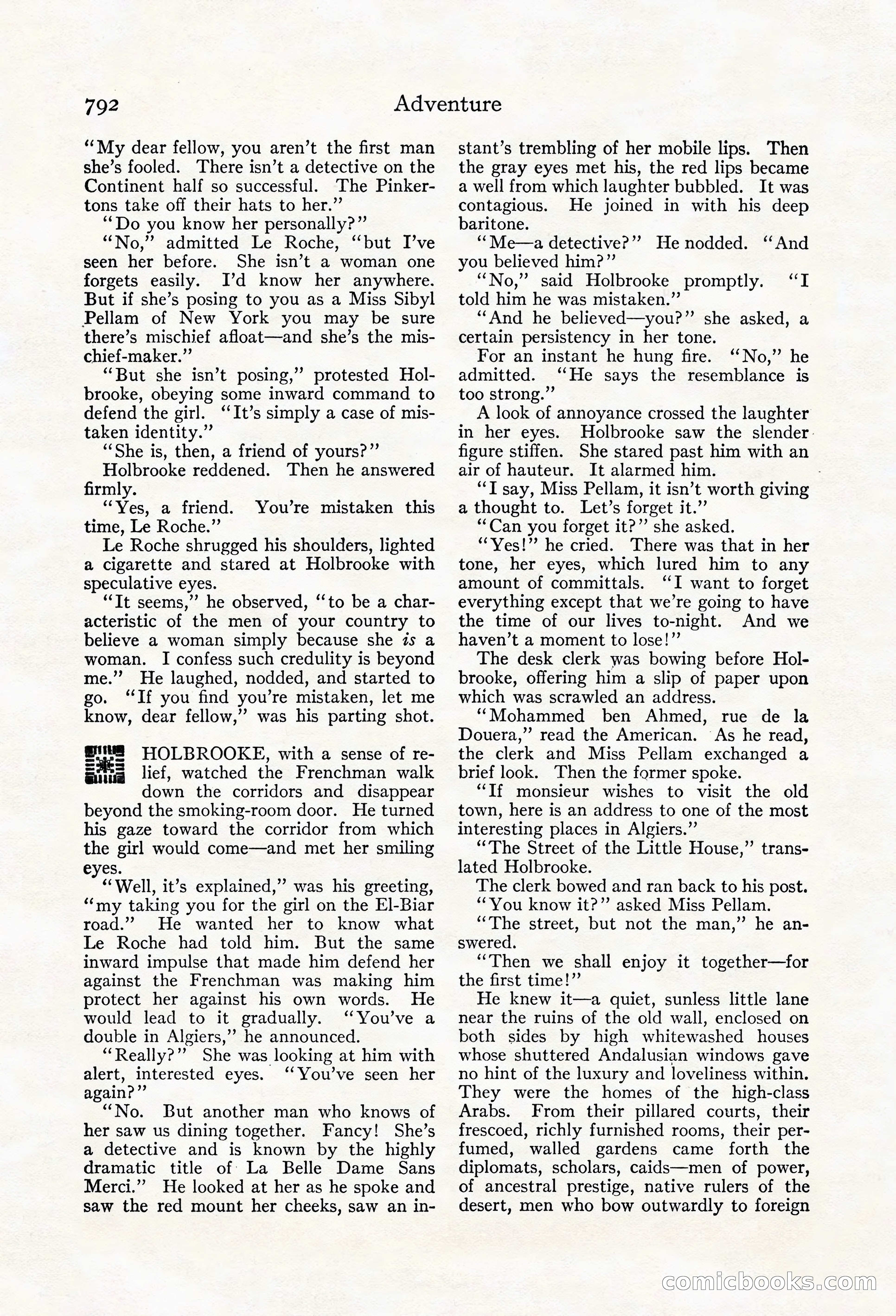
792 “My dear fellow, you aren’t the first man she’s fooled. There isn’t a detective on the Continent half so successful. The Pinker- tons take off their hats to her.” ‘Do you know her personally?”’ ““No,” admitted Le Roche, ‘‘but I’ve seen her before. She isn’t a woman one forgets easily. I’?d know her anywhere. But if she’s posing to you as a Miss Sibyl Pellam of New York you may be sure there’s mischief afloat—and she’s the mis- chief-maker.”’ “But she isn’t posing,” protested Hol- brooke, obeying some inward command to defend the girl. “It’s simply a case of mis- taken identity.” ‘She is, then, a friend of yours?”’ Holbrooke reddened. Then he answered firmly. “Yes, a friend. You’re mistaken this time, Le Roche.” Le Roche shrugged his shoulders, lighted a cigarette and stared at Holbrooke with speculative eyes. ‘““It seems,”’ he observed, ‘‘to be a char- acteristic of the men of your country to believe a woman simply because she zs a woman. I confess such credulity is beyond me.” He laughed, nodded, and started to go. “If you find you’re mistaken, let me know, dear fellow,’ was his parting shot. oe HOLBROOKE, with a sense of re- sag lief, watched the Frenchman walk down the corridors and disappear beyond the smoking-room door. He turned his gaze toward the corridor from which the girl would come—and met her smiling eyes. ‘“Well, it’s explained,” was his greeting, ““my taking you for the girl on the El-Biar road.” He wanted her to know what Le Roche had told him. But the same inward impulse that made him defend her against the Frenchman was making him protect her against his own words. He would lead to it gradually. ‘‘You’ve a double in Algiers,” he announced. *“‘Really?”’ She was looking at him with alert, interested eyes. ‘‘You’ve seen her again?” “No. But another man who knows of her saw us dining together. Fancy! She’s a detective and is known by the highly dramatic title of La Belle Dame Sans Merci.” He looked at her as he spoke and saw the red mount her cheeks, saw an in- Adventure stant’s trembling of her mobile lips. Then the gray eyes met his, the red lips became a well from which laughter bubbled. It was contagious. He joined in with his deep baritone. ‘“*Me—a detectiver”’ He nodded. you believed him?” “No,” said Holbrooke promptly. told him he was mistaken.” ‘“‘And he believed—you?” she asked, a certain persistency in her tone. For an instant he hung fire. admitted. too strong.” A look of annoyance crossed the laughter in her eyes. figure stiffen. She stared past him with an air of hauteur. It alarmed him. “Tsay, Miss Pellam, it isn’t worth giving a thought to. Let’s forget it.” “Can you forget it?’’ she asked. “Yes!” he cried. There was that in her tone, her eyes, which lured him to any amount of committals. “I want to forget everything except that we’re going to have the time of our lives to-night. And we haven’t a moment to lose!” The desk clerk was bowing before Hol- brooke, offering him a slip of paper upon which was scrawled an address. ‘Mohammed ben Ahmed, rue de la Douera,”’ read the American. As he read, the clerk and Miss Pellam exchanged a brief look. Then the former spoke. “If monsieur wishes to visit the old town, here is an address to one of the most interesting places in Algiers.” “The Street of the Little House,” trans- lated Holbrooke. The clerk bowed and ran back to his post. ‘You know it?” asked Miss Pellam. “The street, but not the man,” he an- swered. “Then we shall enjoy it together—for the first time!”’ He knew it—a quiet, sunless little lane near the ruins of the old wall, enclosed on both sides by high whitewashed houses whose shuttered Andalusian windows gave no hint of the luxury and loveliness within. They were the homes of the high-class Arabs. From their pillared courts, their frescoed, richly furnished rooms, their per- fumed, walled gardens came forth the diplomats, scholars, caids—men of power, of ancestral prestige, native rulers of the desert, men who bow outwardly to foreign “And all No,” he ‘““He says the resemblance is C© Holbrooke saw the slender: MICLOOKS C©