
Pulp Fiction, 1911 · page 40 of 196
Adventure Magazine Cover — page 40: what you’re looking at
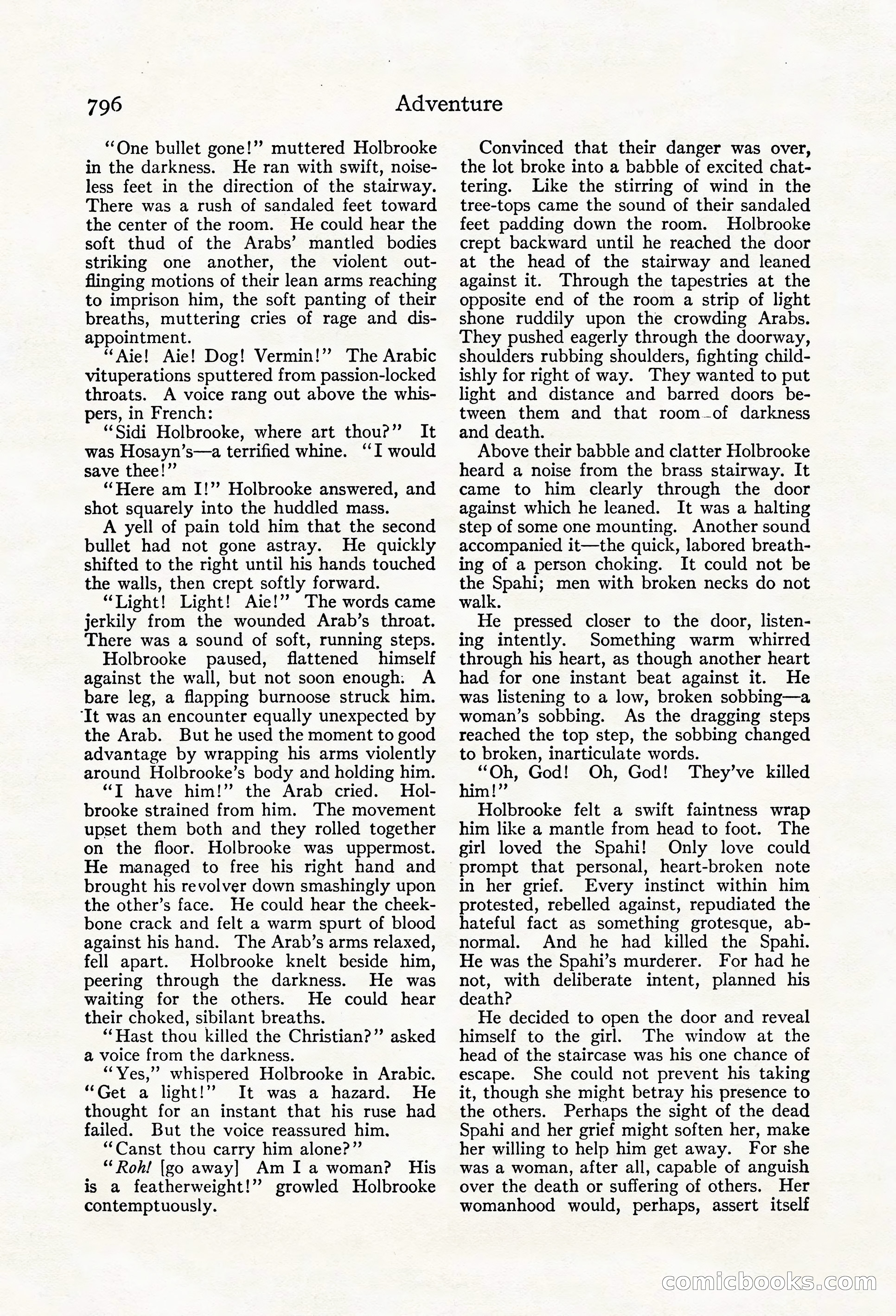
A restored page from Pulp Fiction, 1911. Page through the whole issue in the reader above.
📄 Transcribed text from this page (OCR, searchable)
Machine-transcribed from the original scan — historical spelling and the odd misread are preserved.
796 “One bullet gone!’’ muttered Holbrooke in the darkness. He ran with swift, noise- less feet in the direction of the stairway. There was a rush of sandaled feet toward the center of the room. He could hear the soft thud of the Arabs’ mantled bodies striking one another, the violent out- flinging motions of their lean arms reaching to imprison him, the soft panting of their breaths, muttering cries of rage and dis- appointment. ‘“‘Aie! Aie! Dog! Vermin!” The Arabic vituperations sputtered from passion-locked throats. A voice rang out above the whis- pers, in French: ‘Sidi Holbrooke, where art thou?” It was Hosayn’s—a terrified whine. ‘I would save thee!”’ ‘Here am I!”? Holbrooke answered, and shot squarely into the huddled mass. A yell of pain told him that the second bullet had not gone astray. He quickly shifted to the right until his hands touched the walls, then crept softly forward. “Light! Light! Aie!’”? The words came jerkily from the wounded Arab’s throat. There was a sound of soft, running steps. Holbrooke paused, flattened himself against the wall, but not soon enough. A bare leg, a flapping burnoose struck him. ‘It was an encounter equally unexpected by the Arab. But he used the moment to good advantage by wrapping his arms violently around Holbrooke’s body and holding him. “T have him!” the Arab cried. Hol- brooke strained from him. The movement upset them both and they rolled together on the floor. Holbrooke was uppermost. He managed to free his right hand and brought his revolver down smashingly upon the other’s face. He could hear the cheek- bone crack and felt a warm spurt of blood against his hand. The Arab’s arms relaxed, fell apart. Holbrooke knelt beside him, peering through the darkness. He was waiting for the others. He could hear their choked, sibilant breaths. “Hast thou killed the Christian?” asked a voice from the darkness. *“Yes,”’ whispered Holbrooke in Arabic. “Get a light!” It was a hazard. He thought for an instant that his ruse had failed. But the voice reassured him. ‘“‘Canst thou carry him alone?” “Roh! [go away] Am Ia woman? His is a featherweight!” growled Holbrooke contemptuously. Adventure Convinced that their danger was over, the lot broke into a babble of excited chat- tering. Like the stirring of wind in the tree-tops came the sound of their sandaled feet padding down the room. Holbrooke crept backward until he reached the door at the head of the stairway and leaned against it. Through the tapestries at the opposite end of the room a strip of light shone ruddily upon the crowding Arabs. They pushed eagerly through the doorway, shoulders rubbing shoulders, fighting child- ishly for right of way. They wanted to put light and distance and barred doors be- tween them and that room—of darkness and death. Above their babble and clatter Holbrooke heard a noise from the brass stairway. It came to him clearly through the door against which he leaned. It was a halting step of some one mounting. Another sound accompanied it—the quick, labored breath- ing of a person choking. It could not be the Spahi; men with broken necks do not walk. He pressed closer to the door, listen- ing intently. Something warm whirred through his heart, as though another heart had for one instant beat against it. He was listening to a low, broken sobbing—a woman’s sobbing. As the dragging steps reached the top step, the sobbing changed to broken, inarticulate words. “Oh, God! Oh, God! They’ve killed him!” Holbrooke felt a swift faintness wrap him like a mantle from head to foot. The girl loved the Spahi! Only love could prompt that personal, heart-broken note in her grief. Every instinct within him protested, rebelled against, repudiated the > hateful fact as something grotesque, ab- normal. And he had killed the Spahi. He was the Spahi’s murderer. For had he not, with deliberate intent, planned his death? He decided to open the door and reveal himself to the girl. The window at the head of the staircase was his one chance of escape. She could not prevent his taking it, though she might betray his presence to the others. Perhaps the sight of the dead Spahi and her grief might soften her, make her willing to help him get away. For she was a woman, after all, capable of anguish over the death or suffering of others. Her womanhood would, perhaps, assert itself cComiclbook CO