
Pulp Fiction, 1911 · page 7 of 196
Adventure Magazine Cover — page 7: what you’re looking at
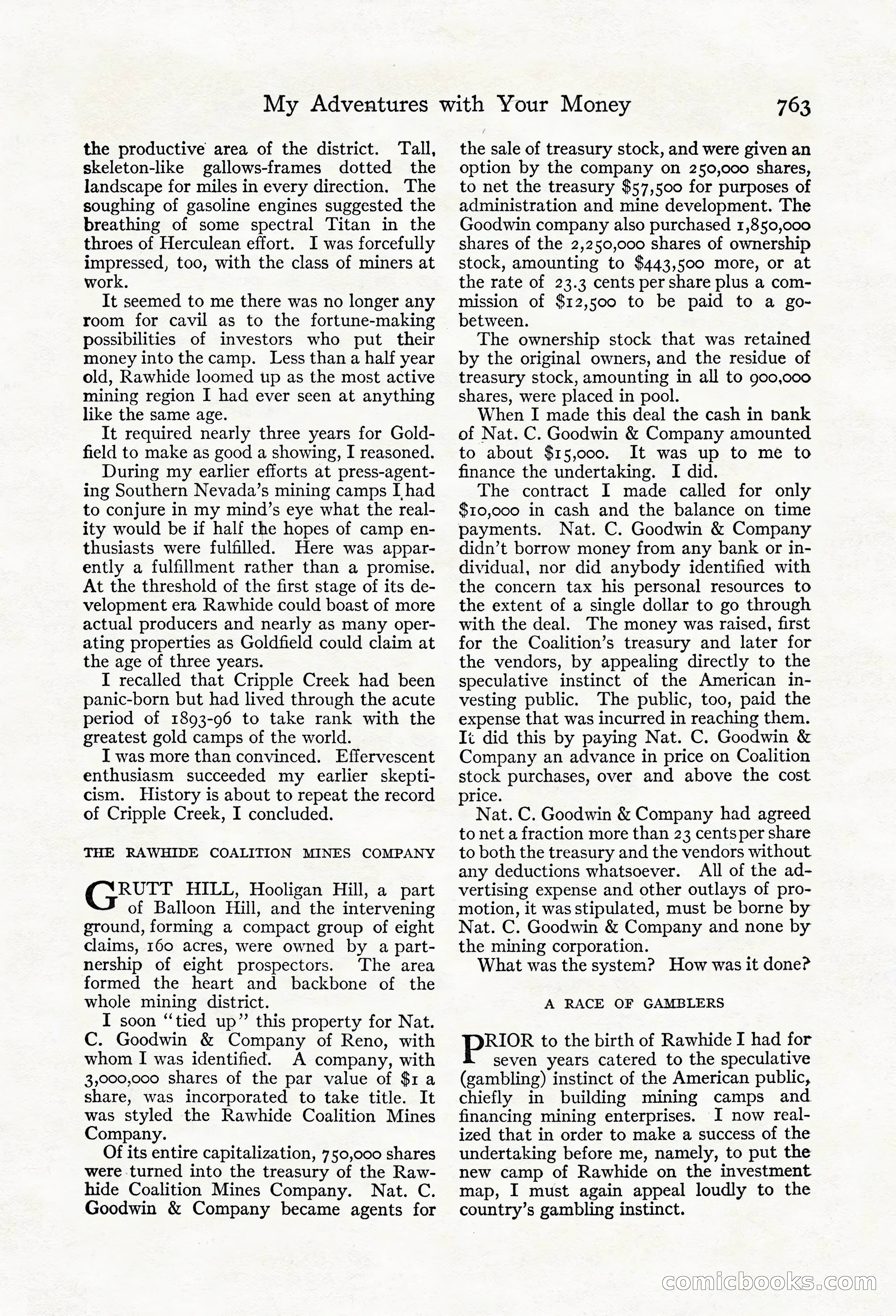
A restored page from Pulp Fiction, 1911. Page through the whole issue in the reader above.
📄 Transcribed text from this page (OCR, searchable)
Machine-transcribed from the original scan — historical spelling and the odd misread are preserved.
My Adventures with Your Money the productive area of the district. Tall, skeleton-like gallows-frames dotted the landscape for miles in every direction. The soughing of gasoline engines suggested the breathing of some spectral Titan in the throes of Herculean effort. I was forcefully impressed, too, with the class of miners at work. It seemed to me there was no longer any room for cavil as to the fortune-making possibilities of investors who put their money into the camp. Less than a half year old, Rawhide loomed up as the most active mining region I had ever seen at anything like the same age. It required nearly three years for Gold- field to make as good a showing, I reasoned. During my earlier efforts at press-agent- ing Southern Nevada’s mining camps I had to conjure in my mind’s eye what the real- ity would be if half the hopes of camp en- thusiasts were fulfilled. Here was appar- ently a fulfillment rather than a promise. At the threshold of the first stage of its de- velopment era Rawhide could boast of more actual producers and nearly as many oper- ating properties as Goldfield could claim at the age of three years. I recalled that Cripple Creek had been panic-born but had lived through the acute period of 1893-96 to take rank with the greatest gold camps of the world. I was more than convinced. Effervescent enthusiasm succeeded my earlier skepti- cism. History is about to repeat the record of Cripple Creek, I concluded. THE RAWHIDE COALITION MINES COMPANY Ot HILL, Hooligan Hill, a part of Balloon Hill, and the intervening ground, forming a compact group of eight claims, 160 acres, were owned by a part- nership of eight prospectors. The area formed the heart and backbone of the whole mining district. I soon “tied up” this property for Nat. C. Goodwin & Company of Reno, with whom I was identified. A company, with 3,000,000 shares of the par value of $1 a share, was incorporated to take title. It was styled the Rawhide Coalition Mines Company. Of its entire capitalization, 750,000 shares were turned into the treasury of the Raw- hide Coalition Mines Company. Nat. C. Goodwin & Company became agents for 763 the sale of treasury stock, and were given an option by the company on 250,000 shares, to net the treasury $57,500 for purposes of administration and mine development. The Goodwin company also purchased 1,850,000 shares of the 2,250,000 shares of ownership stock, amounting to $443,500 more, or at the rate of 23.3 cents per share plus a com- mission of $12,500 to be paid to a go- between. The ownership stock that was retained by the original owners, and the residue of treasury stock, amounting in all to go0,000 shares, were placed in pool. When I made this deal the cash in bank of Nat. C. Goodwin & Company amounted to about $15,000. It was up to me to finance the undertaking. I did. The contract I made called for only $10,000 in cash and the balance on time payments. Nat. C. Goodwin & Company didn’t borrow money from any bank or in- dividual, nor did anybody identified with the concern tax his personal resources to the extent of a single dollar to go through with the deal. The money was raised, first for the Coalition’s treasury and later for the vendors, by appealing directly to the speculative instinct of the American in- vesting public. The public, too, paid the expense that was incurred in reaching them. Tt did this by paying Nat. C. Goodwin & Company an advance in price on Coalition stock purchases, over and above the cost price. Nat. C. Goodwin & Company had agreed to net a fraction more than 23 centsper share to both the treasury and the vendors without any deductions whatsoever. All of the ad- vertising expense and other outlays of pro- motion, it was stipulated, must be borne by Nat. C. Goodwin & Company and none by the mining corporation. What was the system? How was it done? A RACE OF GAMBLERS RIOR to the birth of Rawhide I had for seven years catered to the speculative (gambling) instinct of the American public, chiefly in building mining camps and financing mining enterprises. I now real- ized that in order to make a success of the undertaking before me, namely, to put the new camp of Rawhide on the investment map, I must again appeal loudly to the country’s gambling instinct. C© MICLOOOKS CO