
Pulp Fiction, 1911 · page 78 of 196
Adventure Magazine Cover — page 78: what you’re looking at
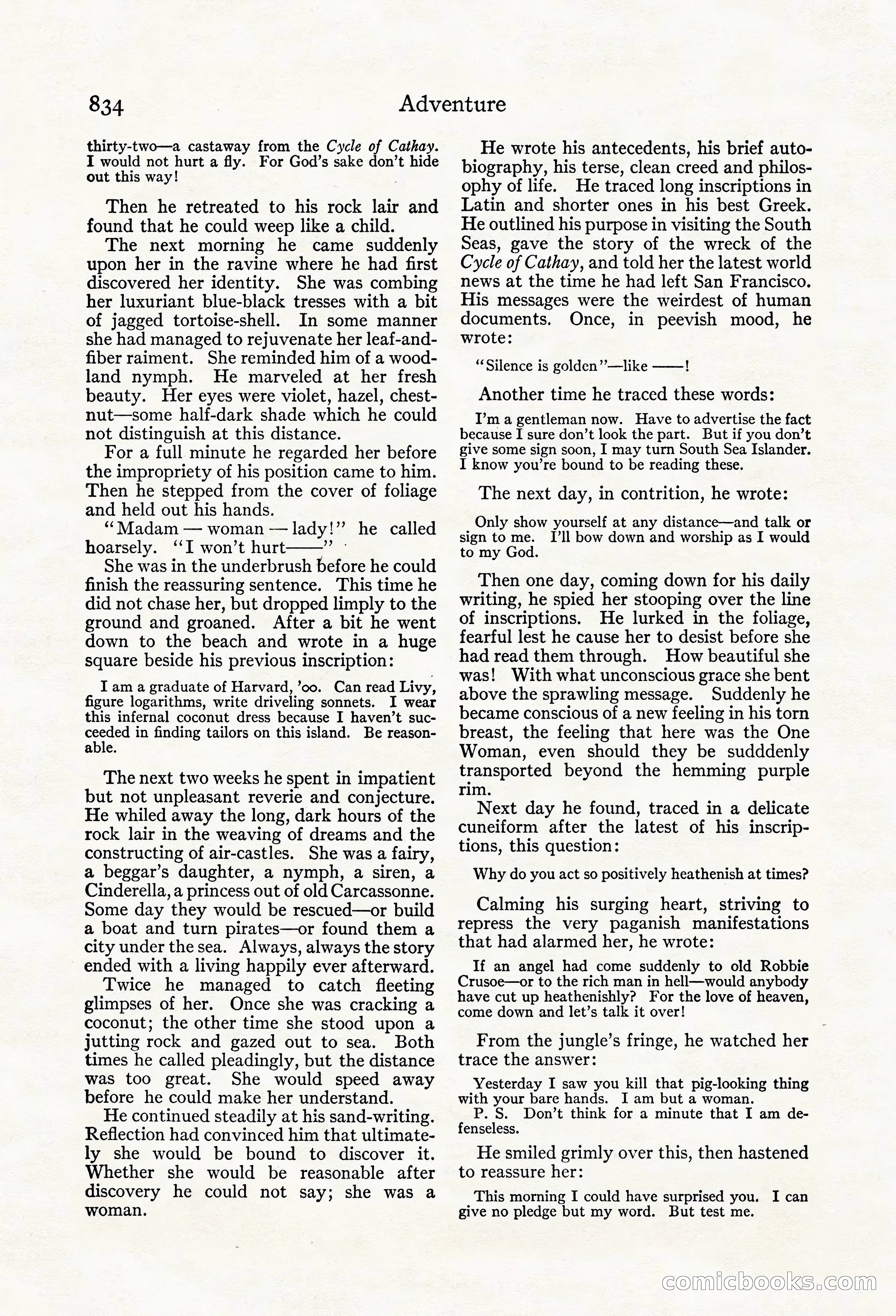
A restored page from Pulp Fiction, 1911. Page through the whole issue in the reader above.
📄 Transcribed text from this page (OCR, searchable)
Machine-transcribed from the original scan — historical spelling and the odd misread are preserved.
834 thirty-two—a castaway from the Cycle of Cathay. I would not hurt a fly. For God’s sake don’t hide out this way! Then he retreated to his rock lair and found that he could weep like a child. The next morning he came suddenly upon her in the ravine where he had first discovered her identity. She was combing her luxuriant blue-black tresses with a bit of jagged tortoise-shell. In some manner she had managed to rejuvenate her leaf-and- fiber raiment. She reminded him of a wood- land nymph. He marveled at her fresh beauty. Her eyes were violet, hazel, chest- nut—some half-dark shade which he could not distinguish at this distance. For a full minute he regarded her before the impropriety of his position came to him. Then he stepped from the cover of foliage and held out his hands. ‘‘Madam — woman — lady!”’ he called hoarsely. ‘‘I won’t hurt coe She was in the underbrush before he could finish the reassuring sentence. This time he did not chase her, but dropped limply to the ground and groaned. After a bit he went down to the beach and wrote in a huge square beside his previous inscription: I am a graduate of Harvard, ’oo. Can read Livy, figure logarithms, write driveling sonnets. I wear this infernal coconut dress because I haven’t suc- coeds in finding tailors on this island. Be reason- able. The next two weeks he spent in impatient but not unpleasant reverie and conjecture. He whiled away the long, dark hours of the rock lair in the weaving of dreams and the constructing of air-castles. She was a fairy, a beggar’s daughter, a nymph, a siren, a Cinderella, a princess out of old Carcassonne. Some day they would be rescued—or build a boat and turn pirates—or found them a city under thesea. Always, always the story ended with a living happily ever afterward. Twice he managed to catch fleeting glimpses of her. Once she was cracking a coconut; the other time she stood upon a jutting rock and gazed out to sea. Both times he called pleadingly, but the distance was too great. She would speed away before he could make her understand. He continued steadily at his sand-writing. Reflection had convinced him that ultimate- ly she would be bound to discover it. Whether she would be reasonable after discovery he could not say; she was a woman. Adventure He wrote his antecedents, his brief auto- biography, his terse, clean creed and philos- ophy of life. He traced long inscriptions in Latin and shorter ones in his best Greek. He outlined his purpose in visiting the South Seas, gave the story of the wreck of the Cycle of Cathay, and told her the latest world news at the time he had left San Francisco. His messages were the weirdest of human documents. Once, in peevish mood, he wrote: “Silence is golden’’—like ——! Another time he traced these words: I’m a gentleman now. Have to advertise the fact because I sure don’t look the part. But if you don’t give some sign soon, I may turn South Sea Islander. I know you’re bound to be reading these. The next day, in contrition, he wrote: Only show yourself at any distance—and talk or sign to me. I’ll bow down and worship as I would to my God. Then one day, coming down for his daily writing, he spied her stooping over the line of inscriptions. He lurked in the foliage, fearful lest he cause her to desist before she had read them through. How beautiful she was! With what unconscious grace she bent above the sprawling message. Suddenly he became conscious of a new feeling in his torn breast, the feeling that here was the One Woman, even should they be sudddenly transported beyond the hemming purple rim. Next day he found, traced in a delicate cuneiform after the latest of his inscrip- tions, this question: Why do you act so positively heathenish at times? Calming his surging heart, striving to repress the very paganish manifestations that had alarmed her, he wrote: If an angel had come suddenly to old Robbie Crusoe—or to the rich man in hell—would anybody have cut up heathenishly? For the love of heaven, come down and let’s talk it over! From the jungle’s fringe, he watched her trace the answer: Yesterday I saw you kill that pig-looking thing with your bare hands. I am but a woman. P. S. Don’t think for a minute that I am de- fenseless. He smiled grimly over this, then hastened to reassure her: This morning I could have surprised you. I can give no pledge but my word. But test me. MICLOOKS