
Pulp Fiction, 1911 · page 128 of 196
Adventure Magazine Cover, October 1911 — page 128: what you’re looking at
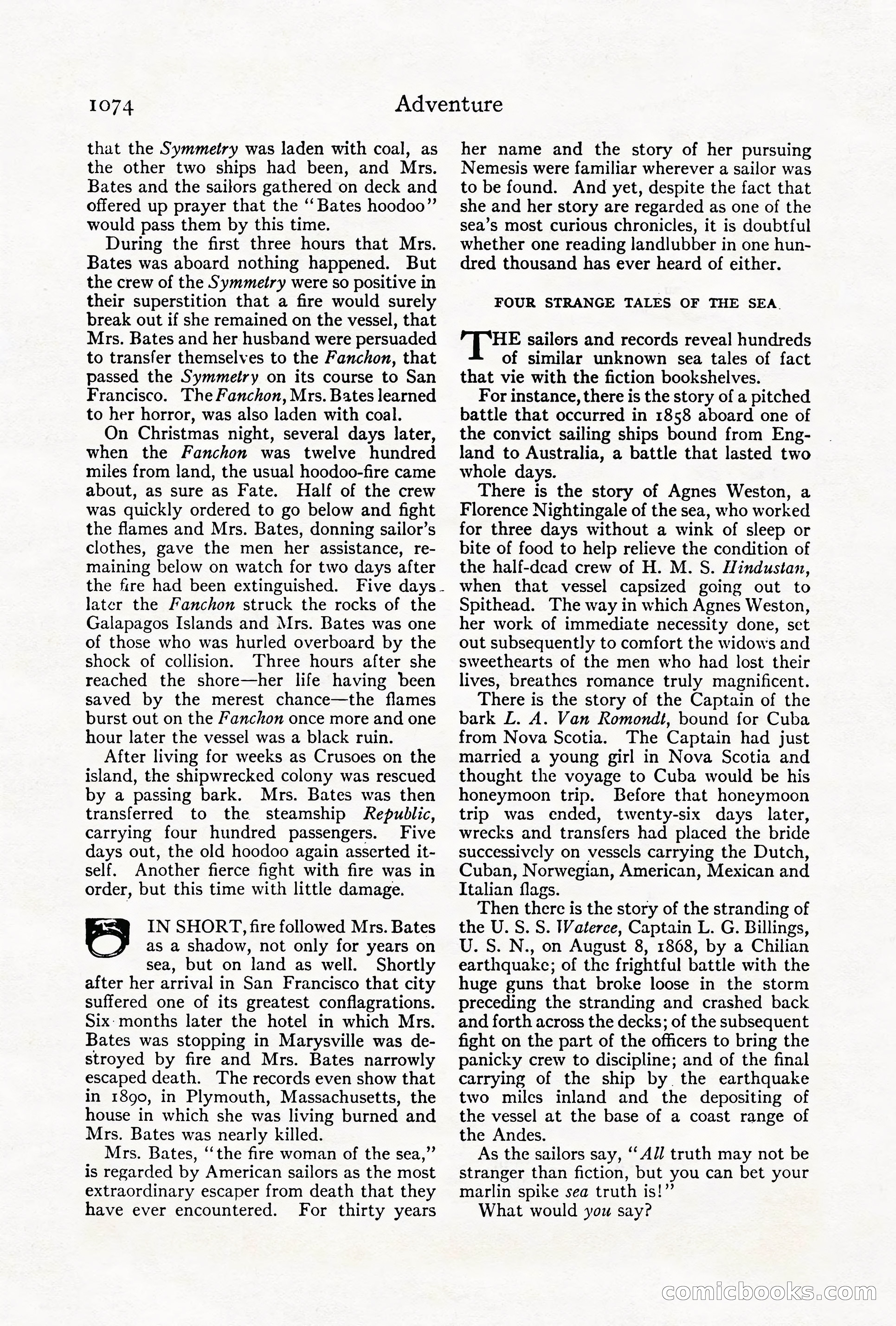
A restored page from Pulp Fiction, 1911. Page through the whole issue in the reader above.
📄 Transcribed text from this page (OCR, searchable)
Machine-transcribed from the original scan — historical spelling and the odd misread are preserved.
1074 that the Symmetry was laden with coal, as the other two ships had been, and Mrs. Bates and the sailors gathered on deck and offered up prayer that the “‘ Bates hoodoo”’ would pass them by this time. During the first three hours that Mrs. Bates was aboard nothing happened. But the crew of the Symmetry were so positive in their superstition that a fire would surely break out if she remained on the vessel, that Mrs. Bates and her husband were persuaded to transfer themselves to the Fanchon, that passed the Symmetry on its course to San Francisco. The Fanchon, Mrs. Bates learned to her horror, was also laden with coal. On Christmas night, several days later, when the Fanchon was twelve hundred miles from land, the usual hoodoo-fire came about, as sure as Fate. Half of the crew was quickly ordered to go below and fight the flames and Mrs. Bates, donning sailor’s clothes, gave the men her assistance, re- maining below on watch for two days after the fire had been extinguished. Five days. later the Fanchon struck the rocks of the Galapagos Islands and Mrs. Bates was one of those who was hurled overboard by the shock of collision. Three hours after she reached the shore—her life having been saved by the merest chance—the flames burst out on the Fanchon once more and one hour later the vessel was a black ruin. After living for weeks as Crusoes on the island, the shipwrecked colony was rescued by a passing bark. Mrs. Bates was then transferred to the steamship Republic, carrying four hundred passengers. Five days out, the old hoodoo again asserted it- self. Another fierce fight with fire was in order, but this time with little damage. IN SHORT, fire followed Mrs. Bates as a shadow, not only for years on sea, but on land as well. Shortly after her arrival in San Francisco that city suffered one of its greatest conflagrations. Six: months later the hotel in which Mrs. Bates was stopping in Marysville was de- stroyed by fire and Mrs. Bates narrowly escaped death. The records even show that in 1890, in Plymouth, Massachusetts, the house in which she was living burned and Mrs. Bates was nearly killed. Mrs. Bates, ‘‘the fire woman of the sea,” is regarded by American sailors as the most extraordinary escaper from death that they have ever encountered. For thirty years Adventure her name and the story of her pursuing Nemesis were familiar wherever a sailor was to be found. And yet, despite the fact that she and her story are regarded as one of the sea’s most curious chronicles, it is doubtful whether one reading landlubber in one hun- dred thousand has ever heard of either. FOUR STRANGE TALES OF THE SEA. HE sailors and records reveal hundreds of similar unknown sea tales of fact that vie with the fiction bookshelves. For instance, there is the story of a pitched battle that occurred in 1858 aboard one of the convict sailing ships bound from Eng- land to Australia, a battle that lasted two whole days. There is the story of Agnes Weston, a Florence Nightingale of the sea, who worked for three days without a wink of sleep or bite of food to help relieve the condition of the half-dead crew of H. M. S. Hindustan, when that vessel capsized going out to Spithead. The way in which Agnes Weston, her work of immediate necessity done, set out subsequently to comfort the widows and sweethearts of the men who had lost their lives, breathes romance truly magnificent. There is the story of the Captain of the bark L. A. Van Romondt, bound for Cuba from Nova Scotia. The Captain had just married a young girl in Nova Scotia and thought the voyage to Cuba would be his honeymoon trip. Before that honeymoon trip was ended, twenty-six days later, wrecks and transfers had placed the bride successively on vessels carrying the Dutch, Cuban, Norwegian, American, Mexican and Italian flags. Then there is the story of the stranding of the U.S. S. Waterce, Captain L. G. Billings, U. S. N., on August 8, 1868, by a Chilian earthquake; of the frightful battle with the huge guns that broke loose in the storm preceding the stranding and crashed back and forth across the decks; of the subsequent fight on the part of the officers to bring the panicky crew to discipline; and of the final carrying of the ship by the earthquake two miles inland and the depositing of the vessel at the base of a coast range of the Andes. As the sailors say, ‘‘ All truth may not be stranger than fiction, but you can bet your marlin spike sea truth is!” What would you say? CO MICLOOKS CO