
Pulp Fiction, 1911 · page 154 of 196
Adventure Magazine Cover, October 1911 — page 154: what you’re looking at
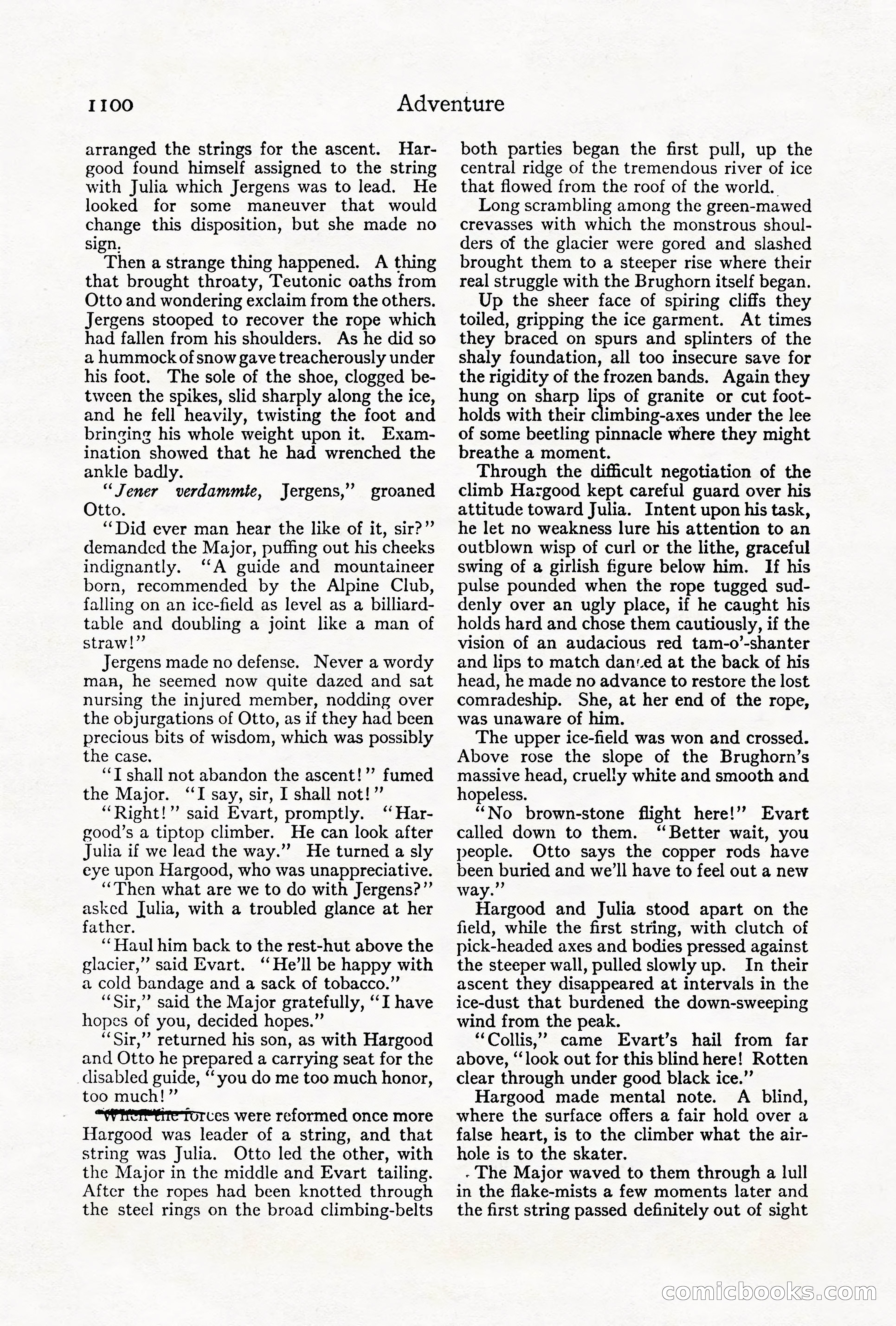
A restored page from Pulp Fiction, 1911. Page through the whole issue in the reader above.
📄 Transcribed text from this page (OCR, searchable)
Machine-transcribed from the original scan — historical spelling and the odd misread are preserved.
II0O arranged the strings for the ascent. Har- good found himself assigned to the string with Julia which Jergens was to lead. He looked for some maneuver that would change this disposition, but she made no sign. Then a strange thing happened. A thing that brought throaty, Teutonic oaths from Otto and wondering exclaim from the others. Jergens stooped to recover the rope which had fallen from his shoulders. As he did so a hummock of snow gave treacherously under his foot. The sole of the shoe, clogged be- tween the spikes, slid sharply along the ice, and he fell heavily, twisting the foot and bringing his whole weight upon it. Exam- ination showed that he had wrenched the ankle badly. “Tener verdammie, Otto. ‘Did ever man hear the like of it, sir?” demandcd the Major, puffing out his cheeks indignantly. “A guide and mountaineer born, recommended by the Alpine Club, falling on an ice-field as level as a billiard- table and doubling a joint like a man of straw!” Jergens made no defense. Never a wordy man, he seemed now quite dazed and sat nursing the injured member, nodding over the objurgations of Otto, as if they had been precious bits of wisdom, which was possibly the case. ‘“‘T shall not abandon the ascent!”’ fumed the Major. ‘‘I say, sir, I shall not!” “Right!” said Evart, promptly. “ Har- good’s a tiptop climber. He can look after Julia if we lead the way.”’ He turned a sly eye upon Hargood, who was unappreciative. ‘““Then what are we to do with Jergens?”’ asked Julia, with a troubled glance at her father. ‘‘ Haul him back to the rest-hut above the glacier,” said Evart. ‘“‘He’ll be happy with a cold bandage and a sack of tobacco.” “Sir,” said the Major gratefully, “I have hopes of you, decided hopes.”’ “Sir,” returned his son, as with Hargood and Otto he prepared a carrying seat for the disabled guide, “‘you do me too much honor, too much!” wiremtiteTorces were reformed once more Hargood was leader of a string, and that string was Julia. Otto led the other, with the Major in the middle and Evart tailing. After the ropes had been knotted through the steel rings on the broad climbing-belts Jergens,” groaned Adventure both parties began the first pull, up the central ridge of the tremendous river of ice that flowed from the roof of the world. Long scrambling among the green-mawed crevasses with which the monstrous shoul- ders of the glacier were gored and slashed brought them to a steeper rise where their real struggle with the Brughorn itself began. Up the sheer face of spiring cliffs they toiled, gripping the ice garment. At times they braced on spurs and splinters of the shaly foundation, all too insecure save for the rigidity of the frozen bands. Again they hung on sharp lips of granite or cut foot- holds with their climbing-axes under the lee of some beetling pinnacle where they might breathe a moment. Through the difficult negotiation of the climb Hargood kept careful guard over his attitude toward Julia. Intent upon his task, he let no weakness lure his attention to an outblown wisp of curl or the lithe, graceful swing of a girlish figure below him. If his pulse pounded when the rope tugged sud- denly over an ugly place, if he caught his holds hard and chose them cautiously, if the vision of an audacious red tam-o’-shanter and lips to match dan:ed at the back of his head, he made no advance to restore the lost comradeship. She, at her end of the rope, was unaware of him. The upper ice-field was won and crossed. Above rose the slope of the Brughorn’s massive head, cruelly white and smooth and hopeless. “No brown-stone flight here!’ Evart called down to them. ‘Better wait, you people. Otto says the copper rods have been buried and we’ll have to feel out a new way.” Hargood and Julia stood apart on the field, while the first string, with clutch of pick-headed axes and bodies pressed against the steeper wall, pulled slowly up. In their ascent they disappeared at intervals in the ice-dust that burdened the down-sweeping wind from the peak. “Collis,” came Evart’s hail from far above, ‘‘look out for this blind here! Rotten clear through under good black ice.”’ Hargood made mental note. A blind, where the surface offers a fair hold over a false heart, is to the climber what the air- hole is to the skater. - The Major waved to them through a lull in the flake-mists a few moments later and the first string passed definitely out of sight COmiclbook (C©