
Pulp Fiction, 1911 · page 163 of 196
Adventure Magazine Cover, October 1911 — page 163: what you’re looking at
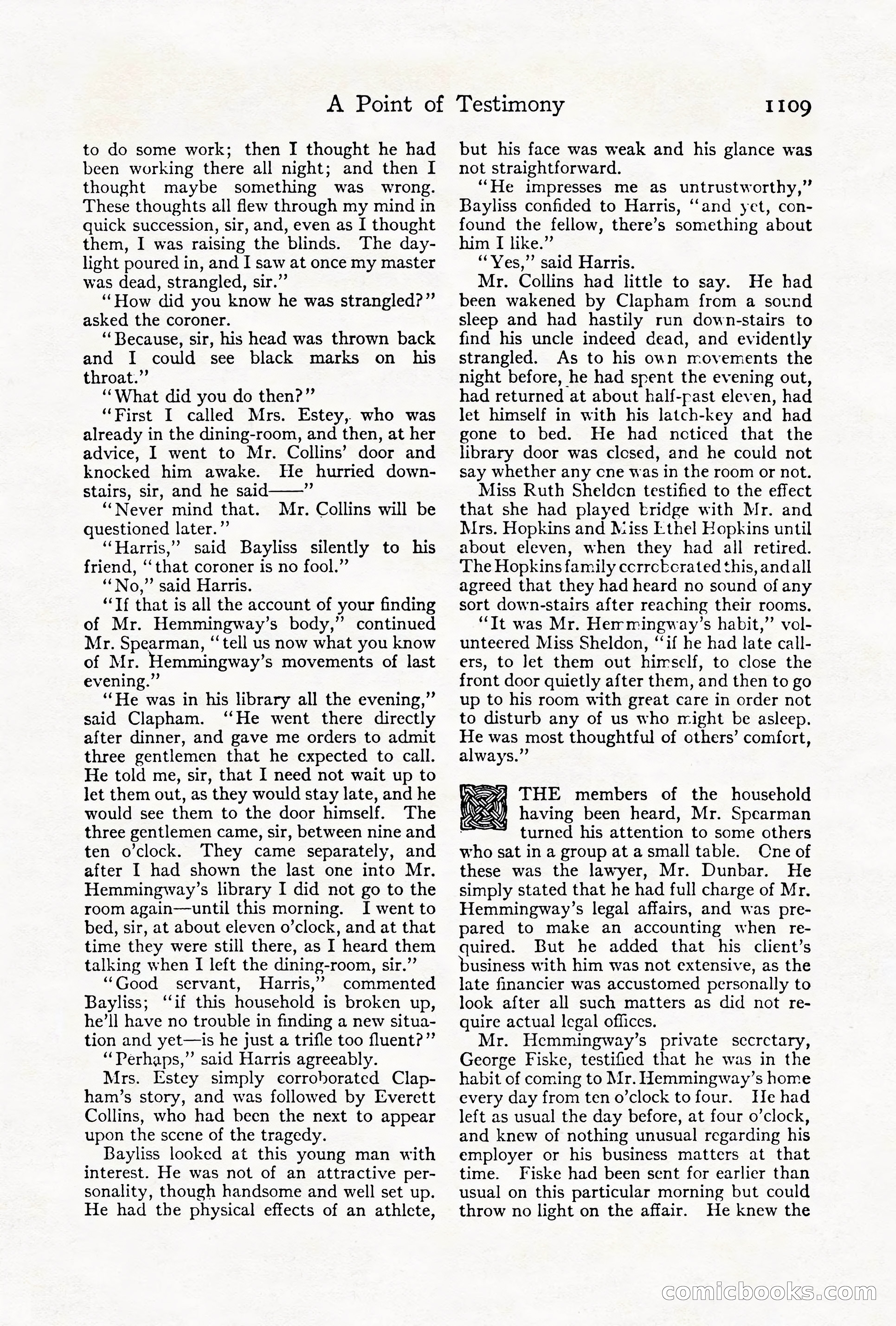
A restored page from Pulp Fiction, 1911. Page through the whole issue in the reader above.
📄 Transcribed text from this page (OCR, searchable)
Machine-transcribed from the original scan — historical spelling and the odd misread are preserved.
A Point of Testimony to do some work; then I thought he had been working there all night; and then I thought maybe something was wrong. These thoughts all flew through my mind in quick succession, sir, and, even as I thought them, I was raising the blinds. The day- light poured in, and I saw at once my master was dead, strangled, sir.”’ ‘How did you know he was strangled?” asked the coroner. “‘Because, sir, his head was thrown back and I could see black marks on his throat.” ‘““What did you do then?”’ “First I called Mrs. Estey, who was already in the dining-room, and then, at her advice, I went to Mr. Collins’ door and knocked him awake. He hurried down- stairs, sir, and he said——”’ “‘Never mind that. Mr. Collins will be questioned later.”’ “Harris,” said Bayliss silently to his friend, ‘‘that coroner is no fool.” ‘“No,” said Harris. “If that is all the account of your finding of Mr. Hemmingway’s body,” continued Mr. Spearman, “tell us now what you know of Mr. Hemmingway’s movements of last evening.” ‘He was in his library all the evening,” said Clapham. ‘“‘He went there directly after dinner, and gave me orders to admit three gentlemen that he expected to call. He told me, sir, that I need not wait up to let them out, as they would stay late, and he would see them to the door himself. The three gentlemen came, sir, between nine and ten o'clock. They came separately, and after I had shown the last one into Mr. Hemmingway’s library I did not go to the room again—until this morning. I went to bed, sir, at about eleven o’clock, and at that time they were still there, as I heard them talking when I left the dining-room, sir.”’ “Good servant, Harris,’ commented Bayliss; ‘‘if this household is broken up, he’ll have no trouble in finding a new situa- tion and yet—is he just a trifle too fluent?”’ “Perhaps,” said Harris agreeably. Mrs. Estey simply corroborated Clap- ham’s story, and was followed by Everett Collins, who had been the next to appear upon the scene of the tragedy. Bayliss looked at this young man with interest. He was not of an attractive per- sonality, though handsome and well set up. He had the physical effects of an athlete, 1109 but his face was weak and his glance was not straightforward. “He impresses me as untrustworthy,” Bayliss confided to Harris, ‘‘and yet, con- found the fellow, there’s something about him I like.” ““Yes,’’ said Harris. Mr. Collins had little to say. He had been wakened by Clapham from a sound sleep and had hastily run down-stairs to find his uncle indeed dead, and evidently strangled. As to his own movements the night before, he had spent the evening out, had returned at about half-past eleven, had let himself in with his latch-key and had gone to bed. He had noticed that the library door was closed, and he could not say whether any cne was in the room or not. Miss Ruth Sheldon testified to the effect that she had played bridge with Mr. and Mrs. Hopkins and Miss Ethel Hopkins until about eleven, when they had all retired. The Hopkins family ccrrckcrated this, andall agreed that they had heard no sound of any sort down-stairs after reaching their rooms. “It was Mr. Hermingway’s habit,”’ vol- unteered Miss Sheldon, “if he had late call- ers, to let them out himself, to close the front door quietly after them, and then to go up to his room with great care in order not to disturb any of us who might be asleep. He was most thoughtful of others’ comfort, always.” 4 THE members of the household ) having been heard, Mr. Spearman turned his attention to some others who sat in a group at asmall table. Cne of these was the lawyer, Mr. Dunbar. He simply stated that he had full charge of Mr. Hemmingway’s legal affairs, and was pre- pared to make an accounting when re- quired. But he added that his client’s business with him was not extensive, as the late financier was accustomed personally to look after all such matters as did not re- quire actual legal offices. Mr. Hemmingway’s private sccrctary, George Fiske, testified that he was in the habit of coming to Mr. dHemmingway’s home every day from teno’clock tofour. He had left as usual the day before, at four o’clock, and knew of nothing unusual regarding his employer or his business matters at that time. Fiske had been sent for earlier than usual on this particular morning but could throw no light on the affair. He knew the C© MICLOOKS ©