
Pulp Fiction, 1911 · page 185 of 196
Adventure Magazine Cover, October 1911 — page 185: what you’re looking at
A restored page from Pulp Fiction, 1911. Page through the whole issue in the reader above.
📄 Transcribed text from this page (OCR, searchable)
Machine-transcribed from the original scan — historical spelling and the odd misread are preserved.
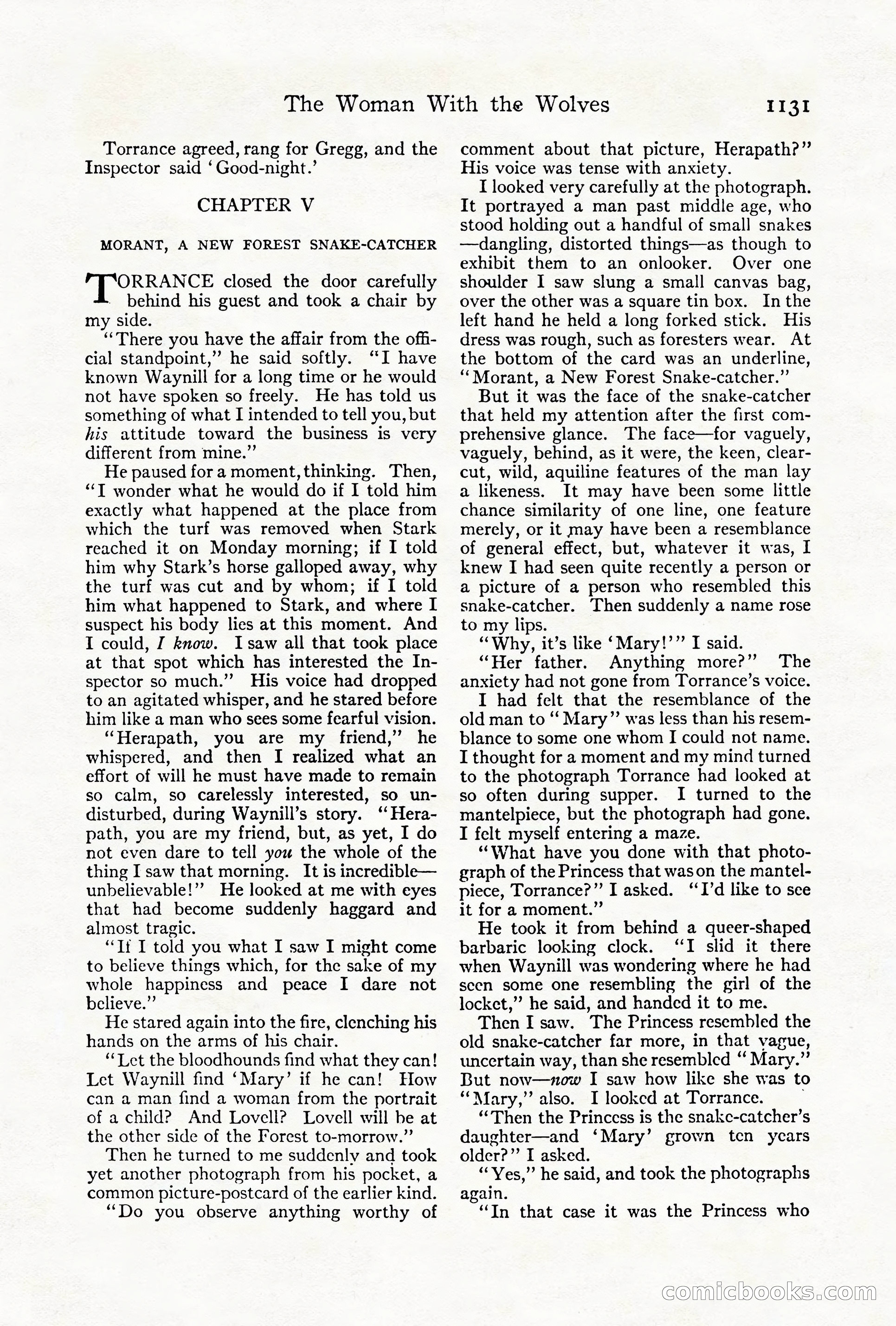
The Woman With the Wolves Torrance agreed, rang for Gregg, and the Inspector said ‘Good-night.’ CHAPTER V MORANT, A NEW FOREST SNAKE-CATCHER Toe closed the door carefully - behind his guest and took a chair by my side. “There you have the affair from the off- cial standpoint,” he said softly. “I have known Waynill for a long time or he would not have spoken so freely. He has told us something of what I intended to tell you, but his attitude toward the business is very different from mine.”’ He paused for a moment, thinking. Then, “‘T wonder what he would do if I told him exactly what happened at the place from which the turf was removed when Stark reached it on Monday morning; if I told him why Stark’s horse galloped away, why the turf was cut and by whom; if I told him what happened to Stark, and where I suspect his body lies at this moment. And I could, J know. Isaw all that took place at that spot which has interested the In- spector so much.”’ His voice had dropped to an agitated whisper, and he stared before him like a man who sees some fearful vision. “Herapath, you are my friend,” he whispered, and then I realized what an effort of will he must have made to remain so calm, so carelessly interested, so un- disturbed, during Waynill’s story. ‘ Hera- path, you are my friend, but, as yet, I do not even dare to tell you the whole of the thing I saw that morning. It is incredible— unbelievable!”” He looked at me with eyes that had become suddenly haggard and almost tragic. “Tt I told you what I saw I might come to believe things which, for the sake of my whole happiness and peace I dare not believe.” He stared again into the fire, clenching his hands on the arms of his chair. “Let the bloodhounds find what they can! Let Waynill find ‘Mary’ if he can! How can a man find a woman from the portrait of a child? And Lovell? Lovell will be at the other side of the Forest to-morrow.” Then he turned to me suddenly and took yet another photograph from his pocket, a common picture-postcard of the earlier kind. ‘‘Do you observe anything worthy of 1131 comment about that picture, Herapath?” His voice was tense with anxiety. I looked very carefully at the photograph. It portrayed a man past middle age, who stood holding out a handful of small snakes —dangling, distorted things—as though to exhibit them to an onlooker. Over one shoulder I saw slung a small canvas bag, over the other was a square tin box. Inthe left hand he held a long forked stick. His dress was rough, such as foresters wear. At the bottom of the card was an underline, ‘““Morant, a New Forest Snake-catcher.”’ But it was the face of the snake-catcher that held my attention after the first com- prehensive glance. The face—for vaguely, vaguely, behind, as it were, the keen, clear- cut, wild, aquiline features of the man lay a likeness. It may have been some little chance similarity of one line, one feature merely, or it may have been a resemblance of general effect, but, whatever it was, I knew I had seen quite recently a person or a picture of a person who resembled this snake-catcher. Then suddenly a name rose to my lips. ““Why, it’s like ‘Mary!’”’ I said. “Her father. Anything more?” The anxiety had not gone from Torrance’s voice. I had felt that the resemblance of the old man to ‘‘ Mary” was less than his resem- blance to some one whom I could not name. I thought for a moment and my mind turned to the photograph Torrance had looked at so often during supper. I turned to the mantelpiece, but the photograph had gone. I felt myself entering a maze. “What have you done with that photo- graph of the Princess that wason the mantel- piece, Torrance?” I asked. “I'd like to see it for a moment.” He took it from behind a queer-shaped barbaric looking clock. “I slid it there when Waynill was wondering where he had seen some one resembling the girl of the locket,” he said, and handed it to me. Then I saw. The Princess resembled the old snake-catcher far more, in that vague, uncertain way, than she resembled “ Mary.”’ But now—zow I saw how like she was to ‘Mary,’ also. I looked at Torrance. ; “Then the Princess is the snake-catcher’s daughter—and ‘Mary’ grown ten ycars older?” I asked. “Yes,” he said, and took the photographs again. “In that case it was the Princess who CO MICLOOKS C©