
Pulp Fiction, 1911 · page 44 of 196
Adventure Magazine Cover, October 1911 — page 44: what you’re looking at
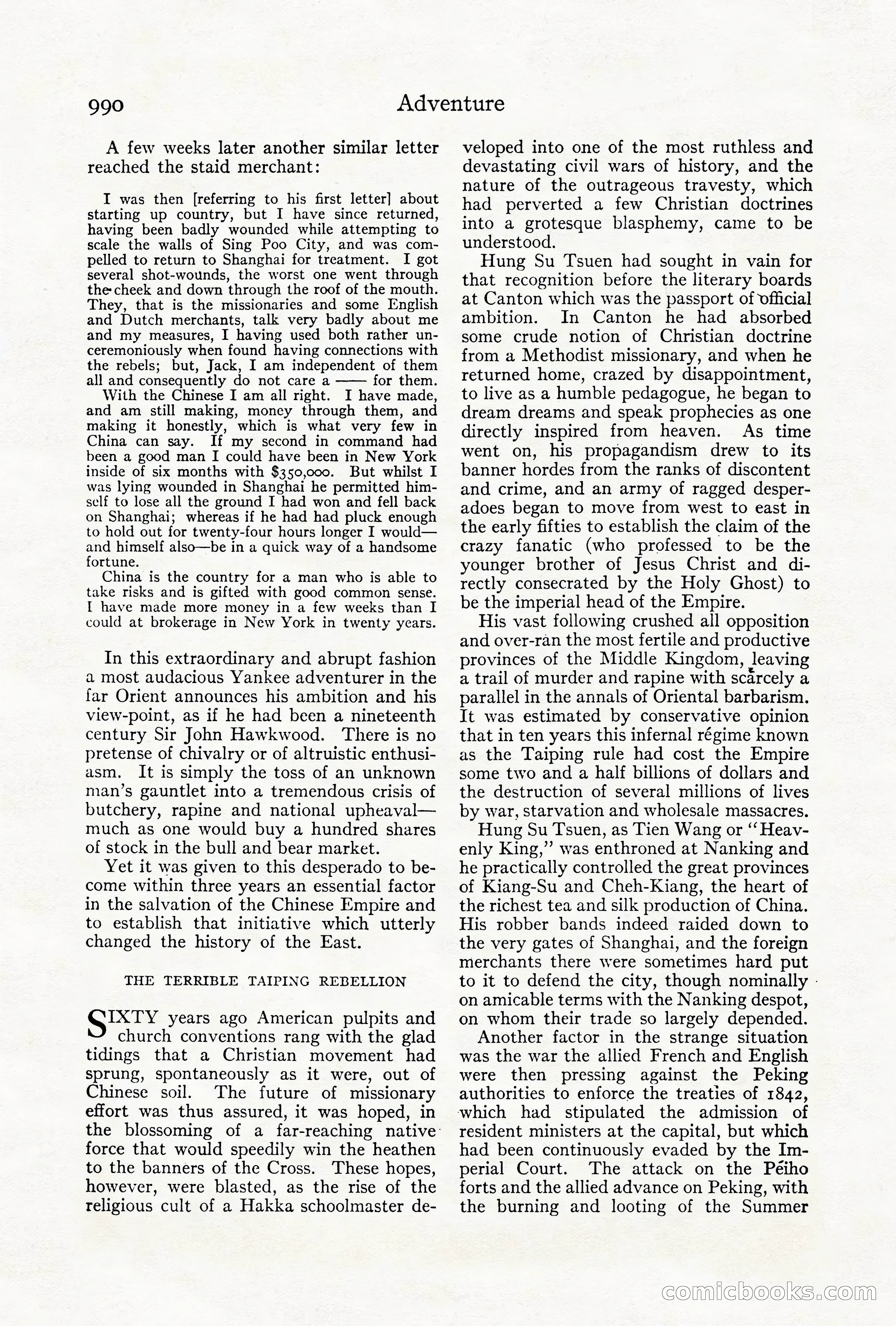
A restored page from Pulp Fiction, 1911. Page through the whole issue in the reader above.
📄 Transcribed text from this page (OCR, searchable)
Machine-transcribed from the original scan — historical spelling and the odd misread are preserved.
990 A few weeks later another similar letter reached the staid merchant: I was then [referring to his first letter] about starting up country, but I have since returned, having been badly wounded while attempting to scale the walls of Sing Poo City, and was com- pelled to return to Shanghai for treatment. I got several shot-wounds, the worst one went through the cheek and down through the roof of the mouth. They, that is the missionaries and some [English and Dutch merchants, talk very badly about me and my measures, I having used both rather un- ceremoniously when found having connections with the rebels; but, Jack, I am independent of them all and consequently do not care a for them. With the Chinese I am all right. I have made, and am still making, money through them, and making it honestly, which is what very few in China can say. If my second in command had been a good man I could have been in New York inside of six months with $350,000. But whilst I was lying wounded in Shanghai he permitted him- self to lose all the ground I had won and fell back on Shanghai; whereas if he had had pluck enough to hold out for twenty-four hours longer I would— and himself also—be in a quick way of a handsome fortune. China is the country for a man who is able to take risks and is gifted with good common sense. I have made more money in a few weeks than I could at brokerage in New York in twenty years. In this extraordinary and abrupt fashion a most audacious Yankee adventurer in the far Orient announces his ambition and his view-point, as if he had been a nineteenth century Sir John Hawkwood. There is no pretense of chivalry or of altruistic enthusi- asm. It is simply the toss of an unknown man’s gauntlet into a tremendous crisis of butchery, rapine and national upheaval— much as one would buy a hundred shares of stock in the bull and bear market. Yet it was given to this desperado to be- come within three years an essential factor in the salvation of the Chinese Empire and to establish that initiative which utterly changed the history of the East. THE TERRIBLE TAIPING REBELLION Si years ago American pulpits and church conventions rang with the glad tidings that a Christian movement had sprung, spontaneously as it were, out of Chinese soil. The future of missionary effort was thus assured, it was hoped, in the blossoming of a far-reaching native: force that would speedily win the heathen to the banners of the Cross. These hopes, however, were blasted, as the rise of the religious cult of a Hakka schoolmaster de- Adventure veloped into one of the most ruthless and devastating civil wars of history, and the nature of the outrageous travesty, which had perverted a few Christian doctrines into a grotesque blasphemy, came to be understood. Hung Su Tsuen had sought in vain for that recognition before the literary boards at Canton which was the passport of official ambition. In Canton he had absorbed some crude notion of Christian doctrine from a Methodist missionary, and when he returned home, crazed by disappointment, to live as a humble pedagogue, he began to dream dreams and speak prophecies as one directly inspired from heaven. As time went on, his propagandism drew to its banner hordes from the ranks of discontent and crime, and an army of ragged desper- adoes began to move from west to east in the early fifties to establish the claim of the crazy fanatic (who professed to be the younger brother of Jesus Christ and di- rectly consecrated by the Holy Ghost) to be the imperial head of the Empire. His vast following crushed all opposition and over-ran the most fertile and productive provinces of the Middle Kingdom, leaving a trail of murder and rapine with scarcely a parallel in the annals of Oriental barbarism. It was estimated by conservative opinion that in ten years this infernal régime known as the Taiping rule had cost the Empire some tio and a half billions of dollars and the destruction of several millions of lives by war, starvation and wholesale massacres. Hung Su Tsuen, as Tien Wang or ‘‘ Heav- enly King,’ was enthroned at Nanking and he practically controlled the great provinces of Kiang-Su and Cheh-Kiang, the heart of the richest tea and silk production of China. His robber bands indeed raided down to the very gates of Shanghai, and the foreign merchants there were sometimes hard put to it to defend the city, though nominally - on amicable terms with the Nanking despot, on whom their trade so largely depended. Another factor in the strange situation was the war the allied French and English were then pressing against the Peking authorities to enforce the treaties of 1842, which had stipulated the admission of resident ministers at the capital, but which had been continuously evaded by the Im- perial Court. The attack on the Péiho forts and the allied advance on Peking, with the burning and looting of the Summer MICLOOKS 5}