
Pulp Fiction, 1911 · page 47 of 196
Adventure Magazine Cover, October 1911 — page 47: what you’re looking at
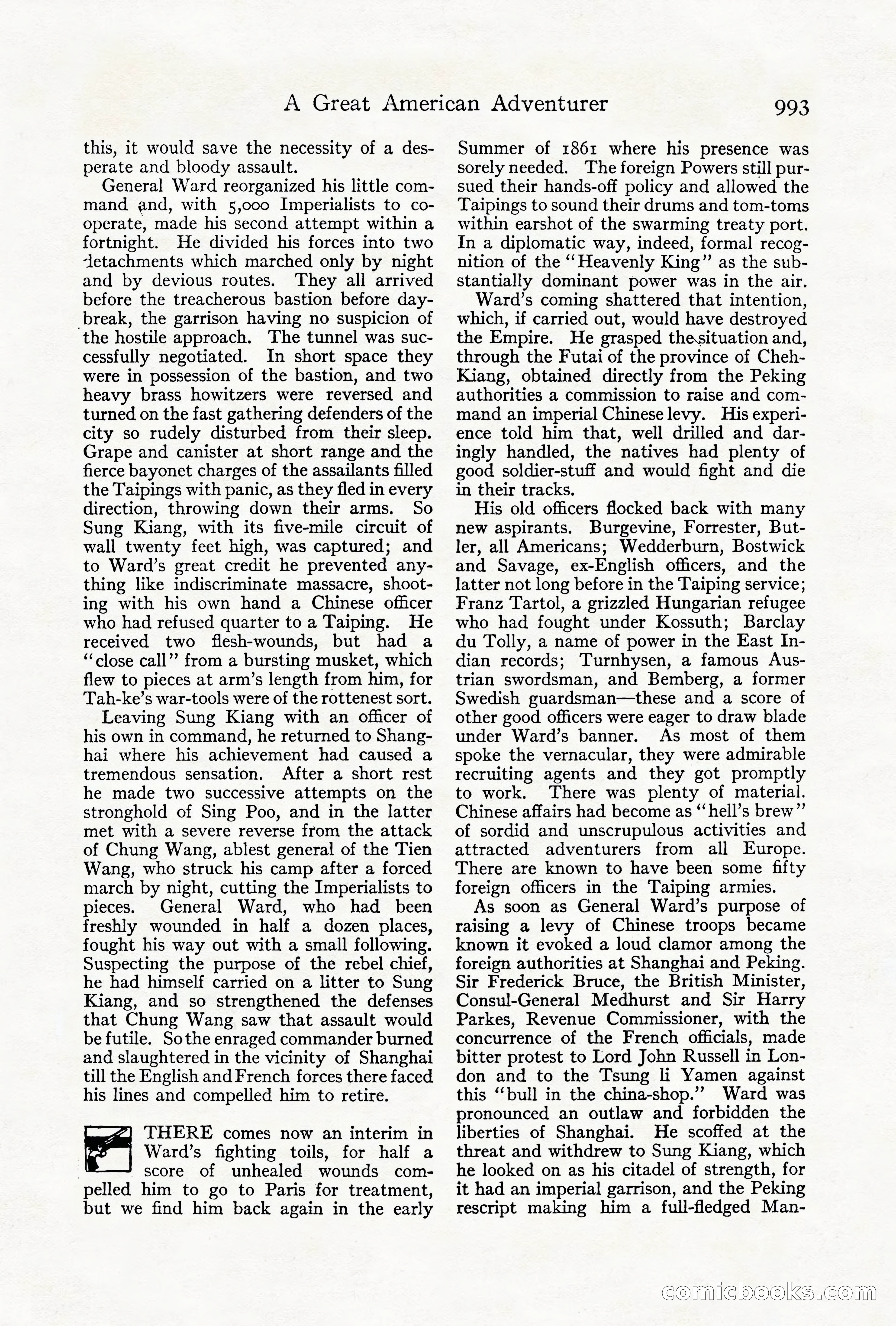
A restored page from Pulp Fiction, 1911. Page through the whole issue in the reader above.
📄 Transcribed text from this page (OCR, searchable)
Machine-transcribed from the original scan — historical spelling and the odd misread are preserved.
A Great American Adventurer this, it would save the necessity of a des- perate and bloody assault. General Ward reorganized his little com- mand and, with 5,000 Imperialists to co- operate, made his second attempt within a fortnight. He divided his forces into two ‘letachments which marched only by night and by devious routes. They all arrived before the treacherous bastion before day- break, the garrison having no suspicion of the hostile approach. The tunnel was suc- cessfully negotiated. In short space they were in possession of the bastion, and two heavy brass howitzers were reversed and turned on the fast gathering defenders of the city so rudely disturbed from their sleep. Grape and canister at short range and the fierce bayonet charges of the assailants filled the Taipings with panic, as they fled in every direction, throwing down their arms. So Sung Kiang, with its five-mile circuit of wall twenty feet high, was captured; and to Ward’s great credit he prevented any- thing like indiscriminate massacre, shoot- ing with his own hand a Chinese officer who had refused quarter to a Taiping. He received two flesh-wounds, but had a “close call”? from a bursting musket, which flew to pieces at arm’s length from him, for Tah-ke’s war-tools were of the rottenest sort. Leaving Sung Kiang with an officer of his own in command, he returned to Shang- hai where his achievement had caused a tremendous sensation. After a short rest he made two successive attempts on the stronghold of Sing Poo, and in the latter met with a severe reverse from the attack of Chung Wang, ablest general of the Tien Wang, who struck his camp after a forced march by night, cutting the Imperialists to pieces. General Ward, who had been freshly wounded in half a dozen places, fought his way out with a small following. Suspecting the purpose of the rebel chief, he had himself carried on a litter to Sung Kiang, and so strengthened the defenses that Chung Wang saw that assault would be futile. Sothe enraged commander burned and slaughtered in the vicinity of Shanghai till the English and French forces there faced his lines and compelled him to retire. Cie) LHERE comes now an interim in aa Ward’s fighting toils, for half a 4 ' score of unhealed wounds com- pelled him to go to Paris for treatment, but we find him back again in the early 993 Summer of 1861 where his presence was sorely needed. The foreign Powers still pur- sued their hands-off policy and allowed the Taipings to sound their drums and tom-toms within earshot of the swarming treaty port. In a diplomatic way, indeed, formal recog- nition of the “‘Heavenly King” as the sub- stantially dominant power was in the air. Ward’s coming shattered that intention, which, if carried out, would have destroyed the Empire. He grasped thesituation and, through the Futai of the province of Cheh- Kiang, obtained directly from the Peking authorities a commission to raise and com- mand an imperial Chinese levy. His experi- ence told him that, well drilled and dar- ingly handled, the natives had plenty of good soldier-stuff and would fight and die in their tracks. His old officers flocked back with many new aspirants. Burgevine, Forrester, But- ler, all Americans; Wedderburn, Bostwick and Savage, ex-English officers, and the latter not long before in the Taiping service; Franz Tartol, a grizzled Hungarian refugee who had fought under Kossuth; Barclay du Tolly, a name of power in the East In- dian records; Turnhysen, a famous Aus- trian swordsman, and Bemberg, a former Swedish guardsman—these and a score of other good officers were eager to draw blade under Ward’s banner. As most of them spoke the vernacular, they were admirable recruiting agents and they got promptly to work. There was plenty of material. Chinese affairs had become as “‘hell’s brew”’ of sordid and unscrupulous activities and attracted adventurers from all Europe. There are known to have been some fifty foreign officers in the Taiping armies. As soon as General Ward’s purpose of raising a levy of Chinese troops became known it evoked a loud clamor among the foreign authorities at Shanghai and Peking. Sir Frederick Bruce, the British Minister, Consul-General Medhurst and Sir Harry Parkes, Revenue Commissioner, with the concurrence of the French officials, made bitter protest to Lord John Russell in Lon- don and to the Tsung li Yamen against this “bull in the china-shop.’”’ Ward was pronounced an outlaw and forbidden the liberties of Shanghai. He scoffed at the threat and withdrew to Sung Kiang, which he looked on as his citadel of strength, for it had an imperial garrison, and the Peking rescript making him a full-fledged Man- COmiclbook C©