
Pulp Fiction, 1911 · page 50 of 196
Adventure Magazine Cover, October 1911 — page 50: what you’re looking at
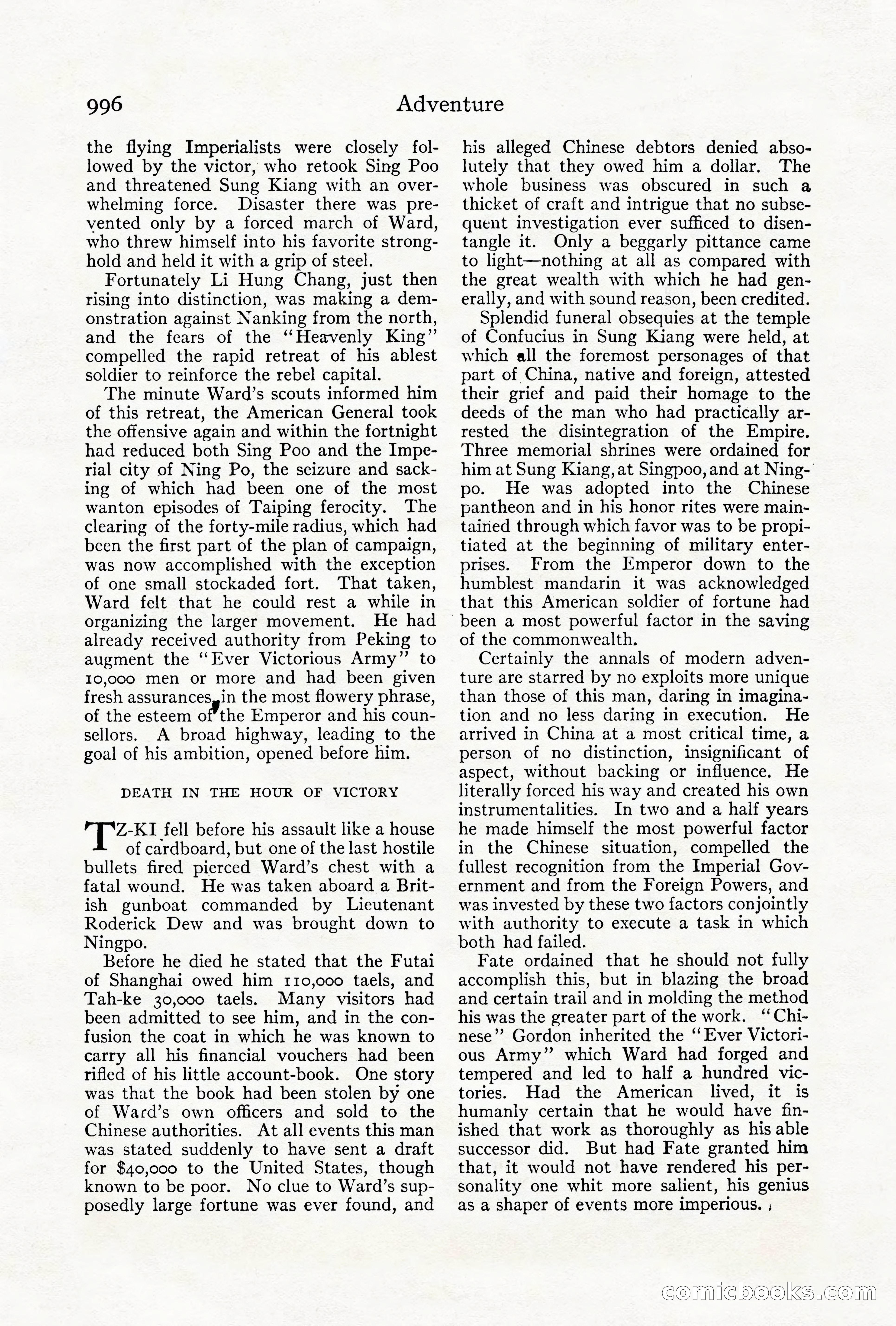
A restored page from Pulp Fiction, 1911. Page through the whole issue in the reader above.
📄 Transcribed text from this page (OCR, searchable)
Machine-transcribed from the original scan — historical spelling and the odd misread are preserved.
996 the flying Imperialists were closely fol- lowed by the victor, who retook Sing Poo and threatened Sung Kiang with an over- whelming force. Disaster there was pre- vented only by a forced march of Ward, who threw himself into his favorite strong- hold and held it with a grip of steel. Fortunately Li Hung Chang, just then rising into distinction, was making a dem- onstration against Nanking from the north, and the fears of the “Heavenly King” compelled the rapid retreat of his ablest soldier to reinforce the rebel capital. The minute Ward’s scouts informed him of this retreat, the American General took the offensive again and within the fortnight had reduced both Sing Poo and the Impec- rial city of Ning Po, the seizure and sack- ing of which had been one of the most wanton episodes of Taiping ferocity. The clearing of the forty-mile radius, which had been the first part of the plan of campaign, was now accomplished with the exception of one small stockaded fort. That taken, Ward felt that he could rest a while in organizing the larger movement. He had already received authority from Peking to augment the “Ever Victorious Army” to 10,000 men or more and had been given fresh assurances, in the most flowery phrase, of the esteem ofthe Emperor and his coun- sellors. A broad highway, leading to the goal of his ambition, opened before him. DEATH IN THE HOUR OF VICTORY Z-KI fell before his assault like a house of cardboard, but one of the last hostile bullets fired pierced Ward’s chest with a fatal wound. He was taken aboard a Brit- ish gunboat commanded by Lieutenant Roderick Dew and was brought down to Ningpo. Before he died he stated that the Futai of Shanghai owed him 110,000 taels, and Tah-ke 30,000 taels. Many visitors had been admitted to see him, and in the con- fusion the coat in which he was known to carry all his financial vouchers had been rifled of his little account-book. One story was that the book had been stolen by one of Ward’s own officers and sold to the Chinese authorities. At all events this man was stated suddenly to have sent a draft for $40,000 to the United States, though known to be poor. No clue to Ward’s sup- posedly large fortune was ever found, and Adventure his alleged Chinese debtors denied abso- lutely that they owed him a dollar. The whole business was obscured in such a thicket of craft and intrigue that no subse- quent investigation ever sufficed to disen- tangle it. Only a beggarly pittance came to light—nothing at all as compared with the great wealth with which he had gen- erally, and with sound reason, been credited. Splendid funeral obsequies at the temple of Confucius in Sung Kiang were held, at which all the foremost personages of that part of China, native and foreign, attested their grief and paid their homage to the deeds of the man who had practically ar- rested the disintegration of the Empire. Three memorial shrines were ordained for him at Sung Kiang, at Singpoo, and at Ning-' po. He was adopted into the Chinese pantheon and in his honor rites were main- tained through which favor was to be propi- tiated at the beginning of military enter- prises. From the Emperor down to the humblest mandarin it was acknowledged that this American soldier of fortune had been a most powerful factor in the saving of the commonwealth. Certainly the annals of modern adven- ture are starred by no exploits more unique than those of this man, daring in imagina- tion and no less daring in execution. He arrived in China at a most critical time, a person of no distinction, insignificant of aspect, without backing or influence. He literally forced his way and created his own instrumentalities. In two and a half years he made himself the most powerful factor in the Chinese situation, compelled the fullest recognition from the Imperial Gov- ernment and from the Foreign Powers, and was invested by these two factors conjointly with authority to execute a task in which both had failed. Fate ordained that he should not fully accomplish this, but in blazing the broad and certain trail and in molding the method his was the greater part of the work. ‘Chi- nese”? Gordon inherited the ‘‘ Ever Victori- ous Army” which Ward had forged and tempered and led to half a hundred vic- tories. Had the American lived, it is humanly certain that he would have fin- ished that work as thoroughly as his able successor did. But had Fate granted him that, it would not have rendered his per- sonality one whit more salient, his genius as a shaper of events more imperious. ; CO MICLOOKS (©