
Pulp Fiction, 1911 · page 58 of 196
Adventure Magazine Cover, October 1911 — page 58: what you’re looking at
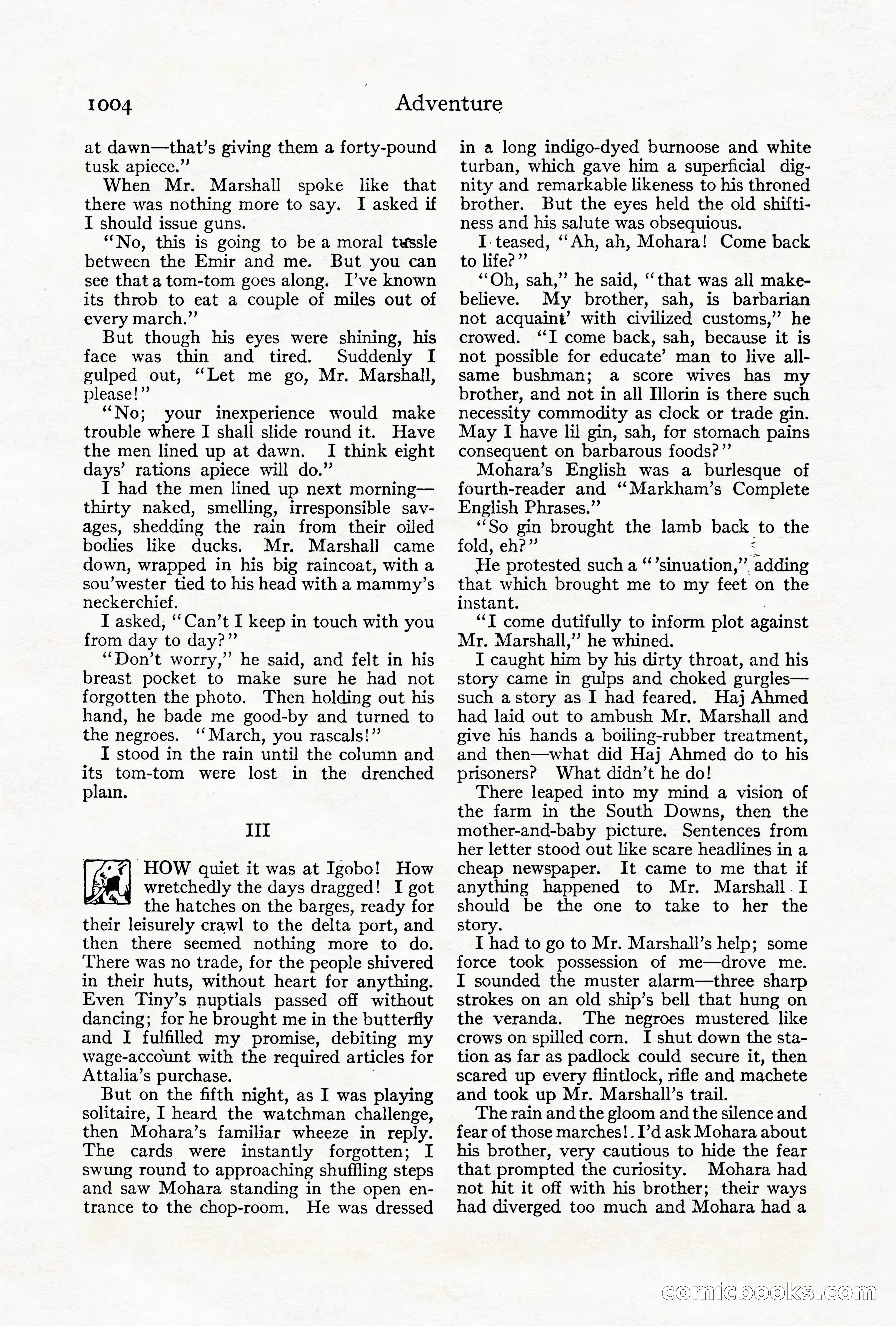
A restored page from Pulp Fiction, 1911. Page through the whole issue in the reader above.
📄 Transcribed text from this page (OCR, searchable)
Machine-transcribed from the original scan — historical spelling and the odd misread are preserved.
1004 at dawn—that’s giving them a forty-pound tusk apiece.” When Mr. Marshall spoke like that there was nothing more to say. I asked if I should issue guns. ‘‘No, this is going to be a moral tussle between the Emir and me. But you can see thata tom-tom goes along. I’ve known its throb to eat a couple of miles out of every march.”’ But though his eyes were shining, his face was thin and tired. Suddenly I gulped out, ‘“‘Let me go, Mr. Marshall, please!”’ trouble where I shall slide round it. Have the men lined up at dawn. I think eight days’ rations apiece will do.” I had the men lined up next morning— thirty naked, smelling, irresponsible sav- ages, shedding the rain from their oiled bodies like ducks. Mr. Marshal] came down, wrapped in his big raincoat, with a sou’wester tied to his head with a mammy’s neckerchief. I asked, ‘‘Can’t I keep in touch with you from day to day?” “Don’t worry,’ he said, and felt in his breast pocket to make sure he had not forgotten the photo. Then holding out his hand, he bade me good-by and turned to the negroes. ‘‘ March, you rascals!” I stood in the rain until the column and its tom-tom were lost in the drenched plain. Til “HOW quiet it was at Igobo! How ba wretchedly the days dragged! I got ——~ the hatches on the barges, ready for their leisurely crawl to the delta port, and then there seemed nothing more to do. There was no trade, for the people shivered in their huts, without heart for anything. Even Tiny’s nuptials passed off without dancing; for he brought me in the butterfly and I fulfilled my promise, debiting my wage-account with the required articles for Attalia’s purchase. But on the fifth night, as I was playing solitaire, I heard the watchman challenge, then Mohara’s familiar wheeze in reply. The cards were instantly forgotten; I swung round to approaching shuffling steps and saw Mohara standing in the open en- trance to the chop-room. He was dressed your inexperience would make. Adventure in a long indigo-dyed burnoose and white turban, which gave him a superficial dig- nity and remarkable likeness to his throned brother. But the eyes held the old shifti- ness and his salute was obsequious. I-teased, ‘‘Ah, ah, Mohara! Come back to life?”’ ‘“‘Oh, sah,” he said, “‘that was all make- believe. My brother, sah, is barbarian not acquaint’ with civilized customs,” he crowed. ‘‘I come back, sah, because it is not possible for educate’ man to live all- same bushman; a score wives has my brother, and not in all Illorin is there such necessity commodity as clock or trade gin. May I have li gin, sah, for stomach pains consequent on barbarous foods?”’ Mohara’s English was a burlesque of fourth-reader and ‘‘Markham’s Complete English Phrases.” “So gin brought the lamb back to the fold, eh?” = He protested such a ‘‘’sinuation,”’ adding that which brought me to my feet on the instant. “I come dutifully to inform plot against Mr. Marshall,” he whined. I caught him by his dirty throat, and his story came in gulps and choked gurgles— such astory as I had feared. Haj Ahmed had laid out to ambush Mr. Marshall and give his hands a boiling-rubber treatment, and then—what did Haj Ahmed do to his prisoners? What didn’t he do! There leaped into my mind a vision of the farm in the South Downs, then the mother-and-baby picture. Sentences from her letter stood out like scare headlines in a cheap newspaper. It came to me that if anything happened to Mr. Marshall I should be the one to take to her the story. I had to go to Mr. Marshall’s help; some force took possession of me—drove me. I sounded the muster alarm—three sharp strokes on an old ship’s bell that hung on the veranda. ‘The negroes mustered like crows on spilled corn. I shut down the sta- tion as far as padlock could secure it, then scared up every flintlock, nfle and machete and took up Mr. Marshall’s trail. The rain and the gloom and the silence and fear of those marches! . I’d ask Mohara about his brother, very cautious to hide the fear that prompted the curiosity. Mohara had not hit it off with his brother; their ways had diverged too much and Mohara had a Comicbook CO