
Pulp Fiction, 1911 · page 66 of 196
Adventure Magazine Cover, October 1911 — page 66: what you’re looking at
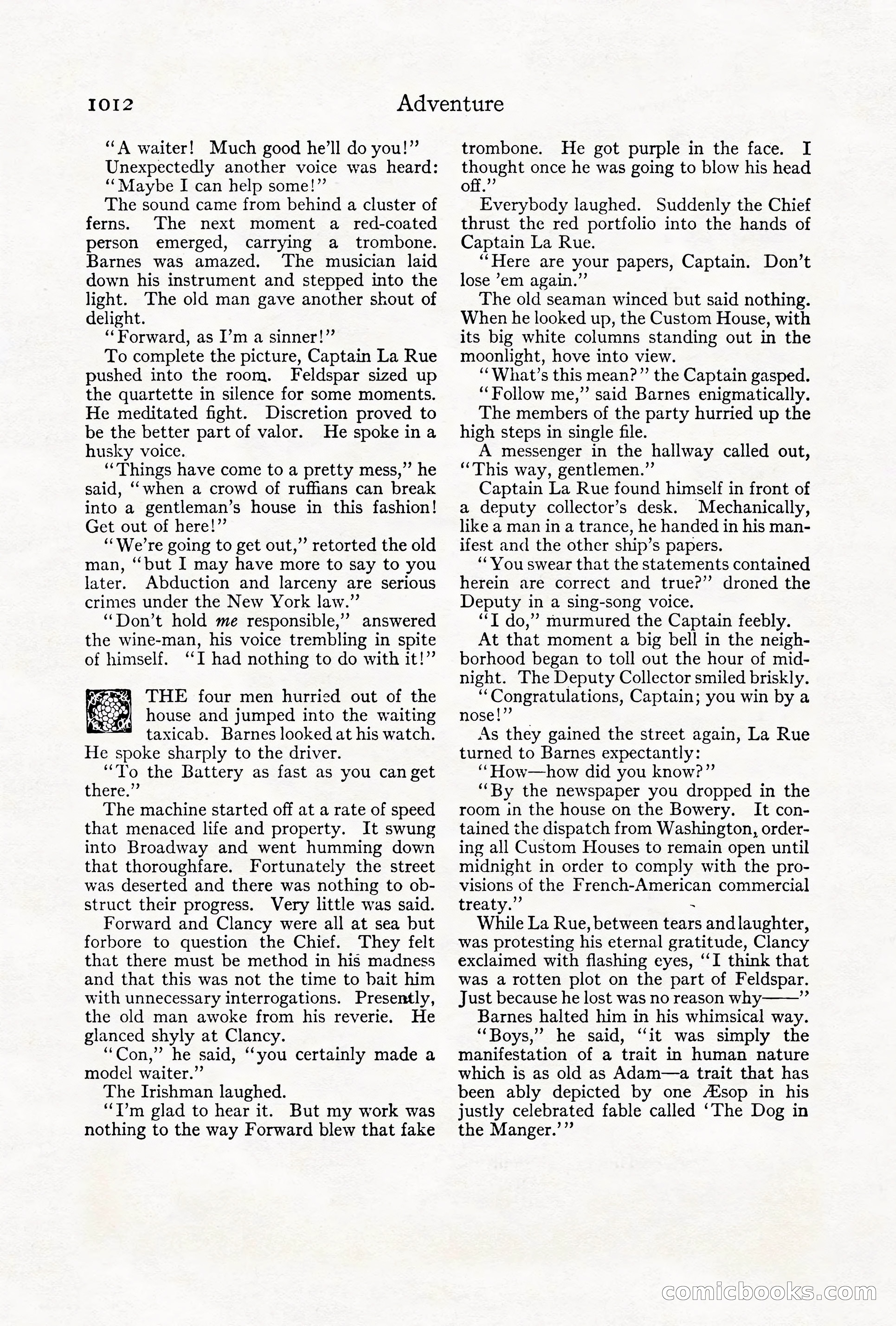
A restored page from Pulp Fiction, 1911. Page through the whole issue in the reader above.
📄 Transcribed text from this page (OCR, searchable)
Machine-transcribed from the original scan — historical spelling and the odd misread are preserved.
TOI2 “A waiter! Much good he’ll do you!” Unexpectedly another voice was heard: ‘““Maybe I can help some!”’ The sound came from behind a cluster of ferns. The next moment a _ red-coated person emerged, carrying a _ trombone. Barnes was amazed. ‘The musician laid down his instrument and stepped into the light. The old man gave another shout of delight. ‘‘Forward, as I’m a sinner!” To complete the picture, Captain La Rue pushed into the room. Feldspar sized up the quartette in silence for some moments. He meditated fight. Discretion proved to be the better part of valor. He spoke ina husky voice. “Things have come to a pretty mess,”’ he said, ‘‘when a crowd of rufhians can break into a gentleman’s house in this fashion! Get out of here!”’ ““We’re going to get out,” retorted the old man, “but I may have more to say to you later. Abduction and larceny are serious crimes under the New York law.” “Don’t hold me responsible,’’ answered the wine-man, his voice trembling in spite of himself. “I had nothing to do with it!” &4 THE four men hurried out of the We house and jumped into the waiting =" taxicab. Barnes looked at his watch. He spoke sharply to the driver. “To the Battery as fast as you can get there.” The machine started off at a rate of speed that menaced life and property. It swung into Broadway and went humming down that thoroughfare. Fortunately the street was deserted and there was nothing to ob- struct their progress. Very little was said. Forward and Clancy were all at sea but forbore to question the Chief. They felt that there must be method in his madness and that this was not the time to bait him with unnecessary interrogations. Presently, the old man awoke from his reverie. He glanced shyly at Clancy. “Con,” he said, “‘you certainly made a model waiter.” The Irishman laughed. ‘I’m glad to hear it. But my work was nothing to the way Forward blew that fake Adventure trombone. He got purple in the face. I thought once he was going to blow his head off.” Everybody laughed. Suddenly the Chief thrust the red portfolio into the hands of Captain La Rue. ‘“‘Here are your papers, Captain. Don’t lose ’em again.” The old seaman winced but said nothing. When he looked up, the Custom House, with its big white columns standing out in the moonlight, hove into view. ‘““What’s this mean?” the Captain gasped. ‘Follow me,” said Barnes enigmatically. The members of the party hurried up the high steps in single file. A messenger in the hallway called out, “This way, gentlemen.” Captain La Rue found himself in front of a deputy collector’s desk. Mechanically, like a man in a trance, he handed in his man- ifest and the other ship’s papers. ‘““You swear that the statements contained herein are correct and true?’’ droned the Deputy in a sing-song voice. ‘“T do,” murmured the Captain feebly. At that moment a big bell in the neigh- borhood began to toll out the hour of mid- night. The Deputy Collector smiled briskly. ‘Congratulations, Captain; you win by a nose!”? — As they gained the street again, La Rue turned to Barnes expectantly: ‘““How—how did you know?” ‘By the newspaper you dropped in the room in the house on the Bowery. It con- tained the dispatch from Washington, order- ing all Custom Houses to remain open until midnight in order to comply with the pro- visions of the French-American commercial treaty.” . While La Rue, between tears and laughter, was protesting his eternal gratitude, Clancy exclaimed with flashing eyes, ‘‘I think that was a rotten plot on the part of Feldspar. Just because he lost was no reason why “ Barnes halted him in his whimsical way. “Boys,” he said, “it was simply the manifestation of a trait in human nature which is as old as Adam—a trait that has been ably depicted by one A‘sop in his justly celebrated fable called ‘The Dog in the Manger.’” cComicboooks (©