
Pulp Fiction, 1911 · page 87 of 196
Adventure Magazine Cover, October 1911 — page 87: what you’re looking at
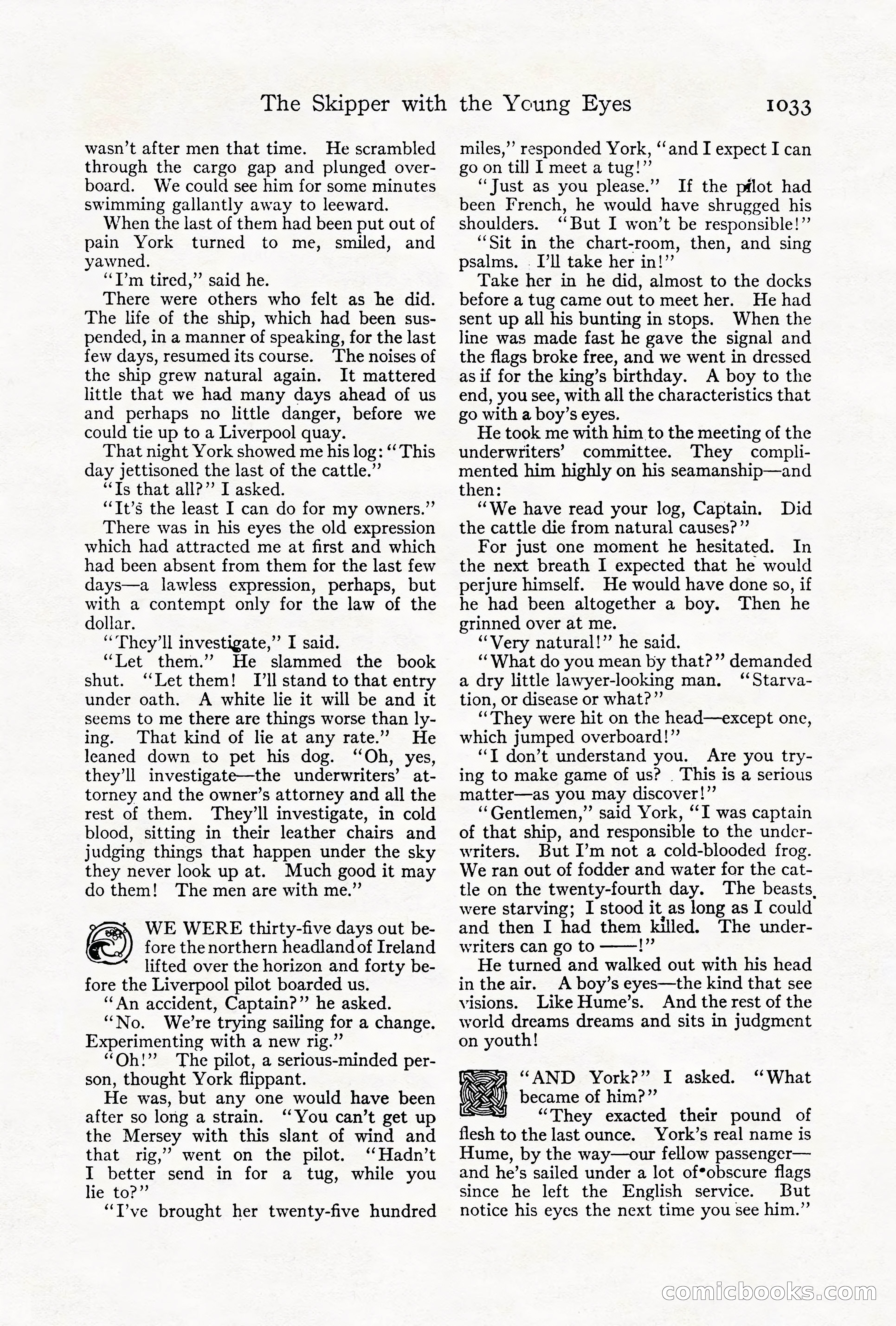
A restored page from Pulp Fiction, 1911. Page through the whole issue in the reader above.
📄 Transcribed text from this page (OCR, searchable)
Machine-transcribed from the original scan — historical spelling and the odd misread are preserved.
The Skipper with the Young Eyes wasn’t after men that time. He scrambled through the cargo gap and plunged over- board. We could see him for some minutes swimming gallantly away to leeward. When the last of them had been put out of pain York turned to me, smiled, and yawned. ‘“‘T’m tired,” said he. There were others who felt as he did. The life of the ship, which had been sus- pended, in a manner of speaking, for the last few days, resumed its course. ‘The noises of the ship grew natural again. It mattered little that we had many days ahead of us and perhaps no little danger, before we could tie up to a Liverpool quay. That night York showed me his log: ‘‘ This day jettisoned the last of the cattle.” “Is that all?” I asked. “It’s the least I can do for my owners.” There was in his eyes the old expression which had attracted me at first and which had been absent from them for the last few days—a lawless expression, perhaps, but with a contempt only for the law of the dollar. “They’ll investigate,” I said. “Let them.” He slammed the book shut. “Let them! I'll stand to that entry under oath. A white lie it will be and it seems to me there are things worse than ly- ing. That kind of he at any rate.” He leaned down to pet his dog. “Oh, yes, they’ll investigate—the underwriters’ at- torney and the owner’s attorney and all the rest of them. They’ll investigate, in cold blood, sitting in their leather chairs and judging things that happen under the sky they never look up at. Much good it may do them! The men are with me.” &) fore the northern headland of Ireland lifted over the horizon and forty be- fore the Liverpool pilot boarded us. ‘An accident, Captain?” he asked. “No. We’re trying sailing for a change. Experimenting with a new rig.” “Oh!” The pilot, a serious-minded per- son, thought York flippant. He was, but any one would have been after so long a strain. ‘You can’t get up the Mersey with this slant of wind and that rig,” went on the pilot. ‘Hadn’t I better send in for a tug, while you lie to?” “lve brought her twenty-five hundred WE WERE thirty-five days out be- 1033 miles,’”’ responded York, “ go on till I meet a tug!” “Just as you please.”’ If the pilot had been French, he would have shrugged his shoulders. “But I won’t be responsible!”’ ‘Sit in the chart-room, then, and sing psalms. . Pll take her in!”’ Take her in he did, almost to the docks before a tug came out to meet her. He had sent up all his bunting in stops. When the line was made fast he gave the signal and the flags broke free, and we went in dressed as if for the king’s birthday. A boy to the end, you see, with all the characteristics that go with a boy’s eyes. He took me with him to the meeting of the underwriters’ committee. They compli- mented him highly on his seamanship—and then: ‘““We have read your log, Captain. the cattle die from natural causes? ”’ For just one moment he hesitated. In the next breath I expected that he would perjure himself. He would have done so, if he had been altogether a boy. Then he grinned over at me. “Very natural!” he said. “What do you mean by that?” demanded a dry little lawyer-looking man. “Starva- tion, or disease or what?”’ “They were hit on the head—except one, which jumped overboard!” “JT don’t understand you. Are you try- ing to make game of us? . This is a serious matter—as you may discover!”’ ‘‘Gentlemen,” said York, “‘I was captain of that ship, and responsible to the under- writers. But I’m not a cold-blooded frog. We ran out of fodder and water for the cat- tle on the twenty-fourth day. were starving; I stood it as long as I could and then I had them killed. The under- writers can go to i He turned and walked out with his head in the air. A boy’s eyes—the kind that see visions. Like Hume’s. And the rest of the world dreams dreams and sits in judgment on youth! and I expect I can Did rer AND York?” I asked. ‘What WW VY became of him?” / “They exacted their pound of Pa: to the last ounce. York’s real name is Hume, by the way—our fellow passenger— and he’s sailed under a lot of*obscure flags since he left the English service. But notice his eyes the next time you see him.” ISG COmiclbook The beasts. C©