
Pulp Fiction, 1914 · page 102 of 228
Adventure, December 1914 — page 102: what you’re looking at
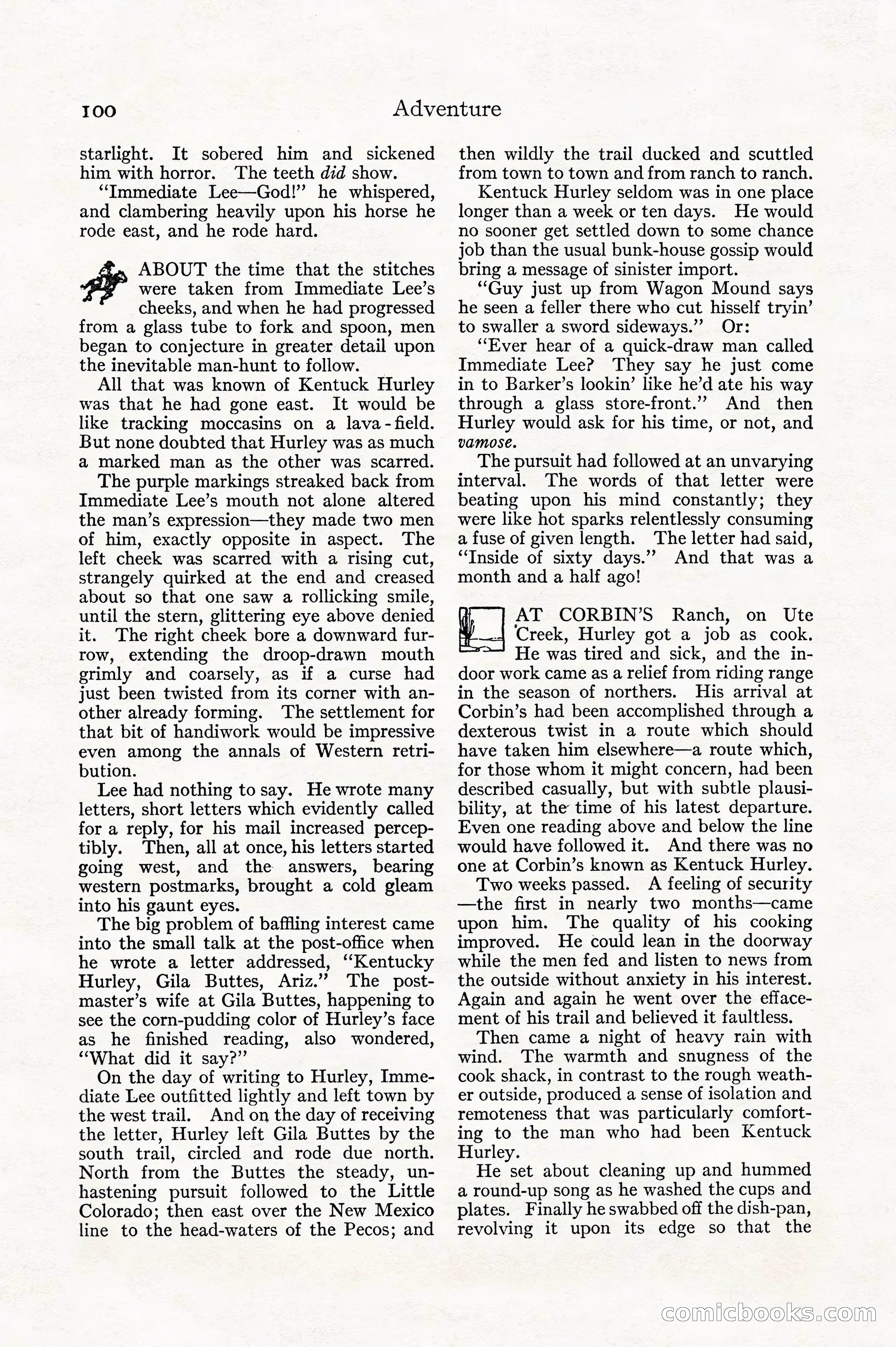
A restored page from Pulp Fiction, 1914. Page through the whole issue in the reader above.
📄 Transcribed text from this page (OCR, searchable)
Machine-transcribed from the original scan — historical spelling and the odd misread are preserved.
TOO starlight. It sobered him and _ sickened him with horror. The teeth did show. “Immediate Lee—God!’’ he whispered, and clambering heavily upon his horse he rode east, and he rode hard. sf were taken from Immediate Lee’s cheeks, and when he had progressed from a glass tube to fork and spoon, men began to conjecture in greater detail upon the inevitable man-hunt to follow. _ All that was known of Kentuck Hurley was that he had gone east. It would be like tracking moccasins on a lava - field. But none doubted that Hurley was as much a marked man as the other was scarred. The purple markings streaked back from Immediate Lee’s mouth not alone altered the man’s expression—they made two men of him, exactly opposite in aspect. The left cheek was scarred with a rising cut, strangely quirked at the end and creased about so that one saw a rollicking smile, until the stern, glittering eye above denied it. The right cheek bore a downward fur- row, extending the droop-drawn mouth grimly and coarsely, as if a curse had just been twisted from its corner with an- other already forming. The settlement for that bit of handiwork would be impressive even among the annals of Western retri- bution. Lee had nothing to say. He wrote many letters, short letters which evidently called for a reply, for his mail increased percep- tibly. Then, all at once, his letters started going west, and the answers, bearing western postmarks, brought a cold gleam into his gaunt eyes. The big problem of baffling interest came into the small talk at the post-office when he wrote a letter addressed, ‘Kentucky Hurley, Gila Buttes, Ariz.” The post- master’s wife at Gila Buttes, happening to see the corn-pudding color of Hurley’s face as he finished reading, also wondered, ‘‘What did it say?”’ On the day of writing to Hurley, Imme- diate Lee outfitted lightly and left town by the west trail. And on the day of receiving the letter, Hurley left Gila Buttes by the south trail, circled and rode due north. North from the Buttes the steady, un- hastening pursuit followed to the Little Colorado; then east over the New Mexico line to the head-waters of the Pecos; and ABOUT the time that the stitches Adventure then wildly the trail ducked and scuttled from town to town and from ranch to ranch. Kentuck Hurley seldom was in one place longer than a week or ten days. He would no sooner get settled down to some chance job than the usual bunk-house gossip would bring a message of sinister import. “Guy just up from Wagon Mound says he seen a feller there who cut hisself tryin’ to swaller a sword sideways.”’ Or: “Ever hear of a quick-draw man called Immediate Lee? They say he just come in to Barker’s lookin’ like he’d ate his way through a glass store-front.’”’ And then Hurley would ask for his time, or not, and vamose. The pursuit had followed at an unvarying interval. The words of that letter were beating upon his mind constantly; they were like hot sparks relentlessly consuming a fuse of given length. The letter had said, ‘Inside of sixty days.’”’ And that was a month and a half ago! H | Creek, Hurley got a job as cook. He was tired and sick, and the in- door work came as a relief from riding range in the season of northers. His arrival at Corbin’s had been accomplished through a dexterous twist in a route which should have taken him elsewhere—a route which, for those whom it might concern, had been described casually, but with subtle plausi- bility, at the time of his latest departure. Even one reading above and below the line would have followed it. And there was no one at Corbin’s known as Kentuck Hurley. Two weeks passed. A feeling of security —the first in nearly two months—came upon him. The quality of his cooking improved. He could lean in the doorway while the men fed and listen to news from the outside without anxiety in his interest. Again and again he went over the efface- ment of his trail and believed it faultless. Then came a night of heavy rain with wind. The warmth and snugness of the cook shack, in contrast to the rough weath- er outside, produced a sense of isolation and remoteness that was particularly comfort- ing to the man who had been Kentuck Hurley. He set about cleaning up and hummed a round-up song as he washed the cups and plates. Finally he swabbed off the dish-pan, revolving it upon its edge so that the AT CORBIN’S Ranch, on Ute MICLOOOK C©