
Pulp Fiction, 1914 · page 116 of 228
Adventure, December 1914 — page 116: what you’re looking at
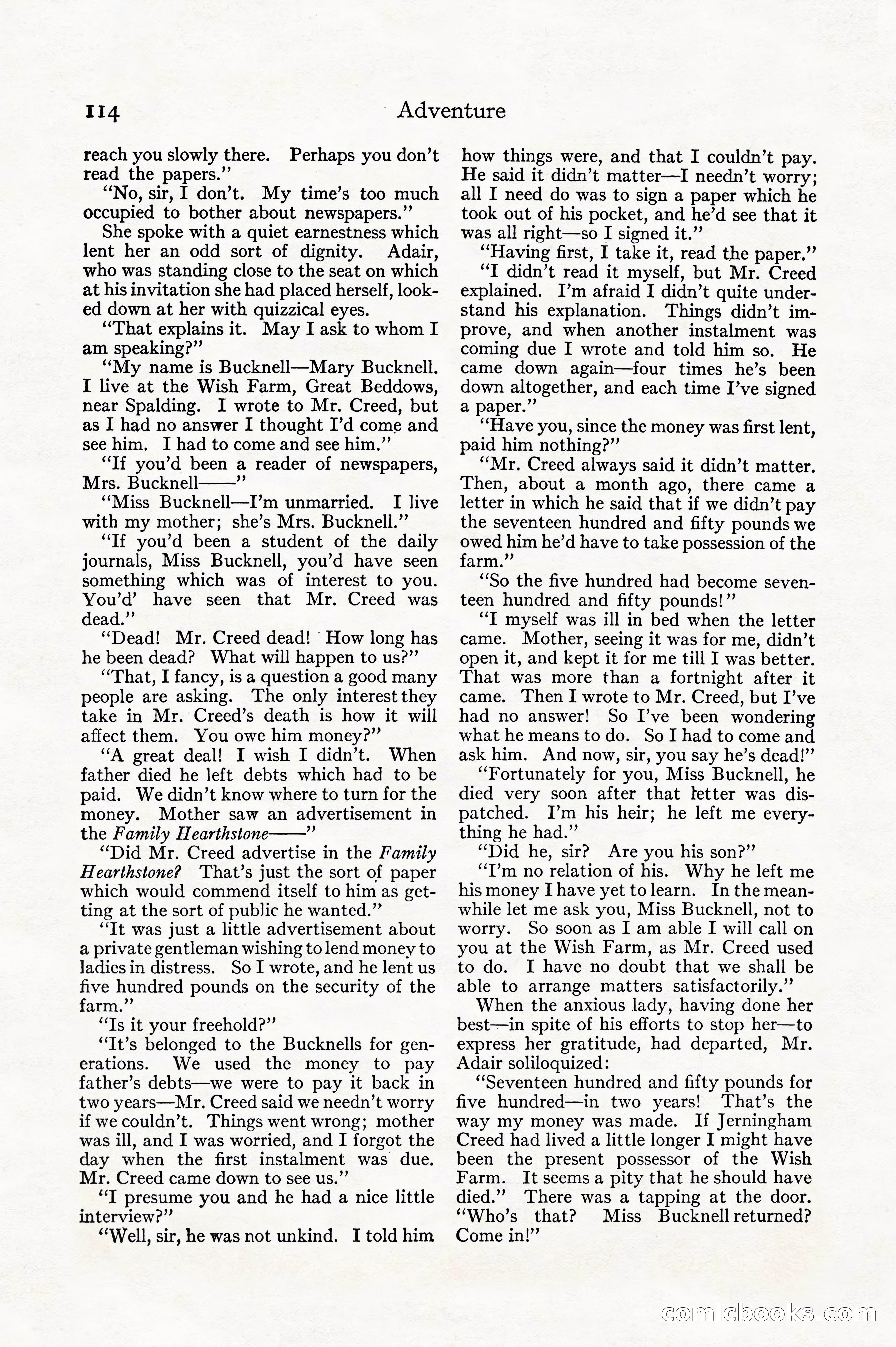
A restored page from Pulp Fiction, 1914. Page through the whole issue in the reader above.
📄 Transcribed text from this page (OCR, searchable)
Machine-transcribed from the original scan — historical spelling and the odd misread are preserved.
114 reach you slowly there. read the papers.” ~ “No, sir, I don’t. My time’s too much occupied to bother about newspapers.” She spoke with a quiet earnestness which lent her an odd sort of dignity. Adair, who was standing close to the seat on which at his invitation she had placed herself, look- ed down at her with quizzical eyes. ‘That explains it. May I ask to whom I am speaking?” ‘“‘My name is Bucknell—Mary Bucknell. I live at the Wish Farm, Great Beddows, near Spalding. I wrote to Mr. Creed, but as I had no answer I thought I’d come and see him. I had to come and see him.” “If you’d been a reader of newspapers, Mrs. Bucknell ad “Miss Bucknell—I’m unmarried. I live with my mother; she’s Mrs. Bucknell.” “If you’d been a student of the daily journals, Miss Bucknell, you’d have seen something which was of interest to you. You’d’ have seen that Mr. Creed was dead.”’ “Dead! Mr. Creed dead! How long has he been dead? What will happen to us?”’ “That, I fancy, is a question a good many people are asking. The only interest they take in Mr. Creed’s death is how it will affect them. You owe him money?” “A great deal! I wish I didn’t. When father died he left debts which had to be paid. We didn’t know where to turn for the money. Mother saw an advertisement in the Family Hearthstone a “Did Mr. Creed advertise in the Family Hearthstone? That’s just the sort of paper which would commend itself to him as get- ting at the sort of public he wanted.” “It was just a little advertisement about a private gentleman wishing to lend money to ladies in distress. So I wrote, and he lent us five hundred pounds on the security of the farm.” “Ts it your freehold?” “It’s belonged to the Bucknells for gen- erations. We used the money to pay father’s debts—we were to pay it back in two years—Mr. Creed said we needn’t worry if we couldn’t. Things went wrong; mother was ill, and I was worried, and I forgot the day when the first instalment was due. Mr. Creed came down to see us.” “TI presume you and he had a nice little interview?” “Well, sir, he was not unkind. I told him Perhaps you don’t ~ Adventure how things were, and that I couldn’t pay. He said it didn’t matter—I needn’t worry; all I need do was to sign a paper which he took out of his pocket, and he’d see that it was all right—so I signed it.” “Having first, I take it, read the paper.” “T didn’t read it myself, but Mr. Creed explained. I’m afraid I didn’t quite under- stand his explanation. Things didn’t im- prove, and when another instalment was coming due I wrote and told him so. He came down again—four times he’s been down altogether, and each time I’ve signed a paper.” ‘‘Have you, since the money was first lent, paid him nothing?” “Mr. Creed always said it didn’t matter. Then, about a month ago, there came a letter in which he said that if we didn’t pay the seventeen hundred and fifty pounds we owed him he’d have to take possession of the farm.” ‘So the five hundred had become seven- teen hundred and fifty pounds!” “I myself was ill in bed when the letter came. Mother, seeing it was for me, didn’t open it, and kept it for me till I was better. That was more than a fortnight after it came. Then I wrote to Mr. Creed, but I’ve had no answer! So I’ve been wondering what he means to do. So I had to come and ask him. And now, sir, you say he’s dead!”’ “Fortunately for you, Miss Bucknell, he died very soon after that TIetter was dis- patched. I’m his heir; he left me every- thing he had.” “Did he, sir? Are you his son?” ‘“T’m no relation of his. Why he left me his money Ihave yet tolearn. In the mean- while let me ask you, Miss Bucknell, not to worry. So soon as I am able I will call on you at the Wish Farm, as Mr. Creed used to do. I have no doubt that we shall be able to arrange matters satisfactorily.” When the anxious lady, having done her best—in spite of his efforts to stop her—to express her gratitude, had departed, Mr. Adair soliloquized: ‘Seventeen hundred and fifty pounds for five hundred—in two years! ‘That’s the way my money was made. If Jerningham Creed had lived a little longer I might have been the present possessor of the Wish Farm. It seemsa pity that he should have died.”’ There was a tapping at the door. “Who’s that? Miss Bucknell returned? Come in!”’ Gomiicovook C@