
Pulp Fiction, 1914 · page 125 of 228
Adventure, December 1914 — page 125: what you’re looking at
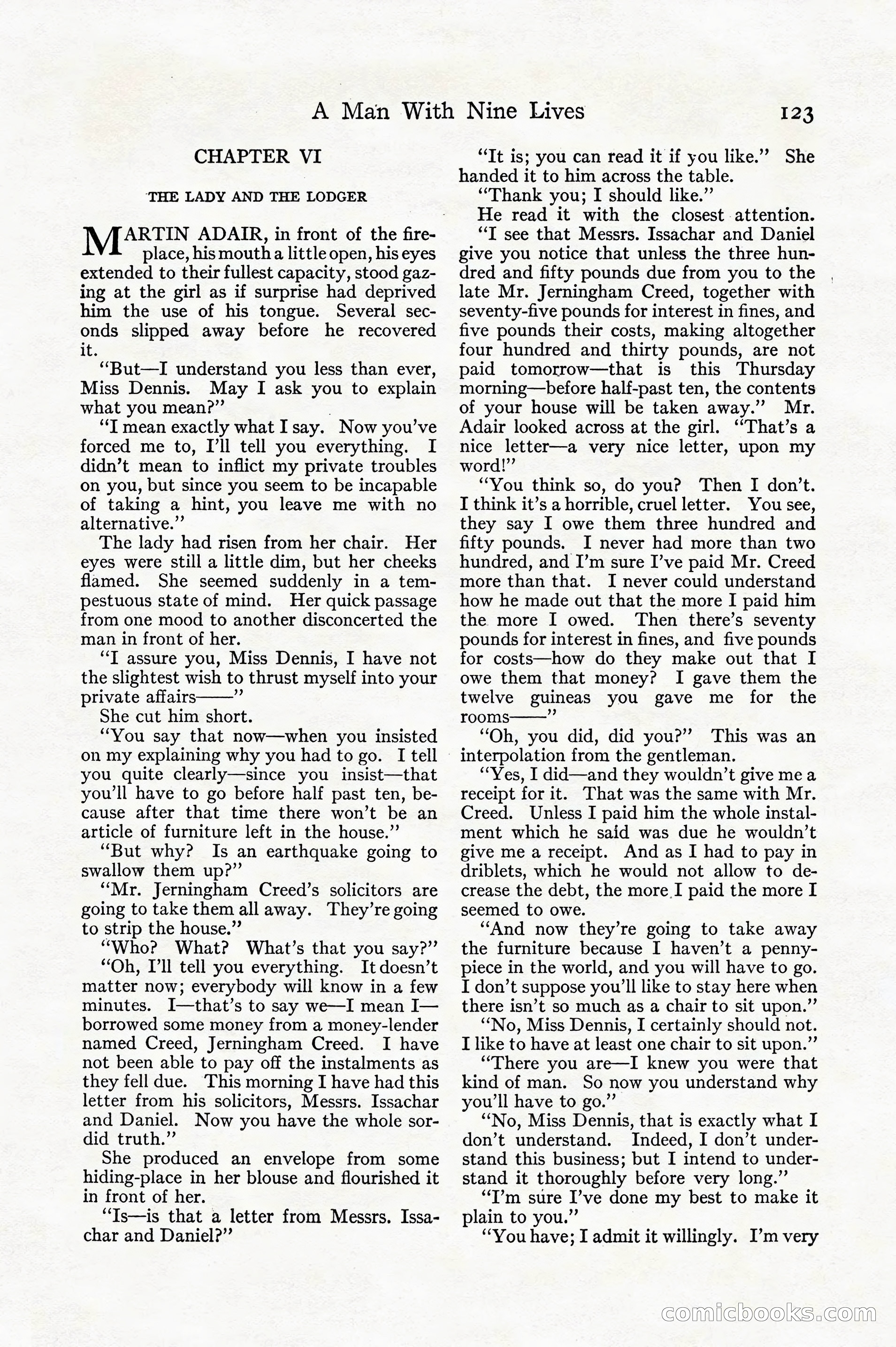
A restored page from Pulp Fiction, 1914. Page through the whole issue in the reader above.
📄 Transcribed text from this page (OCR, searchable)
Machine-transcribed from the original scan — historical spelling and the odd misread are preserved.
A Man With Nine Lives CHAPTER VI ‘THE LADY AND THE LODGER ARTIN ADAIR, in front of the fire- place, his mouth a little open, his eyes extended to their fullest capacity, stood gaz- ing at the girl as if surprise had deprived him the use of his tongue. Several sec- onds slipped away before he recovered it. “But—I understand you less than ever, Miss Dennis. May I ask you to explain what you mean?” “T mean exactly what Isay. Now you’ve forced me to, I'll tell you everything. I didn’t mean to inflict my private troubles on you, but since you seem to be incapable of taking a hint, you leave me with no alternative.” The lady had risen from her chair. Her eyes were still a little dim, but her cheeks flamed. She seemed suddenly in a tem- pestuous state of mind. Her quick passage from one mood to another disconcerted the man in front of her. “T assure you, Miss Dennis, I have not the slightest wish to thrust myself into your private affairs C She cut him short. “You say that now—when you insisted on my explaining why you had to go. I tell you quite clearly—since you insist—that you'll have to go before half past ten, be- cause after that time there won’t be an article of furniture left in the house.” “But why? Is an earthquake going to swallow them up?” “Mr. Jerningham Creed’s solicitors are going to take them all away. They’re going to strip the house.” “Who? What? What’s that you say?” “Oh, Ill tell you everything. It doesn’t matter now; everybody will know in a few minutes. I—that’s to say we—I mean I— borrowed some money from a money-lender named Creed, Jerningham Creed. I have not been able to pay off the instalments as they fell due. This morning I have had this letter from his solicitors, Messrs. Issachar and Daniel. Now you have the whole sor- did truth.” She produced an envelope from some hiding-place in her blouse and flourished it in front of her. “Is—is that a letter from Messrs. Issa- char and Daniel?” 123 “It is; you can read it if you like.”’ She handed it to him across the table. “Thank you; I should like.” He read it with the closest attention. “I see that Messrs. Issachar and Daniel give you notice that unless the three hun- dred and fifty pounds due from you to the late Mr. Jerningham Creed, together with seventy-five pounds for interest in fines, and five pounds their costs, making altogether four hundred and thirty pounds, are not paid tomorrow—that is this Thursday morning—before half-past ten, the contents of your house will be taken away.” Mr. Adair looked across at the girl. “That’s a nice letter—a very nice letter, upon my word!”’ “You think so, do your Then I don’t. I think it’s a horrible, cruel letter. You see, they say I owe them three hundred and fifty pounds. I never had more than two hundred, and I’m sure I’ve paid Mr. Creed more than that. I never could understand how he made out that the more I paid him the more I owed. Then there’s seventy pounds for interest in fines, and five pounds for costs—how do they make out that I owe them that money? I gave them the twelve guineas you gave me for the rooms——” “Oh, you did, did your’ This was an - interpolation from the gentleman. “Yes, I did—and they wouldn’t give me a receipt for it. That was the same with Mr. Creed. Unless I paid him the whole instal- ment which he said was due he wouldn’t give me a receipt. And as I had to pay in driblets, which he would not allow to de- crease the debt, the more I paid the more I seemed to owe. ‘“‘And now they’re going to take away the furniture because I haven’t a penny- piece in the world, and you will have to go. I don’t suppose you'll like to stay here when there isn’t so much as a chair to sit upon.” “No, Miss Dennis, I certainly should not. I like to have at least one chair to sit upon.” ‘There you are—I knew you were that kind of man. So now you understand why you'll have to go.” ‘“‘No, Miss Dennis, that is exactly what I don’t understand. Indeed, I don’t under- stand this business; but I intend to under- stand it thoroughly before very long.” “T’m sure I’ve done my best to make it plain to you.” ‘You have; I admit it willingly. I’m very NOOK (©