
Pulp Fiction, 1914 · page 131 of 228
Adventure, December 1914 — page 131: what you’re looking at
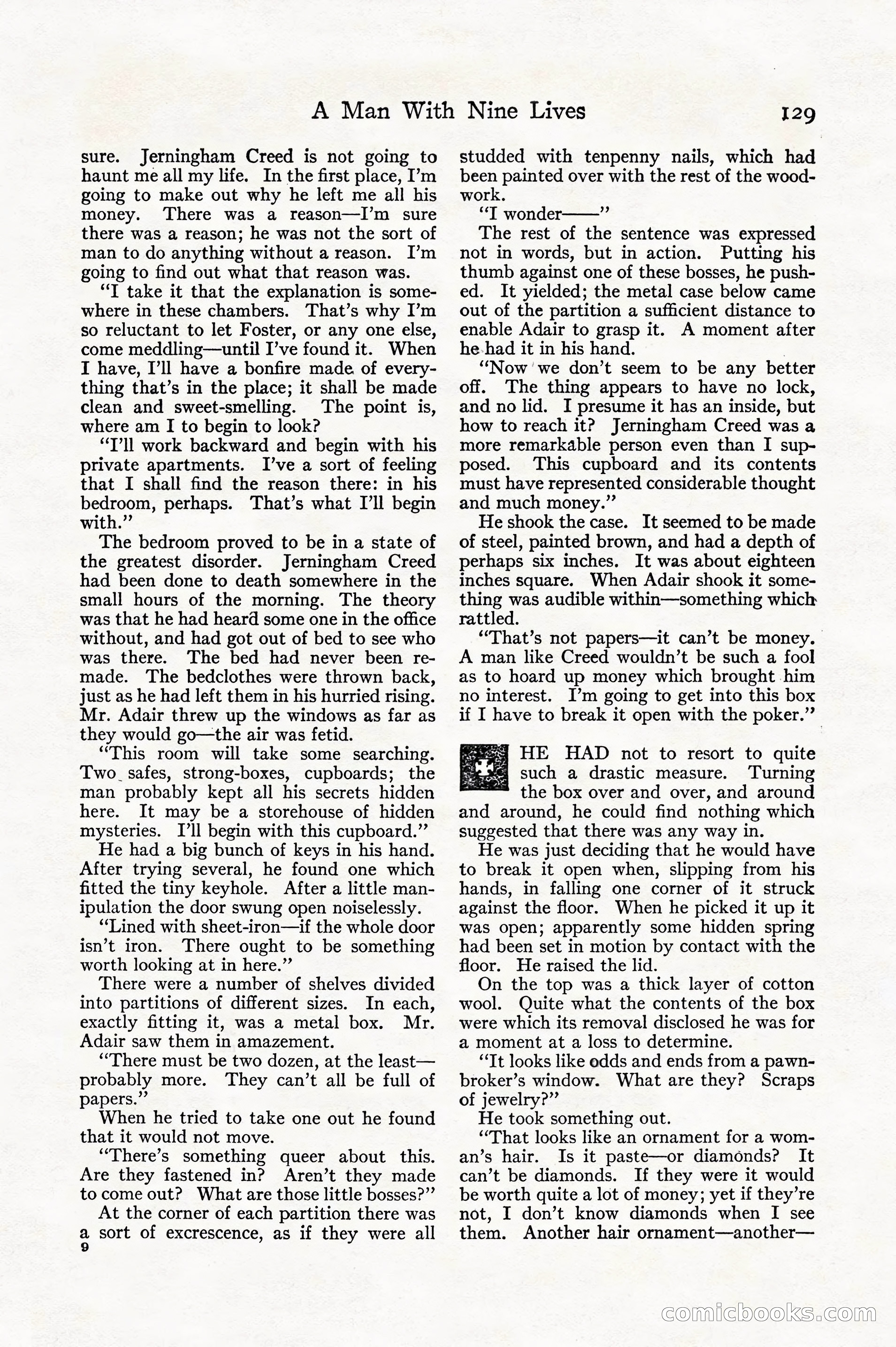
A restored page from Pulp Fiction, 1914. Page through the whole issue in the reader above.
📄 Transcribed text from this page (OCR, searchable)
Machine-transcribed from the original scan — historical spelling and the odd misread are preserved.
A Man With Nine Lives sure. Jerningham Creed is not going to haunt me all my life. In the first place, I’m going to make out why he left me all his money. ‘There was a reason—I’m sure there was a reason; he was not the sort of man to do anything without a reason. I’m going to find out what that reason was. “T take it that the explanation is some- where in these chambers. That’s why I’m so reluctant to let Foster, or any one else, come meddling—until I’ve found it. When I have, I’ll have a bonfire made. of every- thing that’s in the place; it shall be made clean and sweet-smelling. The point is, where am I to begin to look? “T’ll work backward and begin with his private apartments. I’ve a sort of feeling that I shall find the reason there: in his bedroom, perhaps. That’s what I’ll begin with.” The bedroom proved to be in a state of the greatest disorder. Jerningham Creed had been done to death somewhere in the small hours of the morning. The theory was that he had heard some one in the office without, and had got out of bed to see who was there. The bed had never been re- made. The bedclothes were thrown back, just as he had left them in his hurried rising. Mr. Adair threw up the windows as far as they would go—the air was fetid. “This room will take some searching. Two_ safes, strong-boxes, cupboards; the man probably kept all his secrets hidden here. It may be a storehouse of hidden mysteries. I’ll begin with this cupboard.” He had a big bunch of keys in his hand. After trying several, he found one which fitted the tiny keyhole. After a little man- ipulation the door swung open noiselessly. “Lined with sheet-iron—if the whole door isn’t iron. There ought to be something worth looking at in here.” There were a number of shelves divided into partitions of different sizes. In each, exactly fitting it, was a metal box. Mr. Adair saw them in amazement. “There must be two dozen, at the least— probably more. They can’t all be full of papers.” When he tried to take one out he found that it would not move. ‘“‘There’s something queer about this. Are they fastened in? Aren’t they made to come out? What are those little bosses?” At the corner of each partition there was a sort of excrescence, as if they were all 129 studded with tenpenny nails, which had been painted over with the rest of the wood- work. “T wonder é The rest of the sentence was expressed not in words, but in action. Putting his thumb against one of these bosses, he push- ed. It yielded; the metal case below came out of the partition a sufficient distance to enable Adair to grasp it. A moment after he-had it in his hand. | ‘“‘Now we don’t seem to be any better off. The thing appears to have no lock, and no lid. I presume it has an inside, but how to reach it? Jerningham Creed was a more remarkable person even than I sup- posed. This cupboard and its contents must have represented considerable thought and much money.” He shook the case. It seemed to be made of steel, painted brown, and had a depth of perhaps six inches. It was about eighteen inches square. When Adair shook it some- thing was audible within—something which rattled. b) ‘“‘That’s not papers—it can’t be money. A man like Creed wouldn’t be such a fool as to hoard up money which brought him no interest. I’m going to get into this box if I have to break it open with the poker.’’ fees HE HAD not to resort to quite Se xe] such a drastic measure. Turning =“ the box over and over, and around and around, he could find nothing which suggested that there was any way in. He was just deciding that he would have to break it open when, slipping from his hands, in falling one corner of it struck against the floor. When he picked it up it was open; apparently some hidden spring had been set in motion by contact with the floor. He raised the lid. On the top was a thick layer of cotton wool. Quite what the contents of the box were which its removal disclosed he was for a moment at a loss to determine. “Tt looks like odds and ends from a pawn- broker’s window. What are they? Scraps of jewelry?” He took something out. ‘That looks like an ornament for a wom- an’s hair. Is it paste—or diamonds? It can’t be diamonds. If they were it would be worth quite a lot of money; yet if they’re not, I don’t know diamonds when I see them. Another hair ornament—another— MICLOOOK C©