
Pulp Fiction, 1914 · page 143 of 228
Adventure, December 1914 — page 143: what you’re looking at
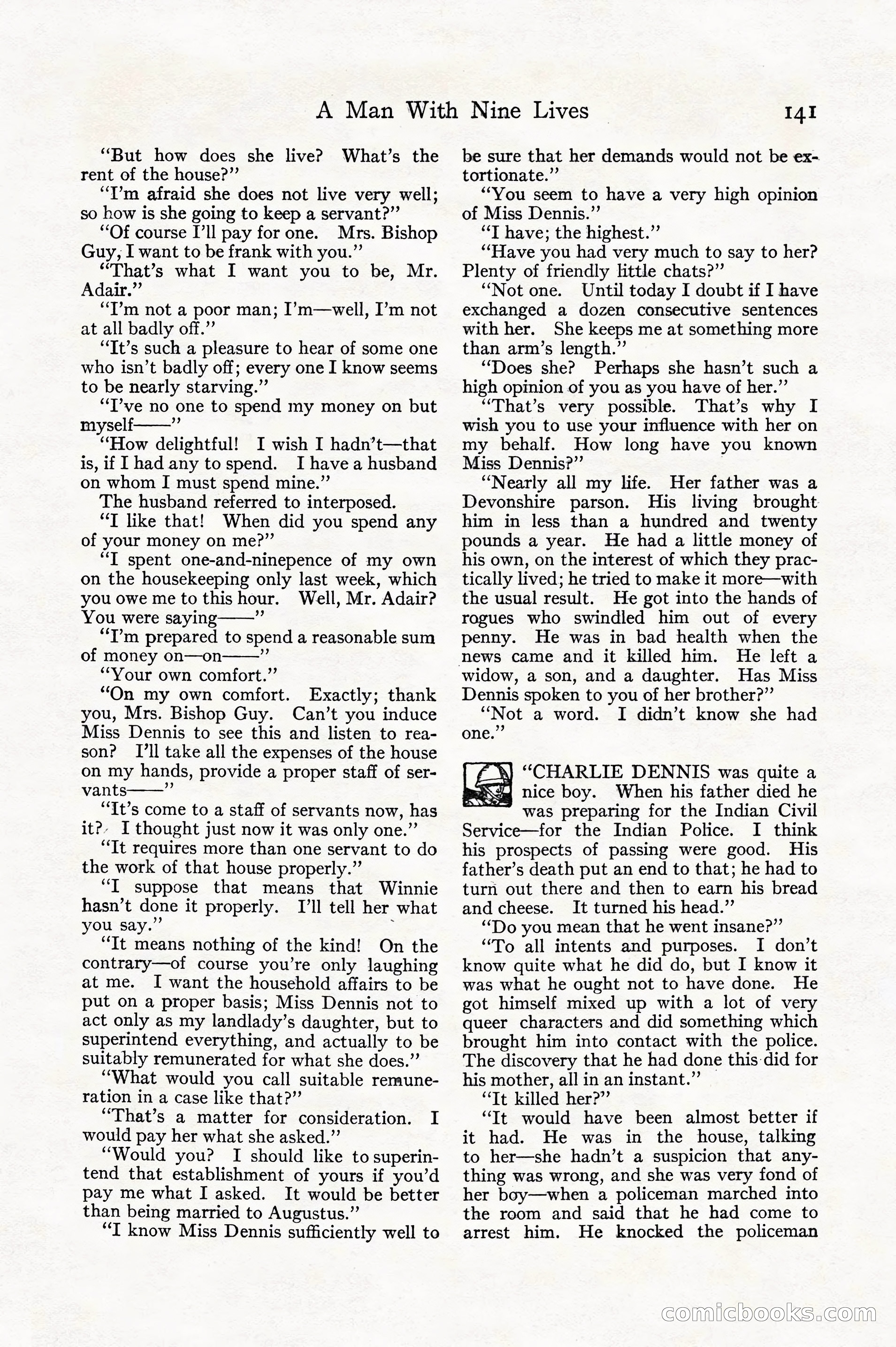
A restored page from Pulp Fiction, 1914. Page through the whole issue in the reader above.
📄 Transcribed text from this page (OCR, searchable)
Machine-transcribed from the original scan — historical spelling and the odd misread are preserved.
A Man With Nine Lives “But how does she live? What’s the rent of the house?” ‘“T’m afraid she does not live very well; so how is she going to keep a servant?” “Of course [’ll pay for one. Mrs. Bishop Guy, I want to be frank with you.” ‘“‘That’s what I want you to be, Mr. Adair.” “Ym not a poor man; I’m—well, I’m not at all badly off.” “It’s such a pleasure to hear of some one who isn’t badly off; every one I know seems to be nearly starving.” “T’ve no one to spend my money on but mysel se “How delightful! I wish I hadn’t—that is, if [had any tospend. I havea husband on whom I must spend mine.” The husband referred to interposed. “T like that! When did you spend any of your money on me?” “T spent one-and-ninepence of my own on the housekeeping only last week, which you owe me to this hour. Well, Mr. Adair? You were saying - “‘T’m prepared to spend a reasonable sum of money on—on “Your own comfort.”’ “On my own comfort. Exactly; thank you, Mrs. Bishop Guy. Can’t you induce Miss Dennis to see this and listen to rea- son? I'll take all the expenses of the house on my hands, provide a proper staff of ser- vants a “It’s come to a staff of servants now, has it?’ I thought just now it was only one.” “It requires more than one servant to do the work of that house properly.” “I suppose that means that Winnie hasn’t done it properly. I’ll tell her what you say.” ; “It means nothing of the kind! On the contrary—of course you’re only laughing at me. I want the household affairs to be put on a proper basis; Miss Dennis not to act only as my landlady’s daughter, but to superintend everything, and actually to be suitably remunerated for what she does.” “What would you call suitable remune- ration in a case like that?” “That’s a matter for consideration. I would pay her what she asked.”’ “Would you? I should like to superin- tend that establishment of yours if you’d pay me what I asked. It would be better than being married to Augustus.” “I know Miss Dennis sufficiently well to IAI be sure that her demands would not be ex-. tortionate.”’ “You seem to have a very high opinion of Miss Dennis.”’ “T have; the highest.” “Have you had very much to say to her? Plenty of friendly little chats?” “Not one. Until today I doubt if I have exchanged a dozen consecutive sentences with her. She keeps me at something more than arm’s length.” “Does she? Perhaps she hasn’t such a high opinion of you as you have of her.” ‘“‘That’s very possible. That’s why I wish you to use your influence with her on my behalf. How long have you known Miss Dennis?”’ 3 “Nearly all my life. Her father was a Devonshire parson. His living brought him in less than a hundred and twenty pounds a year. He had a little money of his own, on the interest of which they prac- tically lived; he tried to make it more—with the usual result. He got into the hands of rogues who swindled him out of every penny. He was in bad health when the news came and it killed him. He left a widow, a son, and a daughter. Has Miss Dennis spoken to you of her brother?” “Not a word. I didn’t know she had one.” y) “CHARLIE DENNIS was quite a paste nice boy. When his father died he ~— ‘was preparing for the Indian Civil Service—for the Indian Police. I think his prospects of passing were good. His father’s death put an end to that; he had to turn out there and then to earn his bread and cheese. It turned his head.” “Do you mean that he went insane?” “To all intents and purposes. I don’t know quite what he did do, but I know it was what he ought not to have done. He got himself mixed up with a lot of very queer characters and did something which brought him into contact with the police. The discovery that he had done this-did for his mother, all in an instant.” “Tt killed her?”’ “Tt would have been almost better if it had. He was in the house, talking to her—she hadn’t a suspicion that any- thing was wrong, and she was very fond of her boy—when a policeman marched into the room and said that he had come to arrest him. He knocked the policeman DOOK C©@