
Pulp Fiction, 1914 · page 149 of 228
Adventure, December 1914 — page 149: what you’re looking at
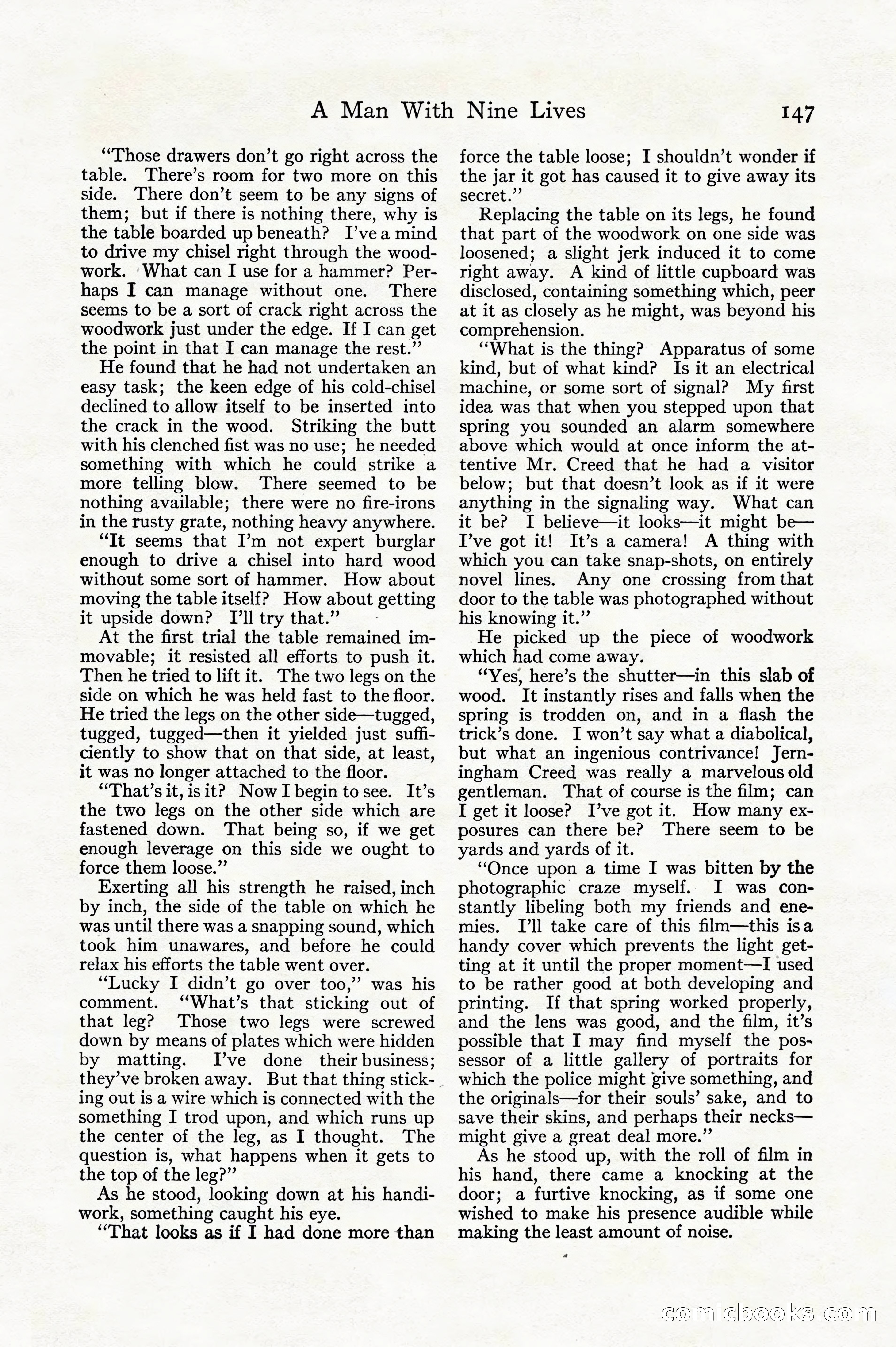
A restored page from Pulp Fiction, 1914. Page through the whole issue in the reader above.
📄 Transcribed text from this page (OCR, searchable)
Machine-transcribed from the original scan — historical spelling and the odd misread are preserved.
A Man With Nine Lives “Those drawers don’t go right across the table. There’s room for two more on this side. There don’t seem to be any signs of them; but if there is nothing there, why is the table boarded up beneath? I’vea mind to drive my chisel right through the wood- work. What can I use for a hammer? Per- haps I can manage without one. There seems to be a sort of crack right across the woodwork just under the edge. If I can get the point in that I can manage the rest.” He found that he had not undertaken an easy task; the keen edge of his cold-chisel declined to allow itself to be inserted into the crack in the wood. Striking the butt with his clenched fist was no use; he needed something with which he could strike a more telling blow. ‘There seemed to be nothing available; there were no fire-irons in the rusty grate, nothing heavy anywhere. “It seems that I’m not expert burglar enough to drive a chisel into hard wood without some sort of hammer. How about moving the table itself? How about getting it upside down? [’ll try that.” At the first trial the table remained im- movable; it resisted all efforts to push it. Then he tried to lift it. The two legs on the side on which he was held fast to the floor. He tried the legs on the other side—tugged, tugged, tugged—then it yielded just suff- ciently to show that on that side, at least, it was no longer attached to the floor. ‘“‘That’s it, is it? Now I begin tosee. It’s the two legs on the other side which are fastened down. That being so, if we get enough leverage on this side we ought to force them loose.”’ Exerting all his strength he raised, inch by inch, the side of the table on which he was until there was a snapping sound, which took him unawares, and before he could relax his efforts the table went over. “Lucky I didn’t go over too,’ was his comment. ‘What’s that sticking out of that leg? Those two legs were screwed down by means of plates which were hidden by matting. D’ve done their business; they’ve broken away. But that thing stick-. ing out is a wire which is connected with the something I trod upon, and which runs up the center of the leg, as I thought. The question is, what happens when it gets to the top of the leg?” As he stood, looking down at his handi- work, something caught his eye. “That looks as if I had done more than 147 force the table loose; I shouldn’t wonder if the jar it got has caused it to give away its secret.” Replacing the table on its legs, he found that part of the woodwork on one side was loosened; a slight jerk induced it to come right away. A kind of little cupboard was disclosed, containing something which, peer at it as closely as he might, was beyond his comprehension. ‘What is the thing? Apparatus of some kind, but of what kind? Is it an electrical machine, or some sort of signal? My first idea was that when you stepped upon that spring you sounded an alarm somewhere above which would at once inform the at- tentive Mr. Creed that he had a visitor below; but that doesn’t look as if it were anything in the signaling way. What can it be? I believe—it looks—it might be— I’ve got it! It’s a camera! A thing with which you can take snap-shots, on entirely novel lines. Any one crossing from that door to the table was photographed without his knowing it.” He picked up the piece of woodwork which had come away. “Ves, here’s the shutter—in this slab of wood. It instantly rises and falls when the spring is trodden on, and in a flash the trick’s done. I won’t say what a diabolical, but what an ingenious contrivance! Jern- ingham Creed was really a marvelous old gentleman. That of course is the film; can I get it loose? I’ve got it. How many ex- posures can there be? There seem to be yards and yards of it. “Once upon a time I was bitten by the photographic craze myself. I was con- stantly libeling both my friends and ene- mies. I’ll take care of this film—this isa handy cover which prevents the light get- ting at it until the proper moment—I used to be rather good at both developing and printing. If that spring worked properly, and the lens was good, and the film, it’s possible that I may find myself the pos- sessor of a little gallery of portraits for which the police might give something, and the originals—for their souls’ sake, and to save their skins, and perhaps their necks— might give a great deal more.” As he stood up, with the roll of film in his hand, there came a knocking at the door; a furtive knocking, as if some one wished to make his presence audible while making the least amount of noise. a MICLOOOK C©