
Pulp Fiction, 1914 · page 153 of 228
Adventure, December 1914 — page 153: what you’re looking at
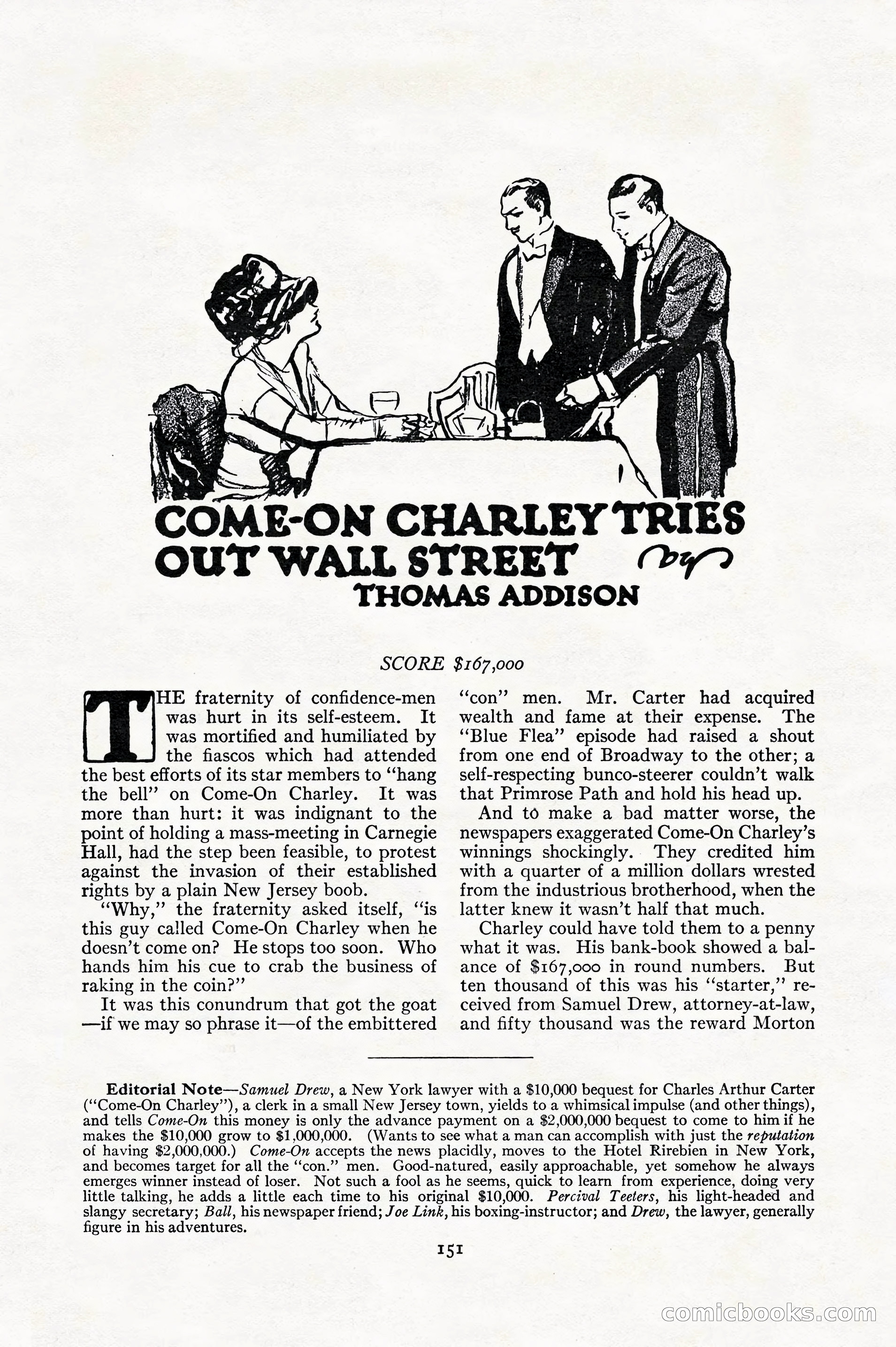
A restored page from Pulp Fiction, 1914. Page through the whole issue in the reader above.
📄 Transcribed text from this page (OCR, searchable)
Machine-transcribed from the original scan — historical spelling and the odd misread are preserved.
COME-ON CHARLEY Tere OUT WALL STREET or THOMAS ADDISON SCORE $167,000 f HE fraternity of confidence-men was hurt in its self-esteem. It was mortified and humiliated by the fiascos which had attended the best efforts of its star members to “hang the bell’? on Come-On Charley. It was more than hurt: it was indignant to the point of holding a mass-meeting in Carnegie Hall, had the step been feasible, to protest against the invasion of their established rights by a plain New Jersey boob. “Why,” the fraternity asked itself, ‘ this guy called Come-On Charley when he doesn’t come on? Hestops too soon. Who hands him his cue to crab the business of raking in the coin?” It was this conundrum that got the goat —1if we may so phrase it—of the embittered “con” men. Mr. Carter had acquired wealth and fame at their expense. The ‘“‘Blue Flea’ episode had raised a shout from one end of Broadway to the other; a self-respecting bunco-steerer couldn’t walk that Primrose Path and hold his head up. And to make a bad matter worse, the newspapers exaggerated Come-On Charley’s winnings shockingly. They credited him with a quarter of a million dollars wrested from the industrious brotherhood, when the latter knew it wasn’t half that much. Charley could have told them to a penny what it was. His bank-book showed a bal- ance of $167,000 in round numbers. But ten thousand of this was his “‘starter,’’ re- ceived from Samuel Drew, attorney-at-law, and fifty thousand was the reward Morton Editorial Note—Samuel Drew, a New York lawyer with a $10,000 bequest for Charles Arthur Carter (““Come-On Charley’’), a clerk in a small New Jersey town, yields to a whimsical impulse (and other things), and tells Come-On this money is only the advance payment on a $2,000,000 bequest to come to him if he makes the $10,000 grow to $1,000,000. (Wants to see what a man can accomplish with just the reputation of having $2,000,000.) Come-On accepts the news placidly, moves to the Hotel Rirebien in New York, and becomes target for all the ‘“‘con.”” men. Good-natured, easily approachable, yet somehow he always emerges winner instead of loser. Not such a fool as he seems, quick to learn from experience, doing very little talking, he adds a little each time to his original $10,000. Percival Teeters, his light-headed and slangy secretary; Ball, his newspaper friend; Joe Link, his boxing-instructor; and Drew, the lawyer, generally figure in his adventures. I5I OO C@