
Pulp Fiction, 1914 · page 158 of 228
Adventure, December 1914 — page 158: what you’re looking at
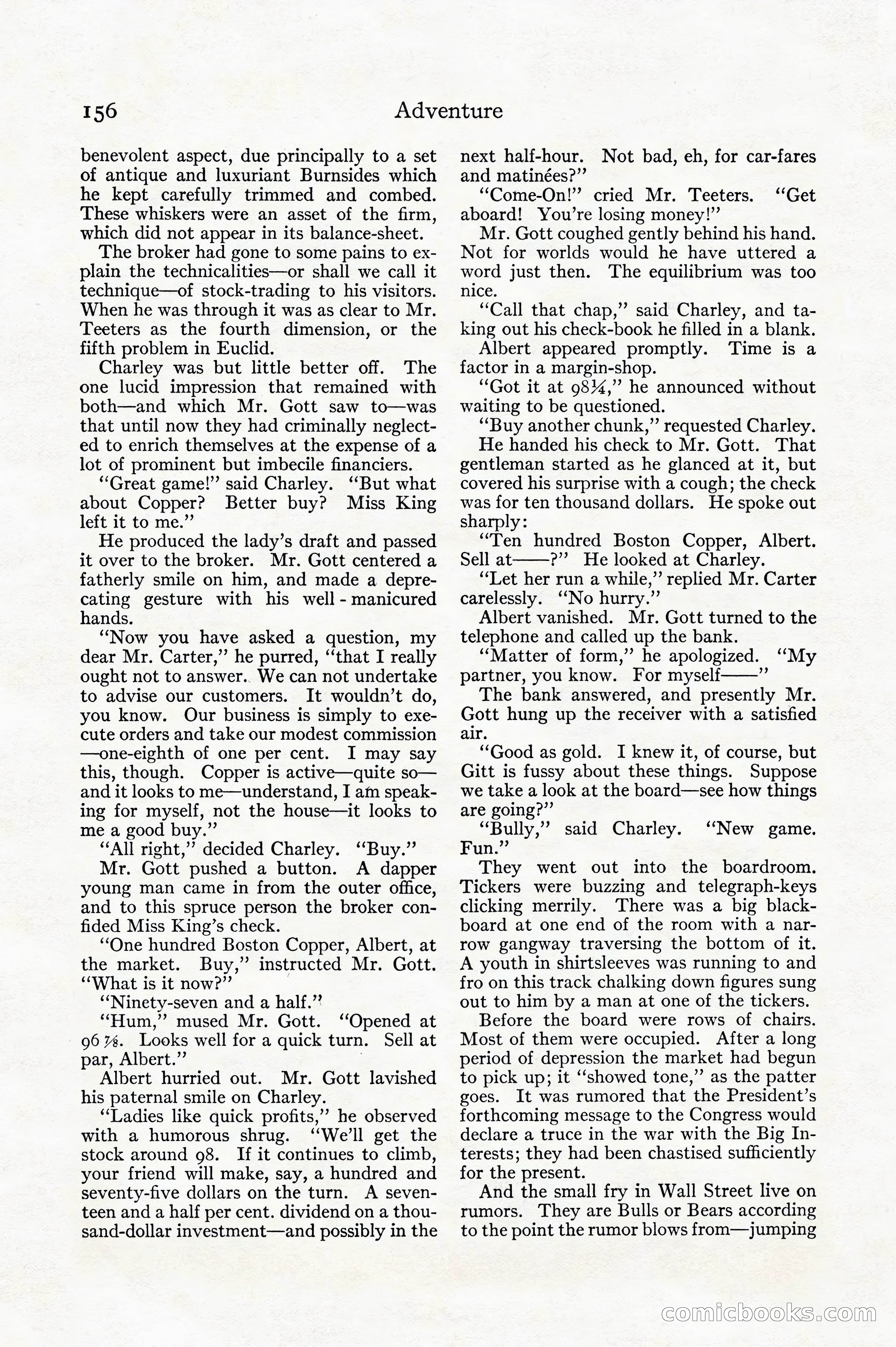
A restored page from Pulp Fiction, 1914. Page through the whole issue in the reader above.
📄 Transcribed text from this page (OCR, searchable)
Machine-transcribed from the original scan — historical spelling and the odd misread are preserved.
156 benevolent aspect, due principally to a set of antique and luxuriant Burnsides which he kept carefully trimmed and combed. These whiskers were an asset of the firm, which did not appear in its balance-sheet. The broker had gone to some pains to ex- plain the technicalities—or shall we call it technique—of stock-trading to his visitors. When he was through it was as clear to Mr. Teeters as the fourth dimension, or the fifth problem in Euclid. Charley was but little better off. The one lucid impression that remained with both—and which Mr. Gott saw to—was that until now they had criminally neglect- ed to enrich themselves at the expense of a lot of prominent but imbecile financiers. “Great game!” said Charley. “But what about Copper? Better buy? Miss King left it to me.” He produced the lady’s draft and passed it over to the broker. Mr. Gott centered a fatherly smile on him, and made a depre- cating gesture with his well - manicured hands. ‘“‘Now you have asked a question, my dear Mr. Carter,”’ he purred, “‘that I really ought not to answer.. We can not undertake to advise our customers. It wouldn’t do, you know. Our business is simply to exe- cute orders and take our modest commission —one-eighth of one per cent. I may say this, though. Copper is active—quite so— and it looks to me—understand, I am speak- ing for myself, not the house—it looks to me a good buy.” “fAll right,” decided Charley. ‘‘Buy.” Mr. Gott pushed a button. A dapper young man came in from the outer office, and to this spruce person the broker con- fided Miss King’s check. “One hundred Boston Copper, Albert, at the market. Buy,” instructed Mr. Gott. ‘“‘What is it now?” ‘‘Ninety-seven and a half.” “Hum,” mused Mr. Gott. “Opened at 96 7%. Looks well for a quick turn. Sell at par, Albert.” 7 Albert hurried out. Mr. Gott lavished his paternal smile on Charley. “Ladies like quick profits,’”’ he observed with a humorous shrug. “We'll get the stock around 98. If it continues to climb, your friend will make, say, a hundred and seventy-five dollars on the turn. A seven- teen and a half per cent. dividend on a thou- sand-dollar investment—and possibly in the Adventure next half-hour. and matinées?”’ ““Come-On!”’ cried Mr. Teeters. aboard! You’re losing money!” Mr. Gott coughed gently behind his hand. Not for worlds would he have uttered a word just then. The equilibrium was too nice. “Call that chap,” said Charley, and ta- king out his check-book he filled in a blank. Albert appeared promptly. Time is a factor in a margin-shop. “Got it at 984,” he announced without waiting to be questioned. ‘Buy another chunk,” requested Charley. He handed his check to Mr. Gott. That gentleman started as he glanced at it, but covered his surprise with a cough; the check was for ten thousand dollars. He spoke out sharply: “Ten hundred Boston Copper, Albert. Sell at——?” He looked at Charley. “Let her run a while,” replied Mr. Carter carelessly. ‘‘No hurry.” Albert vanished. Mr. Gott turned to the telephone and called up the bank. ““Matter of form,’’ he apologized. partner, you know. For myself The bank answered, and presently Mr. Gott hung up the receiver with a satisfied air. “Good as gold. I knew it, of course, but Gitt is fussy about these things. Suppose we take a look at the board—see how things are going?”’ “Bully,” said Charley. Fun.” They went out into the boardroom. Tickers were buzzing and telegraph-keys clicking merrily. There was a big black- board at one end of the room with a nar- row gangway traversing the bottom of it. A youth in shirtsleeves was running to and fro on this track chalking down figures sung out to him by a man at one of the tickers. Before the board were rows of chairs. Most of them were occupied. After a long period of depression the market had begun to pick up; it ‘“‘showed tone,” as the patter goes. It was rumored that the President’s forthcoming message to the Congress would declare a truce in the war with the Big In- terests; they had been chastised sufficiently for the present. And the small fry in Wall Street live on rumors. They are Bulls or Bears according to the point the rumor blows from—jumping Not bad, eh, for car-fares “Get “My ) ‘“‘New game. MICLOOOK (©