
Pulp Fiction, 1914 · page 17 of 228
Adventure, December 1914 — page 17: what you’re looking at
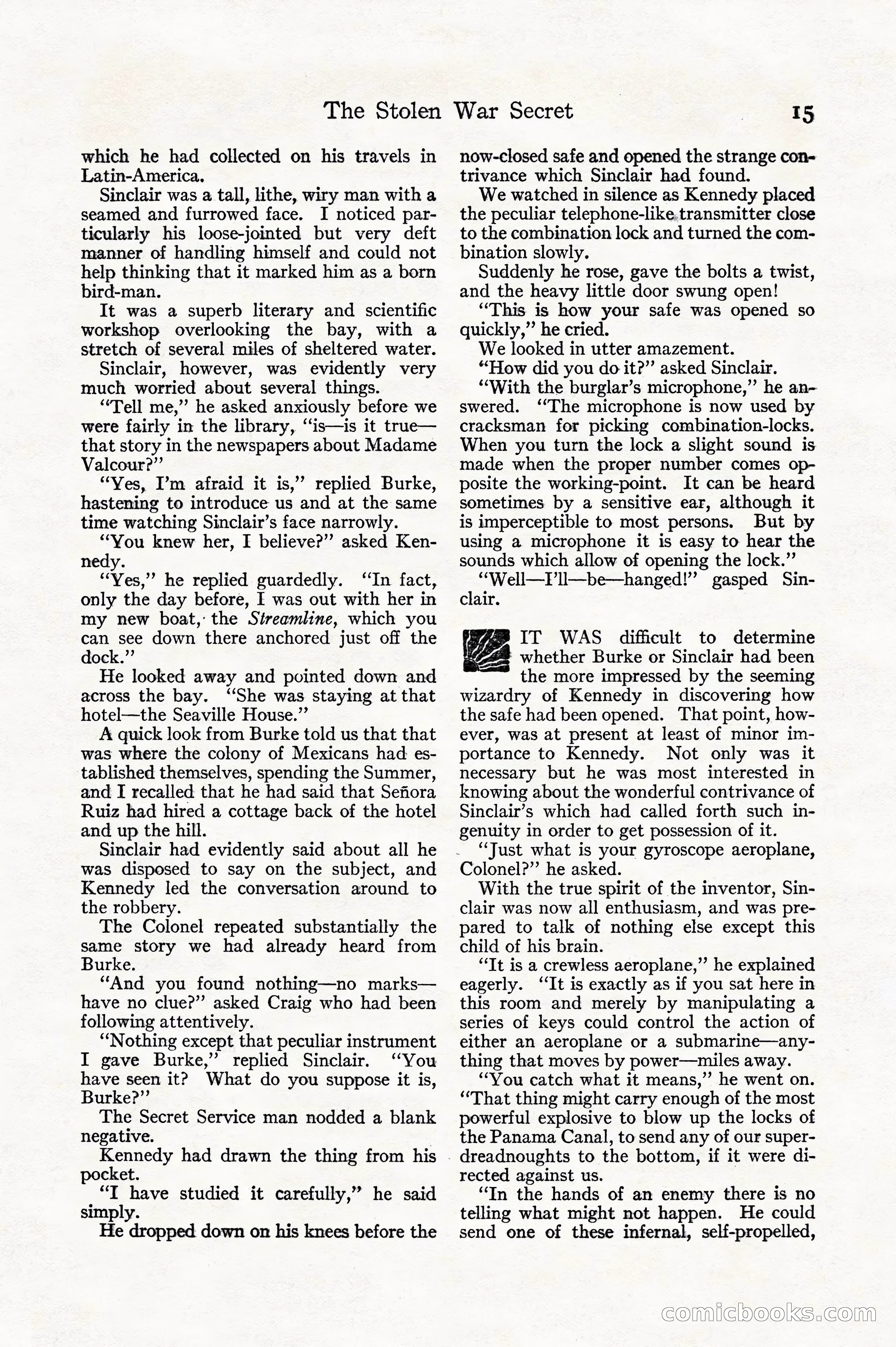
A restored page from Pulp Fiction, 1914. Page through the whole issue in the reader above.
📄 Transcribed text from this page (OCR, searchable)
Machine-transcribed from the original scan — historical spelling and the odd misread are preserved.
The Stolen which he had collected on his travels in Latin-America, Sinclair was a tall, lithe, wiry man with a seamed and furrowed face. I noticed par- ticularly his loose-jointed but very deft manner of handling himself and could not help thinking that it marked him as a born bird-man. It was a superb literary and scientific workshop overlooking the bay, with a stretch of several miles of sheltered water. Sinclair, however, was evidently very much worried about several things. ‘“‘Tell me,” he asked anxiously before we were fairly in the library, ‘‘is—is it true— that story in the newspapers about Madame Valcour?”’ “Ves, I’m afraid it is,’’ replied Burke, hastening to introduce us and at the same time watching Sinclair’s face narrowly. “You knew her, I believe?’ asked Ken- nedy. “Ves,” he replied guardedly. ‘In fact, only the day before, I was out with her in my new boat, the Streamline, which you can see down there anchored just off the dock.”’ He looked away and pvinted down and across the bay. “She was staying at that hotel—the Seaville House.”’ A quick look from Burke told us that that was where the colony of Mexicans had es- tablished themselves, spending the Summer, and I recalled that he had said that Sefiora Ruiz had hired a cottage back of the hotel and up the hill. Sinclair had evidently said about all he was disposed to say on the subject, and Kennedy led the conversation around to the robbery. The Colonel repeated substantially the same story we had already heard from Burke. “And you found nothing—no marks— have no cluer”’ asked Craig who had been following attentively. ‘Nothing except that peculiar instrument I gave Burke,” replied Sinclair. ‘You have seen it? What do you suppose it is, Burke?” The Secret Service man nodded a blank negative. | Kennedy had drawn the thing from his pocket. “T have studied it carefully,” he said simply. He dropped down on his knees before the War Secret 15 now-closed safe and opened the strange con- trivance which Sinclair had found. We watched in silence as Kennedy placed the peculiar telephone-like.transmitter close to the combination lock and turned the com- bination slowly. Suddenly he rose, gave the bolts a twist, and the heavy little door swung open! “This is how your safe was opened so quickly,” he cried. We looked in utter amazement. “How did you do it?” asked Sinclair. ‘With the burglar’s microphone,” he an- swered. ‘The microphone is now used by cracksman for picking combination-locks. When you turn the lock a slight sound is made when the proper number comes op- posite the working-point. It can be heard sometimes by a sensitive ear, although it is imperceptible to most persons. But by using a microphone it is easy to hear the sounds which allow of opening the lock.” ‘“‘Well—I’ll—be—hanged!”’ gasped Sin- clair. IT WAS difficult to determine whether Burke or Sinclair had been the more impressed by the seeming wizardry of Kennedy in discovering how the safe had been opened. That point, how- ever, was at present at least of minor im- portance to Kennedy. Not only was it necessary but he was most interested in knowing about the wonderful contrivance of Sinclair’s which had called forth such in- genuity in order to get possession of it. “Just what is your gyroscope aeroplane, Colonel?” he asked. With the true spirit of the inventor, Sin- clair was now all enthusiasm, and was pre- pared to talk of nothing else except this child of his brain. “Tt is a crewless aeroplane,” he explained eagerly. “It is exactly as if you sat here in this room and merely by manipulating a series of keys could control the action of either an aeroplane or a submarine—any- thing that moves by power—miles away. ‘“You catch what it means,”’ he went on. “That thing might carry enough of the most powerful explosive to blow up the locks of the Panama Canal, to send any of our super- . dreadnoughts to the bottom, if it were di- rected against us. “In the hands of an enemy there is no telling what might not happen. He could send one of these infernal, self-propelled, DOOK C©