
Pulp Fiction, 1914 · page 181 of 228
Adventure, December 1914 — page 181: what you’re looking at
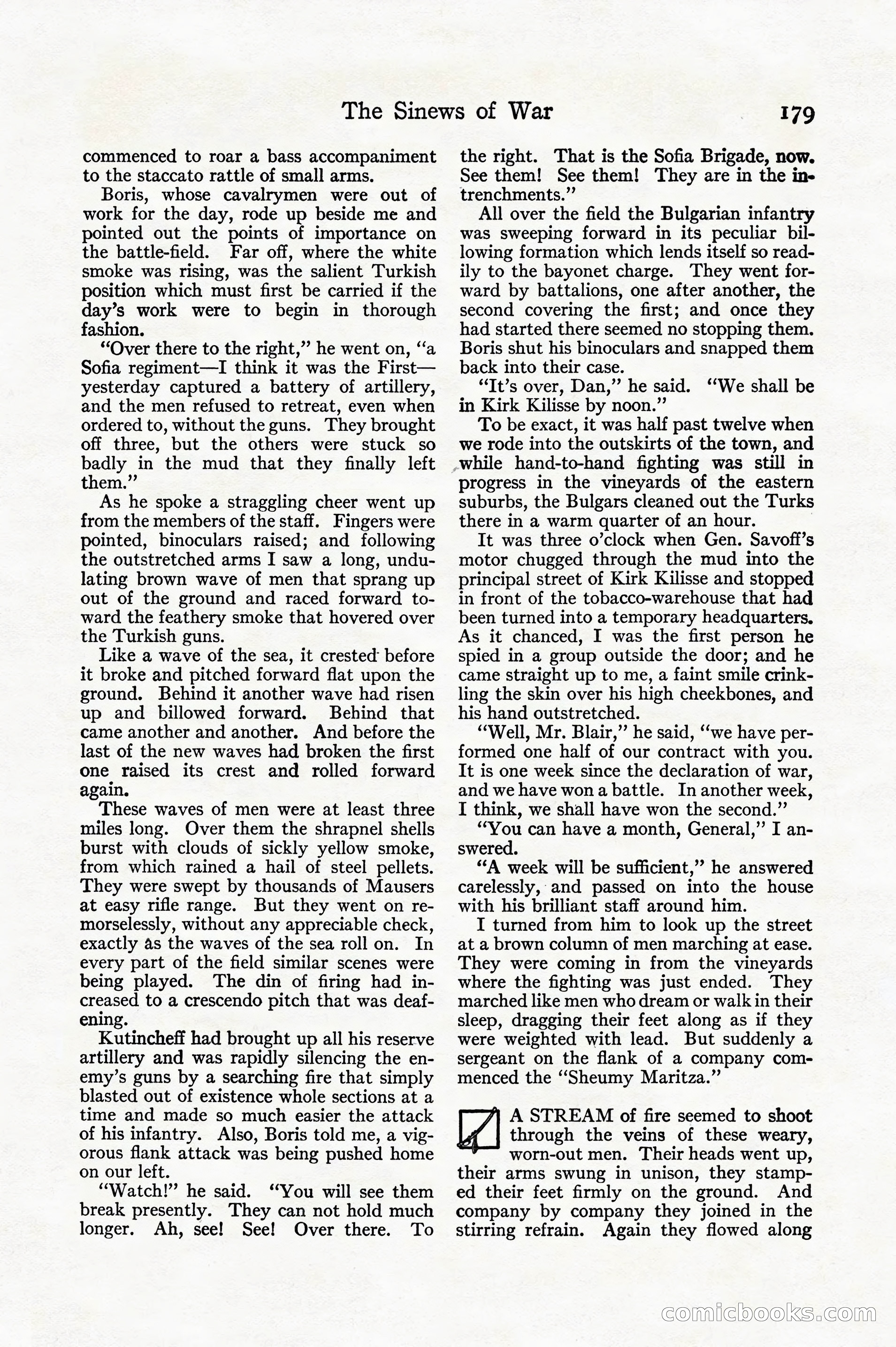
A restored page from Pulp Fiction, 1914. Page through the whole issue in the reader above.
📄 Transcribed text from this page (OCR, searchable)
Machine-transcribed from the original scan — historical spelling and the odd misread are preserved.
The Sinews of War commenced to roar a bass accompaniment to the staccato rattle of small arms. Boris, whose cavalrymen were out of work for the day, rode up beside me and pointed out the points of importance on the battle-field. Far off, where the white smoke was rising, was the salient Turkish position which must first be carried if the day’s work were to begin in thorough fashion. ‘Over there to the right,”’ he went on, “‘a Sofia regiment—I think it was the First— yesterday captured a battery of artillery, and the men refused to retreat, even when ordered to, without the guns. They brought off three, but the others were stuck so badly in the mud that they finally left them.” As he spoke a straggling cheer went up from the members of the staff. Fingers were pointed, binoculars raised; and following the outstretched arms I saw a long, undu- lating brown wave of men that sprang up out of the ground and raced forward to- ward the feathery smoke that hovered over the Turkish guns. Like a wave of the sea, it crested before it broke and pitched forward flat upon the ground. Behind it another wave had risen up and billowed forward. Behind that came another and another. And before the last of the new waves had broken the first one raised its crest and rolled forward again. These waves of men were at least three miles long. Over them the shrapnel shells burst with clouds of sickly yellow smoke, from which rained a hail of steel pellets. They were swept by thousands of Mausers at easy rifle range. But they went on re- morselessly, without any appreciable check, exactly 4s the waves of the sea roll on. In every part of the field similar scenes were being played. The din of firing had in- creased to a crescendo pitch that was deaf- ening. Kutincheff had brought up all his reserve artillery and was rapidly silencing the en- emy’s guns by a searching fire that simply blasted out of existence whole sections at a time and made so much easier the attack of his infantry. Also, Boris told me, a vig- orous flank attack was being pushed home on our left. “Watch!” he said. ‘You will see them break presently. They can not hold much longer. Ah, see! See! Over there. To 179 the right. That is the Sofia Brigade, now. See them! See them! They are in the ine trenchments.”’ All over the field the Bulgarian infantry was sweeping forward in its peculiar bil- lowing formation which lends itself so read- ily to the bayonet charge. They went for- ward by battalions, one after another, the second covering the first; and once they had started there seemed no stopping them. Boris shut his binoculars and snapped them back into their case. “It’s over, Dan,” he said. ‘‘We shall be in Kirk Kilisse by noon.” To be exact, it was half past twelve when we rode into the outskirts of the town, and -while hand-to-hand fighting was still in progress in the vineyards of the eastern suburbs, the Bulgars cleaned out the Turks there in a warm quarter of an hour. | It was three o’clock when Gen. Savoff’s motor chugged through the mud into the principal street of Kirk Kilisse and stopped in front of the tobacco-warehouse that had been turned into a temporary headquarters. As it chanced, I was the first person he spied in a group outside the door; and he came straight up to me, a faint smile crink- ling the skin over his high cheekbones, and his hand outstretched. ‘Well, Mr. Blair,’’ he said, ‘‘we have per- formed one half of our contract with you. It is one week since the declaration of war, and we have wona battle. In another week, I think, we shall have won the second.” *““You can have a month, General,” I an- swered. ‘“A week will be sufficient,” he answered carelessly, and passed on into the house with his brilliant staff around him. I turned from him to look up the street at a brown column of men marching at ease. They were coming in from the vineyards where the fighting was just ended. They marched like men who dream or walk in their sleep, dragging their feet along as if they were weighted with lead. But suddenly a sergeant on the flank of a company com- menced the ‘‘Sheumy Maritza.” FA through the veins of these weary, worn-out men. Their heads went up, their arms swung in unison, they stamp- ed their feet firmly on the ground. And company by company they joined in the stirring refrain. Again they flowed along A STREAM of fire seemed to shoot NOOK C©