
Pulp Fiction, 1914 · page 20 of 228
Adventure, December 1914 — page 20: what you’re looking at
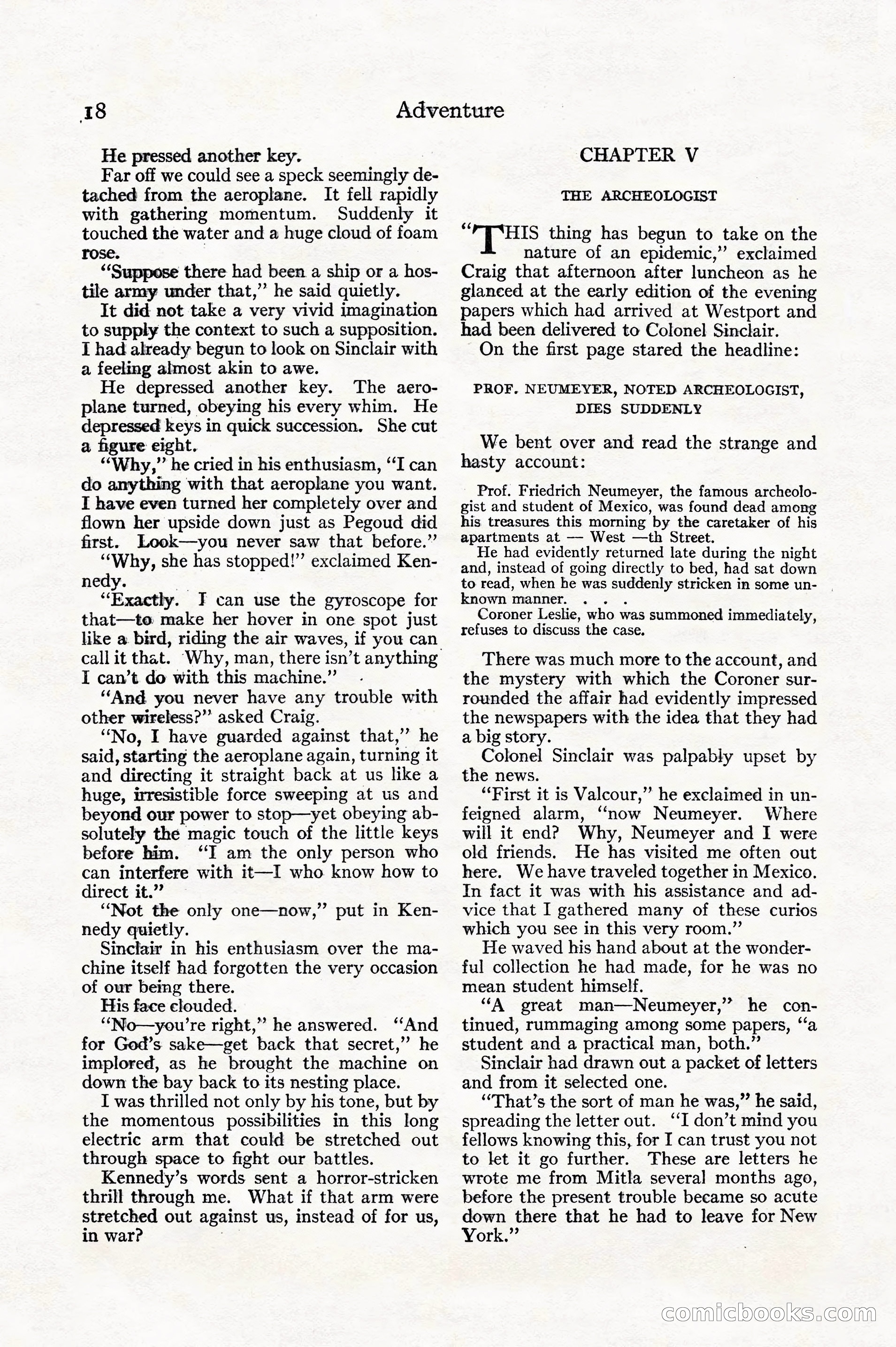
A restored page from Pulp Fiction, 1914. Page through the whole issue in the reader above.
📄 Transcribed text from this page (OCR, searchable)
Machine-transcribed from the original scan — historical spelling and the odd misread are preserved.
18 He pressed another key. Far off we could see a speck seemingly de- tached from the aeroplane. It fell rapidly with gathering momentum. Suddenly it touched the water and a huge cloud of foam rose. ‘‘Suppose there had been a ship or a hos- tile army under that,” he said quietly. It did not take a very vivid imagination to supply the context to such a supposition. I had already begun to look on Sinclair with a feeling almost akin to awe. He depressed another key. The aero- plane turned, obeying his every whim. He depressed keys in quick succession. She cut a figure eight. “Why,” he cried in his enthusiasm, “I can do anything with that aeroplane you want. I have even turned her completely over and flown her upside down just as Pegoud did first. Look—you never saw that before.” ‘“‘Why, she has stopped!” exclaimed Ken- nedy. ies “Exactly. JF can use the gyroscope for that—to make her hover in one spot just like a bird, riding the air waves, if you can. call it that. ‘Why, man, there isn’t anything I can’t do with this machine.”’ ‘“‘And. you never have any trouble with other wireless?” asked Craig. “No, I have guarded against that,’”’ he said, starting the aeroplane again, turning it and directing it straight back at us like a huge, irresistible force sweeping at us and beyond our power to stop—yet obeying ab- solutely the magic touch of the little keys before him. “I am the only person who can interfere with it—I who know how to direct it.” ‘“‘Not the only one—now,”’ put in Ken- nedy quietly. Sinclair in his enthusiasm over the ma- chine itself had forgotten the very occasion of our bemg there. His face clouded. “‘Nio—you’re right,” he answered. “And for God’s sake—get back that secret,” he implored, as he brought the machine on down the bay back to its nesting place. I was thrilled not only by his tone, but by the momentous possibilities in this long electric arm that could be stretched out through space to fight our battles. Kennedy’s words sent a horror-stricken thrill through me. What if that arm were stretched out against us, instead of for us, in ware eo Adventure CHAPTER V THE ARCHEOLOGIST “THIS thing has begun to take on the nature of an epidemic,” exclaimed Craig that afternoon after luncheon as he glanced at the early edition of the evening papers which had arrived at Westport and had been delivered to Colonel Sinclair. On the first page stared the headline: PROF. NEUMEYER, NOTED ARCHEOLOGIST, DIES SUDDENLY We bent over and read the strange and hasty account: Prof. Friedrich Neumeyer, the famous archeolo- gist and student of Mexico, was found dead among his treasures this morning by the caretaker of his apartments at —- West —th Street. He had evidently returned late during the night and, instead of going directly to bed, had sat down to read, when he was suddenly stricken in some un- | known manner. Zn, Coroner Leslie, who was summoned immediately, refuses to discuss the case. There was much more to the account, and the mystery with which the Coroner sur- rounded the affair had evidently impressed the newspapers with the idea that they had a big story. Colonel Sinclair was palpably upset by the news. “First it is Valcour,” he exclaimed in un- feigned alarm, “now Neumeyer. Where will it end? Why, Neumeyer and I were old friends. He has visited me often out here. We have traveled together in Mexico. In fact it was with his assistance and ad- vice that I gathered many of these curios which you see in this very room.” He waved his hand about at the wonder- ful collection he had made, for he was no mean student himself. “A great man—Neumeyer,” he con- tinued, rummaging among some papers, ‘‘a student and a practical man, both.” Sinclair had drawn out a packet of letters and from it selected one. ‘“‘That’s the sort of man he was,” he said, spreading the letter out. ‘‘I don’t mind you fellows knowing this, for I can trust you not to let it go further. These are letters he wrote me from Mitla several months ago, before the present trouble became so acute down there that he had to leave for New York.” > MICLOOOK C@