
Pulp Fiction, 1914 · page 23 of 228
Adventure, December 1914 — page 23: what you’re looking at
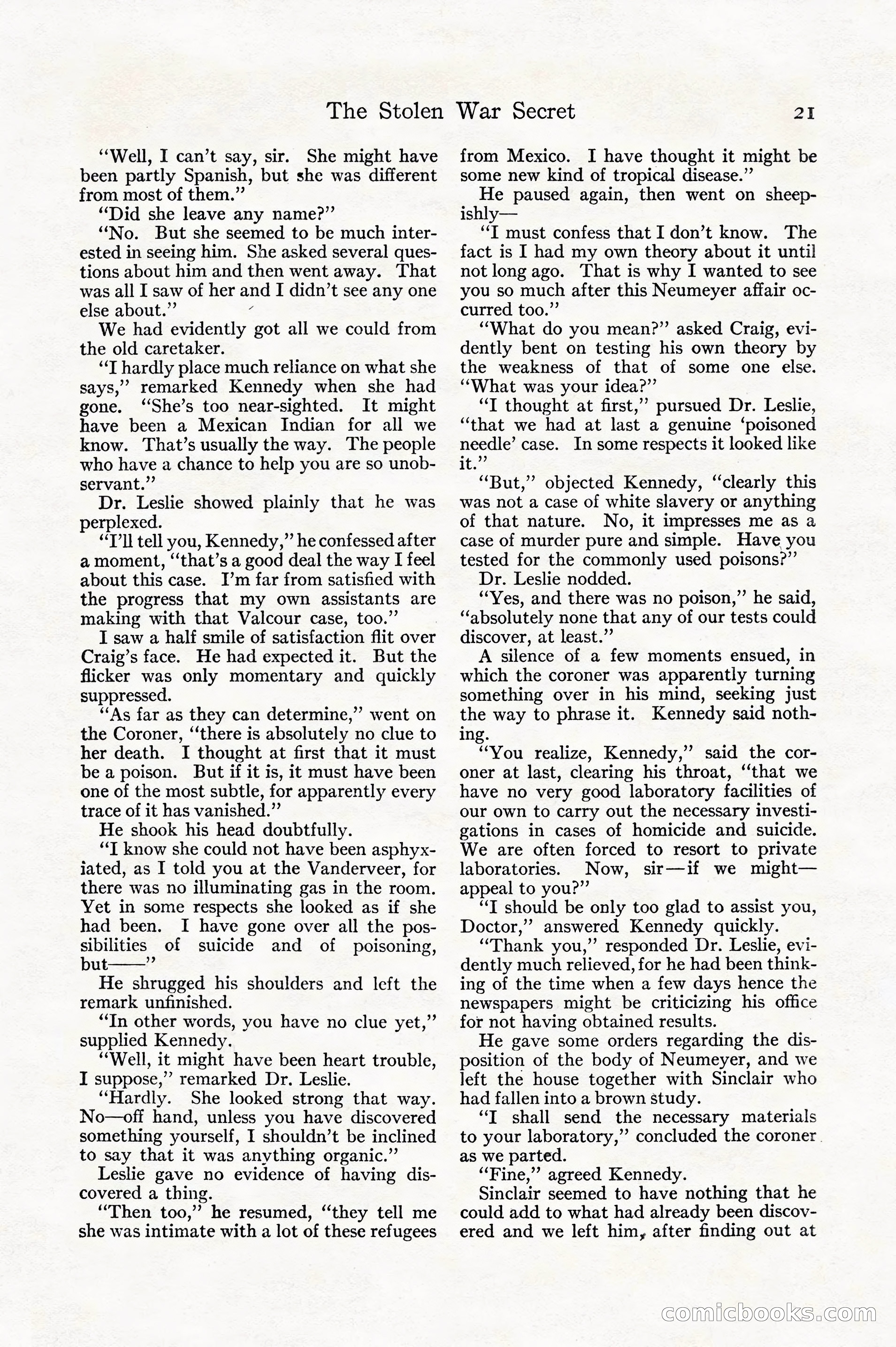
A restored page from Pulp Fiction, 1914. Page through the whole issue in the reader above.
📄 Transcribed text from this page (OCR, searchable)
Machine-transcribed from the original scan — historical spelling and the odd misread are preserved.
The Stolen War Secret “Well, I can’t say, sir. She might have been partly Spanish, but she was different from most of them.” “Did she leave any name?” “No. But she seemed to be much inter- ested in seeing him. She asked several ques- tions about him and then went away. That was all I saw of her and I didn’t see any one else about.” 2 We had evidently got all we could from the old caretaker. “T hardly place much reliance on what she says,” remarked Kennedy when she had gone. ‘She’s too near-sighted. It might have been a Mexican Indian for all we know. That’s usually the way. The people who have a chance to help you are so unob- servant.” Dr. Leslie showed plainly that he was perplexed. “T’ll tell you, Kennedy,” he confessed after a moment, ‘‘that’s a good deal the way I feel about this case. I’m far from satisfied with the progress that my own assistants are making with that Valcour case, too.” I saw a half smile of satisfaction flit over Craig’s face. He had expected it. But the flicker was only momentary and quickly suppressed. ‘“‘As far as they can determine,”’ went on the Coroner, “‘there is absolutely no clue to her death. I thought at first that it must be a poison. But if it is, it must have been one of the most subtle, for apparently every trace of it has vanished.”’ He shook his head doubtfully. “IT know she could not have been asphyx- iated, as I told you at the Vanderveer, for there was no illuminating gas in the room. Yet in some respects she looked as if she had been. I have gone over all the pos- sibilities of suicide and of poisoning, but . He shrugged his shoulders and left the remark unfinished. “In other words, you have no clue yet,” supplied Kennedy. ‘Well, it might have been heart trouble, I suppose,’ remarked Dr. Leslie. “Hardly. She looked strong that way. No—off hand, unless you have discovered something yourself, I shouldn’t be inclined to say that it was anything organic.” Leshe gave no evidence of having dis- covered a thing. “Then too,” he resumed, “‘they tell me she was intimate with a lot of these refugees 2I from Mexico. I have thought it might be some new kind of tropical disease.”’ He paused again, then went on sheep- ishly— ‘“T must confess that I don’t know. The fact is I had my own theory about it until not long ago. That is why I wanted to see you so much after this Neumeyer affair oc- curred too.”’ ‘What do you mean?” asked Craig, evi- dently bent on testing his own theory by the weakness of that of some one else. ‘‘What was your idea?”’ “T thought at first,’’ pursued Dr. Leslie, “that we had at last a genuine ‘poisoned needle’ case. In some respects it looked like it.” “But,” objected Kennedy, ‘“‘clearly this was not a case of white slavery or anything of that nature. No, it impresses me as a case of murder pure and simple. Have you tested for the commonly used poisons?”’ Dr. Leslie nodded. “Yes, and there was no poison,” he said, “absolutely none that any of our tests could discover, at least.” A silence of a few moments ensued, in which the coroner was apparently turning something over in his mind, seeking just the way to phrase it. Kennedy said noth- ing. “You realize, Kennedy,” said the cor- oner at last, clearing his throat, ‘that we have no very good laboratory facilities of our own to carry out the necessary investi- gations in cases of homicide and suicide. We are often forced to resort to private laboratories. Now, sir—if we might— appeal to you?” “T should be only too glad to assist you, Doctor,’’ answered Kennedy quickly. “Thank you,” responded Dr. Leslie, evi- dently much relieved, for he had been think- ing of the time when a few days hence the newspapers might be criticizing his office for not having obtained results. He gave some orders regarding the dis- position of the body of Neumeyer, and we left the house together with Sinclair who had fallen into a brown study. “T shall send the necessary materials to your laboratory,’’ concluded the coroner. as we parted. “Fine,” agreed Kennedy. Sinclair seemed to have nothing that he could add to what had already been discov- ered and we left him, after finding out at MICLOOOK C©