
Pulp Fiction, 1914 · page 25 of 228
Adventure, December 1914 — page 25: what you’re looking at
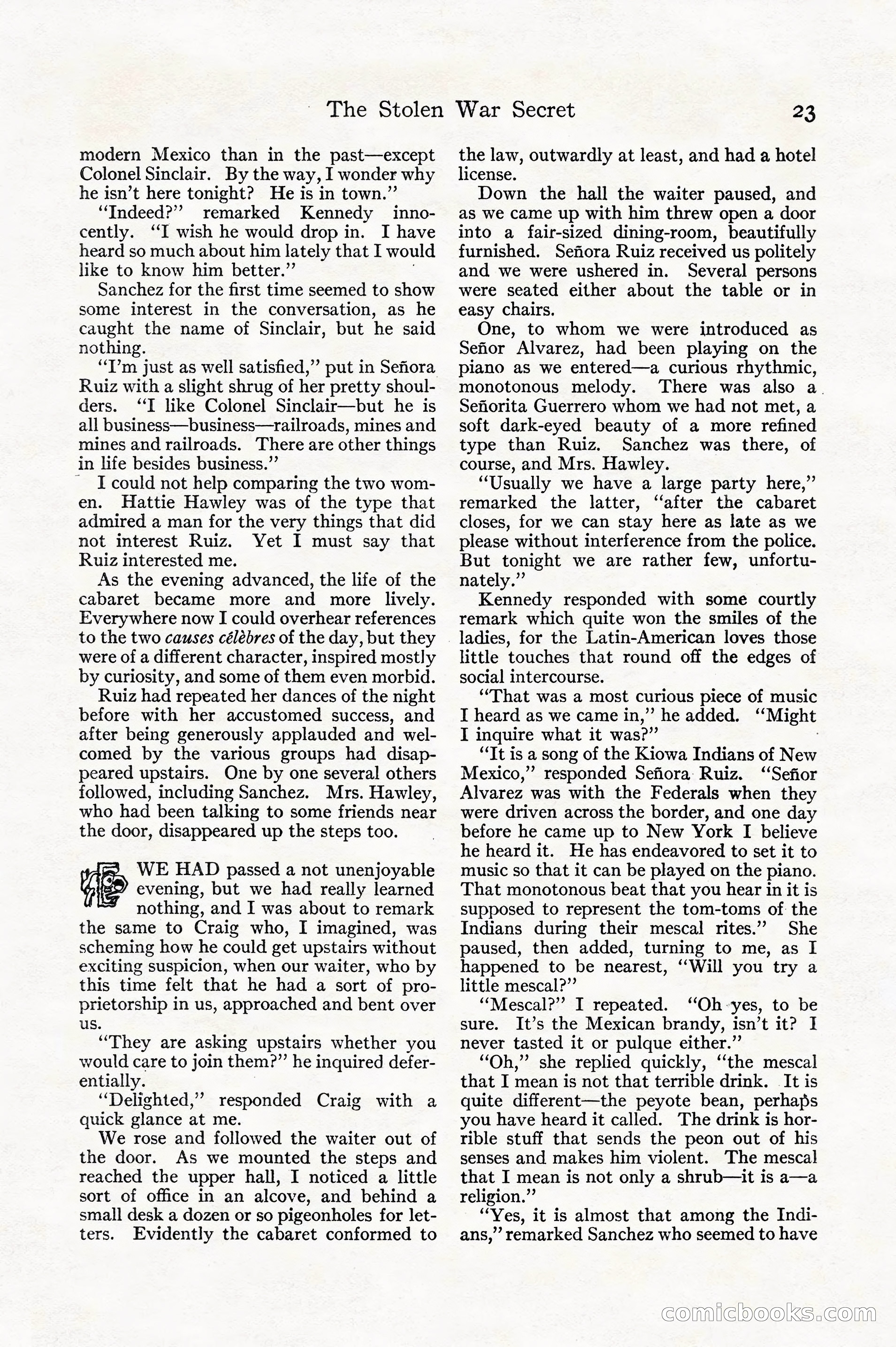
A restored page from Pulp Fiction, 1914. Page through the whole issue in the reader above.
📄 Transcribed text from this page (OCR, searchable)
Machine-transcribed from the original scan — historical spelling and the odd misread are preserved.
The Stolen War Secret modern Mexico than in the past—except Colonel Sinclair. By the way, I wonder why he isn’t here tonight? He is in town.” ‘“‘Indeed?”? remarked Kennedy inno- cently. ‘I wish he would drop in. I have heard so much about him lately that I would like to know him better.” Sanchez for the first time seemed to show some interest in the conversation, as he caught the name of Sinclair, but he said nothing. “I’m just as well satisfied,” put in Sefiora Ruiz with a slight shrug of her pretty shoul- ders. “I like Colonel Sinclair—but he is all business—business—railroads, mines and mines and railroads. There are other things in life besides business.”’ I could not help comparing the two wom- en. Hattie Hawley was of the type that admired a man for the very things that did not interest Ruiz. Yet I must say that Ruiz interested me. As the evening advanced, the life of the cabaret became more and more lively. Everywhere now I could overhear references to the two causes célébres of the day, but they were of a different character, inspired mostly by curiosity, and some of them even morbid. Ruiz had repeated her dances of the night before with her accustomed success, and after being generously applauded and wel- comed by the various groups had disap- peared upstairs. One by one several others followed, including Sanchez. Mrs. Hawley, who had been talking to some friends near the door, disappeared up the steps too. Mae evening, but we had really learned nothing, and I was about to remark the same to Craig who, I imagined, was scheming how he could get upstairs without exciting suspicion, when our waiter, who by this time felt that he had a sort of pro- prietorship in us, approached and bent over us. “They are asking upstairs whether you would care to join them?”’ he inquired defer- entially. ‘““Delighted,’”’? responded Craig with a quick glance at me. We rose and followed the waiter out of the door. As we mounted the steps and reached the upper hall, I noticed a little sort of office in an alcove, and behind a small desk a dozen or so pigeonholes for let- ters. Evidently the cabaret conformed to WE HAD passed a not unenjoyable 23 the law, outwardly at least, and had a hotel license. Down the hall the waiter paused, and as we came up with him threw open a door into a fair-sized dining-room, beautifully furnished. Sefora Ruiz received us politely and we were ushered in. Several persons were seated either about the table or in easy chairs. One, to whom we were introduced as Sefor Alvarez, had been playing on the piano as we entered—a curious rhythmic, monotonous melody. There was also a. Sefiorita Guerrero whom we had not met, a soft dark-eyed beauty of a more refined type than Ruiz. Sanchez was there, of course, and Mrs. Hawley. “Usually we have a large party here,” remarked the latter, ‘‘after the cabaret closes, for we can stay here as late as we please without interference from the police. But tonight we are rather few, unfortu- nately.” Kennedy responded with some courtly remark which quite won the smiles of the ladies, for the Latin-American loves those little touches that round off the edges of social intercourse. ‘‘That was a most curious piece of music I heard as we came in,” he added. “Might I inquire what it was?” “It is a song of the Kiowa Indians of New Mexico,” responded Sefiora Ruiz. ‘Sefior Alvarez was with the Federals when they were driven across the border, and one day before he came up to New York I believe he heard it. He has endeavored to set it to music so that it can be played on the piano. That monotonous beat that you hear in it is supposed to represent the tom-toms of the Indians during their mescal rites.’”’ She paused, then added, turning to me, as I happened to be nearest, “Will you try a little mescal?”’ ““Mescal?”’ I repeated. “Oh-yes, to be sure. It’s the Mexican brandy, isn’t it? I never tasted it or pulque either.” “Oh,” she replied quickly, “‘the mescal that I mean is not that terrible drink. It is quite different—the peyote bean, perhaps you have heard it called. The drink is hor- rible stuff that sends the peon out of his senses and makes him violent. The mescal that I mean is not only a shrub—it is a—a religion.” “Yes, it is almost that among the Indi- ans,’’ remarked Sanchez who seemed to have MICLOOOK C©