
Pulp Fiction, 1914 · page 27 of 228
Adventure, December 1914 — page 27: what you’re looking at
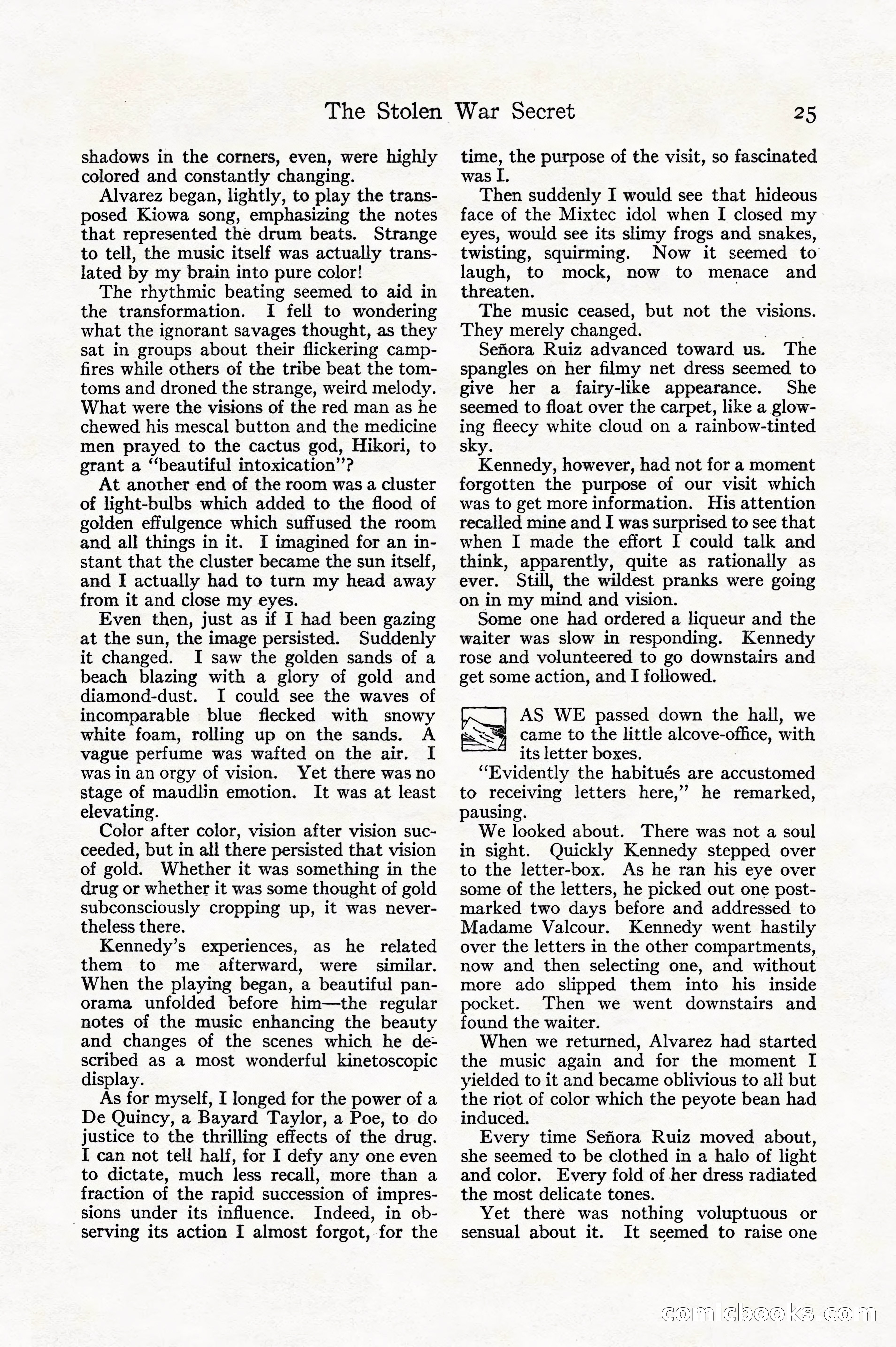
A restored page from Pulp Fiction, 1914. Page through the whole issue in the reader above.
📄 Transcribed text from this page (OCR, searchable)
Machine-transcribed from the original scan — historical spelling and the odd misread are preserved.
The Stolen War Secret shadows in the corners, even, were highly colored and constantly changing. Alvarez began, lightly, to play the trans- posed Kiowa song, emphasizing the notes that represented the drum beats. Strange to tell, the music itself was actually trans- lated by my brain into pure color! The rhythmic beating seemed to aid in the transformation. I fell to wondering what the ignorant savages thought, as they sat in groups about their flickering camp- fires while others of the tribe beat the tom- toms and droned the strange, weird melody. What were the visions of the red man as he chewed his mescal button and the medicine men prayed to the cactus god, Hikori, to grant a “beautiful intoxication’’? At another end of the room was a cluster of light-bulbs which added to the flood of golden effulgence which suffused the room and all things in it. I imagined for an in- stant that the cluster became the sun itself, and I actually had to turn my head away from it and close my eyes. Even then, just as if I had been gazing at the sun, the image persisted. Suddenly it changed. I saw the golden sands of a beach blazing with a glory of gold and diamond-dust. I could see the waves of incomparable blue flecked with snowy white foam, rolling up on the sands. A vague perfume was wafted on the air. I was in an orgy of vision. Yet there was no stage of maudlin emotion. It was at least elevating. Color after color, vision after vision suc- ceeded, but in all there persisted that vision of gold. Whether it was something in the drug or whether it was some thought of gold subconsciously cropping up, it was never- theless there. Kennedy’s experiences, as he related them to me afterward, were similar. When the playing began, a beautiful pan- orama unfolded before him—the regular notes of the music enhancing the beauty and changes of the scenes which he de- scribed as a most wonderful kinetoscopic display. As for myself, I longed for the power of a De Quincy, a Bayard Taylor, a Poe, to do justice to the thrilling effects of the drug. I can not tell half, for I defy any one even to dictate, much less recall, more than a fraction of the rapid succession of impres- sions under its influence. Indeed, in ob- serving its action I almost forgot, for the 29 time, the purpose of the visit, so fascinated was I, Then suddenly I would see that hideous face of the Mixtec idol when I closed my eyes, would see its slimy frogs and snakes, twisting, squirming. laugh, to mock, now to menace and threaten. The music ceased, but not the visions. They merely changed. Sefora Ruiz advanced toward us. The spangles on her filmy net dress seemed to give her a fairy-like appearance. She seemed to float over the carpet, like a glow- ing fleecy white cloud on a rainbow-tinted sky. Kennedy, however, had not for a moment forgotten the purpose of our visit which was to get more information. His attention recalled mine and I was surprised to see that when I made the effort I could talk and think, apparently, quite as rationally as ever. Still, the wildest pranks were going on in my mind and vision. Some one had ordered a liqueur and the waiter was slow in responding. Kennedy rose and volunteered to go downstairs and get some action, and I followed. = came to the little alcove- office, with its letter boxes. “Evidently the habitués are accustomed to receiving letters here,” he remarked, pausing. We looked about. There was not a soul in sight. Quickly Kennedy stepped over to the letter-box. As he ran his eye over some of the letters, he picked out one post- marked two days before and addressed to Madame Valcour. Kennedy went hastily over the letters in the other compartments, now and then selecting one, and without more ado slipped them into his inside pocket. Then we went downstairs and found the waiter. When we returned, Alvarez had started the music again and for the moment I yielded to it and became oblivious to all but the riot of color which the peyote bean had induced. Every time Sefiora Ruiz moved about, she seemed to be clothed in a halo of light and color. Every fold of her dress radiated the most delicate tones. Yet theré was nothing voluptuous or sensual about it. It seemed to raise one AS WE passed down the hall, we DOOLK Now it seemed to C@