
Pulp Fiction, 1914 · page 29 of 228
Adventure, December 1914 — page 29: what you’re looking at
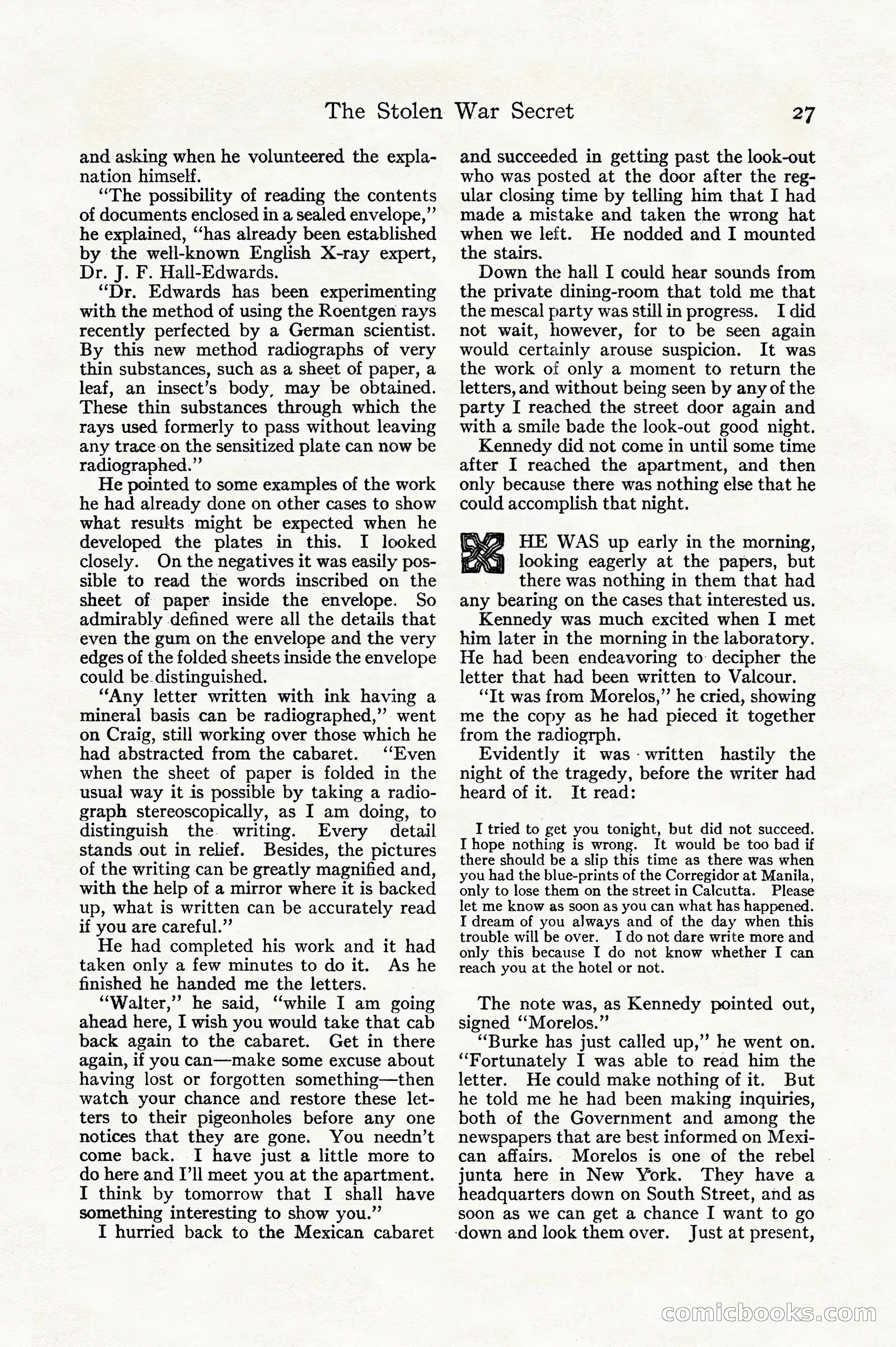
A restored page from Pulp Fiction, 1914. Page through the whole issue in the reader above.
📄 Transcribed text from this page (OCR, searchable)
Machine-transcribed from the original scan — historical spelling and the odd misread are preserved.
The Stolen War Secret and asking when he volunteered the expla- nation himself. “The possibility of reading the contents of documents enclosed in a sealed envelope,” he explained, “‘has already been established by the well-known English X-ray expert, Dr. J. F. Hall-Edwards. “Dr. Edwards has been experimenting with the method of using the Roentgen rays recently perfected by a German scientist. By this new method radiographs of very thin substances, such as a sheet of paper, a leaf, an insect’s body, may be obtained. These thin substances through which the rays used formerly to pass without leaving any trace-on the sensitized plate can now be radiographed.”’ He pointed to some examples of the work he had already done on other cases to show what results might be expected when he developed the plates in this. I looked closely. On the negatives it was easily pos- sible to read the words inscribed on the sheet of paper inside the envelope. So admirably defined were all the details that even the gum on the envelope and the very edges of the folded sheets inside the envelope could be. distinguished. “Any letter written with ink having a mineral basis can be radiographed,’’. went on Craig, still working over those which he had abstracted from the cabaret. ‘‘Even when the sheet of paper is folded in the usual way it is possible by taking a radio- graph stereoscopically, as I am doing, to distinguish the. writing. Every detail stands out in relief. Besides, the pictures of the writing can be greatly magnified and, with the help of a mirror where it is backed up, what is written can be accurately read if you are careful.” He had completed his work and it had taken only a few minutes to do it. As he finished he handed me the letters. “Walter,” he said, “while I am going ahead here, I wish you would take that cab back again to the cabaret. Get in there again, if you can—make some excuse about having lost or forgotten something—then watch your chance and restore these let- ters to their pigeonholes before any one notices that they are gone. You needn’t come back. I have just a little more to do here and I’ll meet you at the apartment. I think by tomorrow that I shall have something interesting to show you.” I hurried back to the Mexican cabaret ‘down and look them over. 27 and succeeded in getting past the look-out who was posted at the door after the reg- ular closing time by telling him that I had made a mistake and taken the wrong hat when we left. He nodded and I mounted the stairs. Down the hall I could hear sounds from the private dining-room that told me that the mescal party was stillin progress. I did not wait, however, for to be seen again would certainly arouse suspicion. It was the work of only a moment to return the letters, and without being seen by any of the party I reached the street door again and with a smile bade the look-out good night. Kennedy did not come in until some time after I reached the apartment, and then only because there was nothing else that he could accomplish that night. V3 HE WAS up early in the morning, EN looking eagerly at the papers, but there was nothing in them that had any bearing on the cases that interested us. Kennedy was much excited when I met him later in the morning in the laboratory. He had been endeavoring to decipher the letter that had been written to Valcour. “Tt was from Morelos,” he cried, showing me the copy as he had pieced it together from the radiogrph. Evidently it was-written hastily the night of the tragedy, before the writer had heard of it. It read: I tried to get you tonight, but did not succeed. I hope nothing is wrong. It would be too bad if there should be a slip this time as there was when you had the blue-prints of the Corregidor at Manila, only to lose them on the street in Calcutta. Please let me know as soon as you can what has happened. I dream of you always and of the day when this trouble will be over. Ido not dare write more and only this because I do not know whether I can reach you at the hotel or not. The note was, as Kennedy pointed out, signed ‘‘Morelos.” ‘“‘Burke has just called up,” he went on. “Fortunately I was able to read him the letter. He could make nothing of it. But he told me he had been making inquiries, both of the Government and among the newspapers that are best informed on Mexi- can affairs. junta here in New York. They have a headquarters down on South Street, and as soon as we can get a chance I want to go Just at present, MICLOOOK Morelos is one of the rebel . C@