
Pulp Fiction, 1914 · page 35 of 228
Adventure, December 1914 — page 35: what you’re looking at
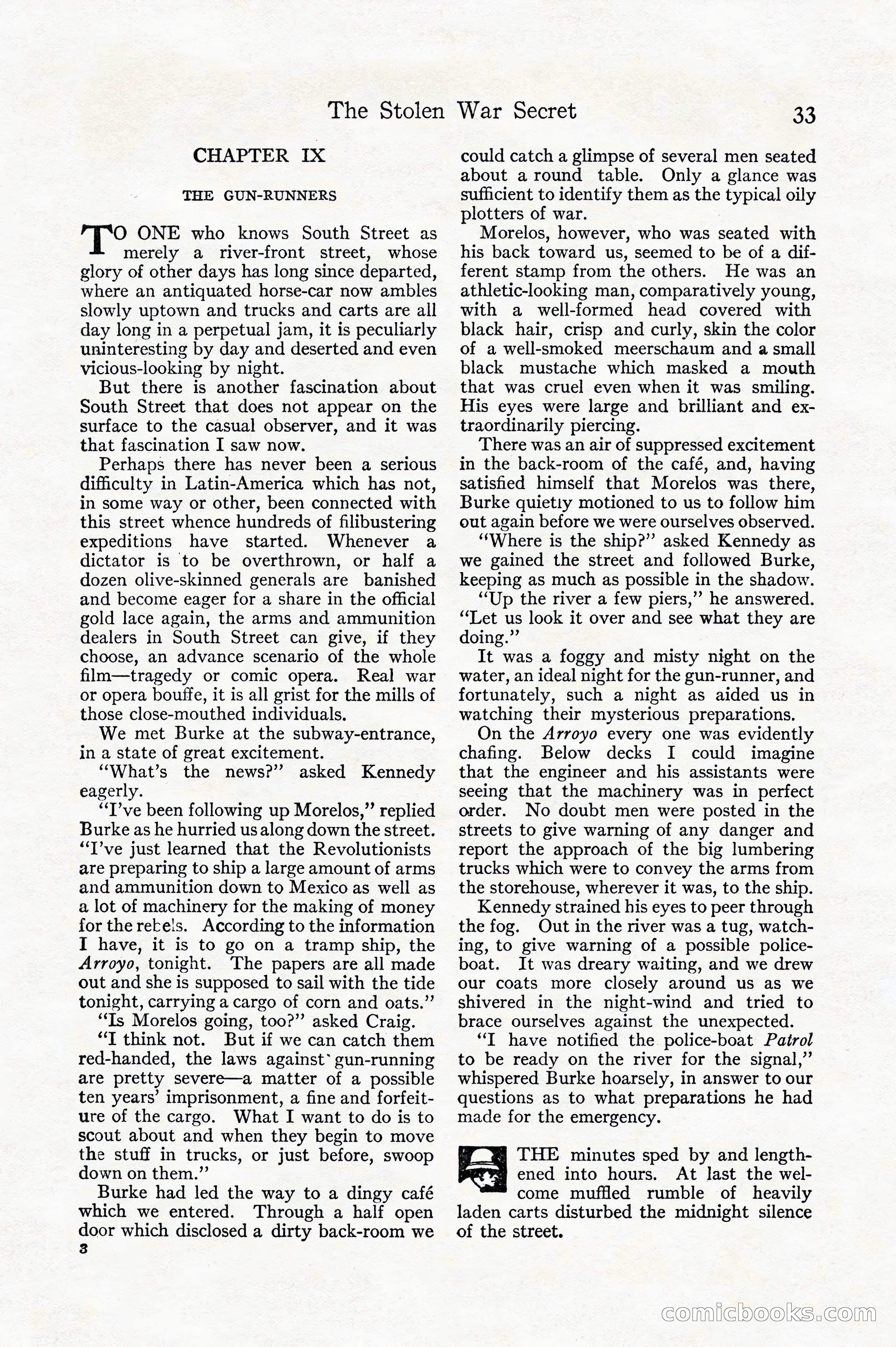
A restored page from Pulp Fiction, 1914. Page through the whole issue in the reader above.
📄 Transcribed text from this page (OCR, searchable)
Machine-transcribed from the original scan — historical spelling and the odd misread are preserved.
The Stolen War Secret CHAPTER IX THE GUN-RUNNERS O ONE who knows South Street as merely a river-front street, whose glory of other days has long since departed, where an antiquated horse-car now ambles slowly uptown and trucks and carts are all day long in a perpetual jam, it is peculiarly uninteresting by day and deserted and even vicious-looking by night. But there is another fascination about South Street that does not appear on the surface to the casual observer, and it was that fascination I saw now. Perhaps there has never been a serious difficulty in Latin-America which has not, in some way or other, been connected with this street whence hundreds of filibustering expeditions have started. Whenever a dictator is to be overthrown, or half a dozen olive-skinned generals are banished and become eager for a share in the official gold lace again, the arms and ammunition dealers in South Street can give, if they choose, an advance scenario of the whole film—tragedy or comic opera. Real war or opera bouffe, it is all grist for the mills of those close-mouthed individuals. We met Burke at the subway-entrance, in a state of great excitement. ‘“‘What’s the news?” asked Kennedy eagerly. “T’ve been following up Morelos,” replied Burke as he hurried us along down the street. “T’ve just learned that the Revolutionists are preparing to ship a large amount of arms and ammunition down to Mexico as well as a lot of machinery for the making of money for the retels. According to the information I have, it is to go on a tramp ship, the Arroyo, tonight. The papers are all made out and she is supposed to sail with the tide tonight, carrying a cargo of corn and oats.” “Is Morelos going, too?” asked Craig. “TI think not. But if we can catch them red-handed, the laws against* gun-running are pretty severe—a matter of a possible ten years’ imprisonment, a fine and forfeit- ure of the cargo. What I want to do is to scout about and when they begin to move the stuff in trucks, or just before, swoop down on them.” Burke had led the way to a dingy café which we entered. Through a half open door which disclosed a dirty back-room we 3 33 could catch a glimpse of several men seated about around table. Only a glance was sufficient to identify them as the typical oily plotters of war. Morelos, however, who was ae with his back toward us, seemed to be of a dif- ferent stamp from the others. He was an athletic-looking man, comparatively young, with a well-formed head covered with black hair, crisp and curly, skin the color of a well-smoked meerschaum and a small black mustache which masked a mouth that was cruel even when it was smiling. His eyes were large and brilliant and ex- traordinarily piercing. There was an air of suppressed excitement in the back-room of the café, and, having satisfied himself that Morelos was there, Burke quietly motioned to us to follow him out again before we were ourselves observed. ‘‘Where is the ship?” asked Kennedy as we gained the street and followed Burke, keeping as much as possible in the shadow. “Up the river a few piers,” he answered. “Let us look it over and see what they are doing.”’ It was a foggy and misty night on the water, an ideal night for the gun-runner, and fortunately, such a night as aided us in watching their mysterious preparations. On the Arroyo every one was evidently chafing. Below decks I could imagine that the engineer and his assistants were seeing that the machinery was in perfect order. No doubt men were posted in the streets to give warning of any danger and report the approach of the big lumbering trucks which were to convey the arms from the storehouse, wherever it was, to the ship. Kennedy strained his eyes to peer through the fog. Out in the river was a tug, watch- ing, to give warning of a possible police- boat. It was dreary waiting, and we drew our coats more closely around us as we shivered in the night-wind and tried to brace ourselves against the unexpected. “I have notified the police-boat Patrol to be ready on the river for the signal,”’ whispered Burke hoarsely, in answer to our questions as to what preparations he had made for the emergency. bed ened into hours. At last the wel- come muffled rumble of heavily laden carts disturbed the midnight silence of the street. THE minutes sped by and length- Giook C©