
Pulp Fiction, 1914 · page 37 of 228
Adventure, December 1914 — page 37: what you’re looking at
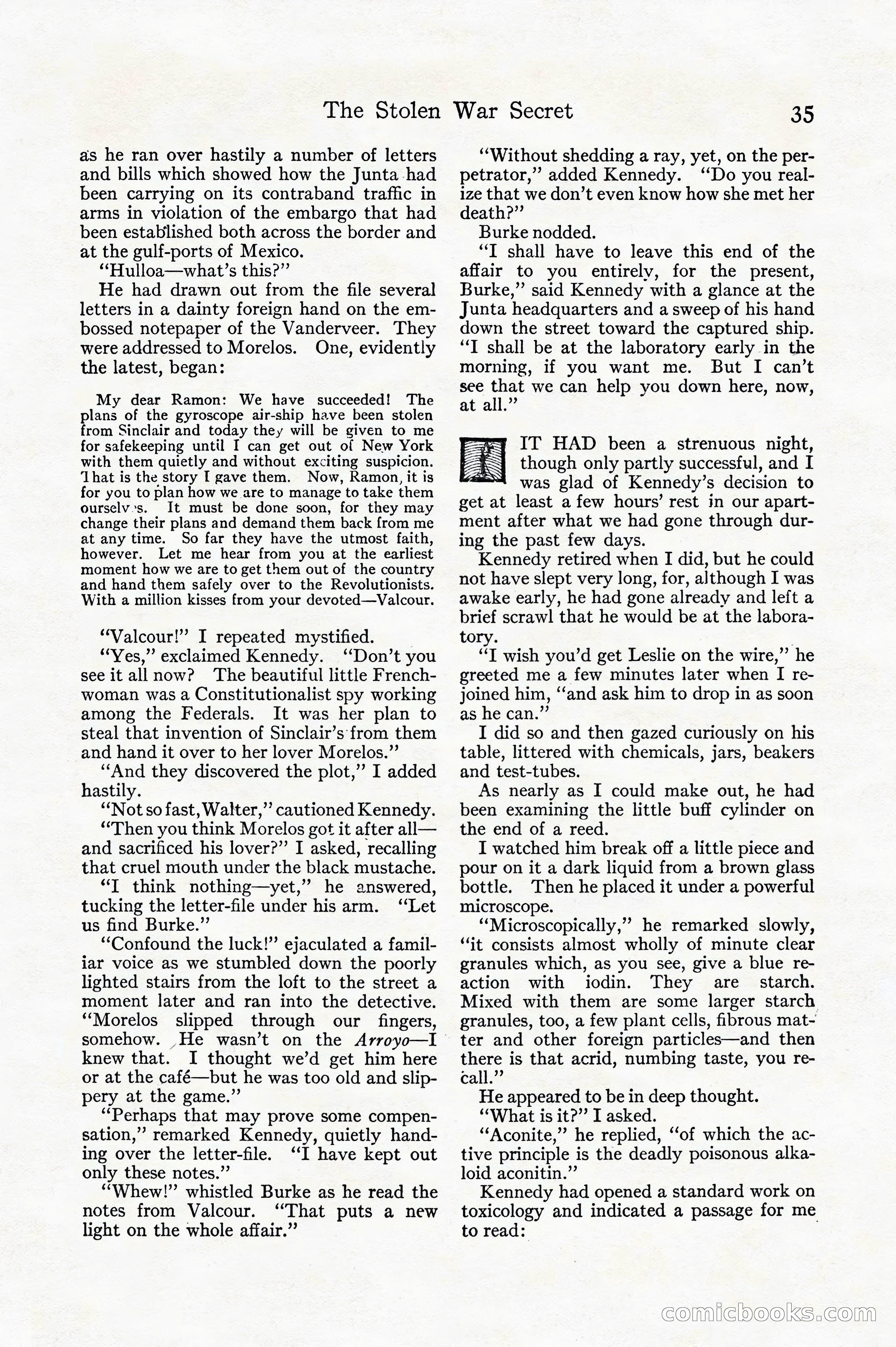
A restored page from Pulp Fiction, 1914. Page through the whole issue in the reader above.
📄 Transcribed text from this page (OCR, searchable)
Machine-transcribed from the original scan — historical spelling and the odd misread are preserved.
The Stolen as he ran over hastily a number of letters and bills which showed how the Junta had been carrying on its contraband traffic in arms in violation of the embargo that had been established both across the border and at the gulf-ports of Mexico. ““Hulloa—what’s this?” He had drawn out from the file several letters in a dainty foreign hand on the em- bossed notepaper of the Vanderveer. They were addressed to Morelos. One, evidently the latest, began: My dear Ramon: We have succeeded! The plans of the gyroscope air-ship have been stolen from Sinclair and today they will be given to me for safekeeping until I can get out of New York with them quietly and without exciting suspicion. ‘That is the story I gave them. Now, Ramon, it is for you to plan how we are to manage to take them ourselv’s. It must be done soon, for they may change their plans and demand them back from me at any time. So far they have the utmost faith, however. Let me hear from you at the earliest moment how we are to get them out of the country and hand them safely over to the Revolutionists. With a million kisses from your devoted—Valcour. ‘“Valcour!”’ I repeated mystified. “Yes,” exclaimed Kennedy. ‘‘Don’t you see it allnow? The beautiful little French- woman was a Constitutionalist spy working among the Federals. It was her plan to steal that invention of Sinclair’s from them and hand it over to her lover Morelos.”’ ‘‘And they discovered the plot,’ I added hastily. “‘Not so fast, Walter,’’ cautioned Kennedy. “Then you think Morelos got it after all— and sacrificed his lover?” I asked, recalling that cruel mouth under the black mustache. “T think nothing—yet,”’ he answered, tucking the letter-file under his arm. “Let us find Burke.”’ ‘“‘Confound the luck!”’ ejaculated a famil- iar voice as we stumbled down the poorly lighted stairs from the loft to the street a moment later and ran into the detective. “Morelos slipped through our fingers, somehow. .He wasn’t on the Arroyo—I knew that. I thought we’d get him here or at the café—but he was too old and slip- pery at the game.” ‘Perhaps that may prove some compen- sation,” remarked Kennedy, quietly hand- ing over the letter-file. ‘I have kept out only these notes.” “Whew!” whistled Burke as he read the notes from Valcour. “That puts a new light on the whole affair.” War Secret 35 “Without shedding a ray, yet, on the per- petrator,” added Kennedy. ‘Do you real- ize that we don’t even know how she met her death?” Burke nodded. “TI shall have to leave this end of the affair to you entirely, for the present, Burke,” said Kennedy with a glance at the Junta headquarters and a sweep of his hand down the street toward the captured ship. “IT shall be at the laboratory early in the morning, if you want me. But I can’t see that we can help you down here, now, at all.” IT HAD been a strenuous night, though only partly successful, and I was glad of Kennedy’s decision to get at least a few hours’ rest in our apart- ment after what we had gone through dur- ing the past few days. Kennedy retired when I did, but he could not have slept very long, for, although I was awake early, he had gone already and left a brief scrawl that he would be at the labora- tory. : “T wish you’d get Leslie on the wire,” he greeted me a few minutes later when I re- joined him, ‘‘and ask him to drop in as soon as he can.” I did so and then gazed curiously on his table, littered with chemicals, jars, beakers and test-tubes. As nearly as I could make out, he had been examining the little buff cylinder on the end of a reed. I watched him break off a little piece and pour on it a dark liquid from a brown glass bottle. Then he placed it under a powerful microscope. “Microscopically,” he remarked slowly, ‘it consists almost wholly of minute clear granules which, as you see, give a blue re- action with iodin. They are starch. Mixed with them are some larger starch granules, too, a few plant cells, fibrous mat- ter and other foreign particles—and then there is that acrid, numbing taste, you re- call.” He appeared to be in deep thought. “What is it?”’ I asked. ‘“‘Aconite,” he replied, ‘‘of which the ac- tive principle is the deadly poisonous alka- loid aconitin.”’ Kennedy had opened a standard work on .\ — toxicology and indicated a passage for me to read: OO C©